中国临床药理学与治疗学 ›› 2026, Vol. 31 ›› Issue (2): 175-184.doi: 10.12092/j.issn.1009-2501.2026.02.005
曲悠扬( ), 朱雨岚()
收稿日期:2025-05-12
修回日期:2025-06-04
出版日期:2026-02-26
发布日期:2026-03-17
通讯作者:
朱雨岚
E-mail:13796659496@163.com;ylz_yulan@163.com
作者简介:曲悠扬,女,主任医师、教授、博士生导师,研究方向:脑血管病、睡眠障碍、癫痫。E-mail:基金资助:
Youyang QU(), Yulan ZHU()
Received:2025-05-12
Revised:2025-06-04
Online:2026-02-26
Published:2026-03-17
Contact:
Yulan ZHU
E-mail:13796659496@163.com;ylz_yulan@163.com
摘要:
癫痫持续状态(SE)是一种严重的急危重症,对患者危害极大。过去10余年来,SE研究方面取得一系列重要进展,本文全面参考近年来国内外权威指南、专家共识以及最新前沿研究成果,叙述了SE的最新进展、诊断与治疗研究现状等。并进一步探究SE在当下临床实践中所面临的关键挑战,对未来发展趋势进行预测,旨在为临床实践提供助力。
中图分类号:
曲悠扬, 朱雨岚. 癫痫持续状态诊断与治疗研究现状[J]. 中国临床药理学与治疗学, 2026, 31(2): 175-184.
Youyang QU, Yulan ZHU. The current research status of the diagnosis and treatment of status epilepticus[J]. Chinese Journal of Clinical Pharmacology and Therapeutics, 2026, 31(2): 175-184.
| 分类标准 | 类型 | 定义 | ||
| T1 (可能导致持续发作时间) | T2 (可能导致长期后果时间) | |||
| 根据癫痫发作持续时间 及发作长期后果分类 | 强直阵挛性癫痫发作 | 5 min | 30 min | |
| 伴意识障碍的局灶性癫痫发作 | 10 min | >60 min | ||
| 失神状态癫痫持续状态 | 10~15 min | 未知 | ||
| 根据癫痫发作持续时间 和治疗反应分类 | 早期或可能的癫痫持续状态 | 持续或间歇性癫痫发作,持续时间超过5 min, 发作间期无意识恢复 | ||
| 确诊癫痫持续状态 | 对一线苯二氮?类药物治疗无反应的癫痫发作 | |||
| 难治性癫痫持续状态 | 使用两种足够剂量抗癫痫药物(如一线苯二氮?类药物+ 二线非苯二氮?类)后仍持续发作 | |||
| 超难治性癫痫持续状态 | 使用麻醉剂治疗,难治性癫痫持续状态仍持续超过24 h或 在撤机麻醉后复发的难治性癫痫持续状态 | |||
| 特定综合征 | NORSE | 无癫痫病史或明确病因的患者突发难治性癫痫持续状态 | ||
| FIRES | 儿童在发热性感染后急性发作难治性癫痫持续状态, 伴认知功能损害 | |||
表 1 根据癫痫发作持续时间和治疗反应定义的SE分期和SE特定综合征汇总
Table 1 Summary of SE staging and SE-specific syndromes defined by epileptic seizure duration and treatment response
| 分类标准 | 类型 | 定义 | ||
| T1 (可能导致持续发作时间) | T2 (可能导致长期后果时间) | |||
| 根据癫痫发作持续时间 及发作长期后果分类 | 强直阵挛性癫痫发作 | 5 min | 30 min | |
| 伴意识障碍的局灶性癫痫发作 | 10 min | >60 min | ||
| 失神状态癫痫持续状态 | 10~15 min | 未知 | ||
| 根据癫痫发作持续时间 和治疗反应分类 | 早期或可能的癫痫持续状态 | 持续或间歇性癫痫发作,持续时间超过5 min, 发作间期无意识恢复 | ||
| 确诊癫痫持续状态 | 对一线苯二氮?类药物治疗无反应的癫痫发作 | |||
| 难治性癫痫持续状态 | 使用两种足够剂量抗癫痫药物(如一线苯二氮?类药物+ 二线非苯二氮?类)后仍持续发作 | |||
| 超难治性癫痫持续状态 | 使用麻醉剂治疗,难治性癫痫持续状态仍持续超过24 h或 在撤机麻醉后复发的难治性癫痫持续状态 | |||
| 特定综合征 | NORSE | 无癫痫病史或明确病因的患者突发难治性癫痫持续状态 | ||
| FIRES | 儿童在发热性感染后急性发作难治性癫痫持续状态, 伴认知功能损害 | |||
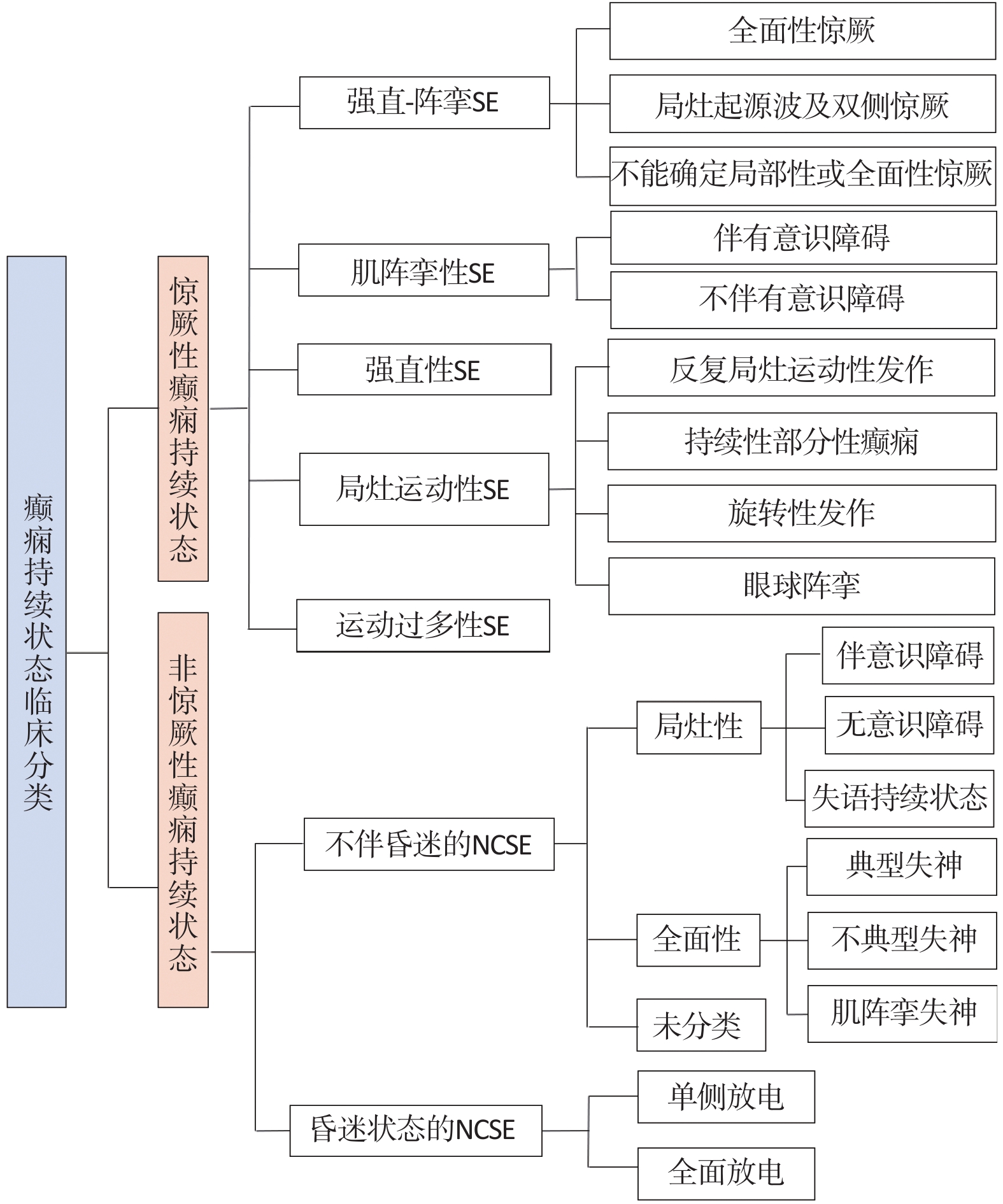
图 1 根据临床表现的癫痫持续状态分类
Fig.1 Classification of SE based on clinical manifestations

图 2 癫痫持续状态的治疗流程[1]
Fig.2 Treatment algorithm for SE[1]
| 1 |
Gettings JV, Mohammad Alizadeh Chafjiri F, Patel AA, et al. Diagnosis and management of status epilepticus: improving the status quo[J]. The Lancet Neurology, 2025, 24 (1): 65- 76.
doi: 10.1016/S1474-4422(24)00430-7 |
| 2 |
Ascoli M, Ferlazzo E, Gasparini S, et al. Epidemiology and outcomes of status epilepticus[J]. Int J Gen Med, 2021, 14, 2965- 2973.
doi: 10.2147/IJGM.S295855 |
| 3 | Trinka E, Cock H, Hesdorffer D, et al. A definition and classification of status epilepticus--report of the ILAE task force on classification of satus epilepticus [J]. Epilepsia, 2015, 56(10): 1515-1523. |
| 4 |
Trinka E, Leitinger M. Management of status epilepticus, refractory status epilepticus, and super-refractory status epilepticus[J]. Continuum (Minneapolis, Minn), 2022, 28 (2): 559- 602.
doi: 10.1212/CON.0000000000001103 |
| 5 |
Cruickshank M, Imamura M, Counsell C, et al. Management of the first stage of convulsive status epilepticus in adults: a systematic review of current randomised evidence[J]. J Neurol, 2022, 269 (7): 3420- 3429.
doi: 10.1007/s00415-022-10979-2 |
| 6 |
Johnson EL, Kaplan PW. Status epilepticus: definition, classification, pathophysiology, and epidemiology[J]. Semin Neurol, 2020, 40 (6): 647- 651.
doi: 10.1055/s-0040-1718722 |
| 7 | 宿英英, 黄旭升, 潘速跃, 等. 惊厥性癫痫持续状态监护与治疗(成人)中国专家共识[J]. 中国现代神经疾病杂志, 2015, 15 (11): 844- 851. |
| 8 | Ochoa JG, Dougherty M, Papanastassiou A, et al. Treatment of super-refractory status epilepticus: a review [J]. Epilepsy Curr, 2021, 21(6): 1535759721999670. |
| 9 | 邓会芳, 孙婧, 王博, 等. 神经重症患者非惊厥性癫痫持续状态的早期预防及分步治疗研究进展[J]. 中国现代医学杂志, 2023, 33 (22): 43- 47. |
| 10 |
李松林, 方健, 陈文武. 非惊厥性癫痫持续状态临床特点及治疗现状[J]. 河南大学学报(医学版), 2016, 35 (3): 1561- 1571.
doi: 10.15991/j.cnki.41-1361/r.2016.03.002 |
| 11 | 孙剑. 脑电监测技术对非惊厥性癫痫持续状态患者的诊断价值[J]. 检验医学与临床, 2019, 16 (18): 2696- 2698. |
| 12 | Baker AM, Yasavolian MA, Arandi NR, et al. Nonconvulsive status epilepticus: overlooked and undertreated[J]. Emerg Med Pract, 2019, 21 (10): 1- 24. |
| 13 |
Peltola ME, Leitinger M, Halford JJ, et al. Routine and sleep EEG: minimum recording standards of the international federation of clinical neurophysiology and the international league against epilepsy[J]. Epilepsia, 2023, 64 (3): 602- 618.
doi: 10.1111/epi.17448 |
| 14 |
Sansevere AJ, Hahn CD, Abend NS, et al. Conventional and quantitative EEG in status epilepticus[J]. Seizure, 2019, 68, 38- 45.
doi: 10.1016/j.seizure.2018.09.011 |
| 15 |
McKenzie ED, Lim AS, Leung EC, et al. Validation of a smartphone-based EEG among people with epilepsy: a prospective study[J]. Scientific Reports, 2017, 7, 45567.
doi: 10.1038/srep45567 |
| 16 |
Richard C, Schriger D, Weingrow D, et al. Rapid electroencephalography and artificial intelligence in the detection and management of nonconvulsive seizures[J]. Ann Emerg Med, 2024, 84 (4): 422- 427.
doi: 10.1016/j.annemergmed.2024.04.026 |
| 17 |
Tveit J, Aurlien H, Plis S, et al. Automated interpretation of clinical electroencephalograms using artificial intelligence[J]. JAMA Neurol, 2023, 80 (8): 805- 812.
doi: 10.1001/jamaneurol.2023.1645 |
| 18 |
Alkhachroum A, Ganesan SL, Koren JP, et al. Quantitative EEG-based seizure estimation in super-refractory status epilepticus[J]. Neurocritical Care, 2022, 36 (3): 897- 904.
doi: 10.1007/s12028-021-01395-x |
| 19 |
Guerriero RM, Gaillard WD. Imaging modalities to diagnose and localize status epilepticus[J]. Seizure, 2019, 68, 46- 51.
doi: 10.1016/j.seizure.2018.10.010 |
| 20 |
Burneo JG, Poon R, Kellett S, et al. The utility of positron emission tomography in epilepsy[J]. Can J Neurol Sci, 2015, 42 (6): 360- 371.
doi: 10.1017/cjn.2015.279 |
| 21 |
Sriwastwa A, Trout AT, Mahoney BW, et al. Nuclear medicine imaging in epilepsy[J]. Radiographics, 2025, 45 (1): e240062.
doi: 10.1148/rg.240062 |
| 22 | Barcia Aguilar C, Sánchez Fernández I, Loddenkemper T, et al. Status epilepticus-work-up and management in children[J]. Semin Neurol, 2020, 40 (6): 661- 674. |
| 23 |
Knowles JK, Helbig I, Metcalf CS, et al. Precision medicine for genetic epilepsy on the horizon: recent advances, present challenges, and suggestions for continued progress[J]. Epilepsia, 2022, 63 (10): 2461- 2475.
doi: 10.1111/epi.17332 |
| 24 |
Fisher RS, Chan DW, Bare M, et al. Capillary prolactin measurement for diagnosis of seizures[J]. Ann Neurol, 1991, 29 (2): 187- 190.
doi: 10.1002/ana.410290212 |
| 25 |
Abubakr A, Wambacq I. Diagnostic value of serum prolactin levels in PNES in the epilepsy monitoring unit[J]. Neurol Clin Pract, 2016, 6 (2): 116- 119.
doi: 10.1212/CPJ.0000000000000232 |
| 26 |
Wang YQ, Wen Y, Wang MM, et al. Prolactin levels as a criterion to differentiate between psychogenic non-epileptic seizures and epileptic seizures: a systematic review[J]. Epilepsy Res, 2021, 169, 106508.
doi: 10.1016/j.eplepsyres.2020.106508 |
| 27 |
Margraf NG, Dargvainiene J, Theel E, et al. Neurofilament light (NfL) as biomarker in serum and CSF in status epilepticus[J]. J Neurol, 2023, 270 (4): 2128- 2138.
doi: 10.1007/s00415-022-11547-4 |
| 28 |
Hanin A, Denis J A, Frazzini V, et al. Neuron specific enolase, S100-beta protein and progranulin as diagnostic biomarkers of status epilepticus[J]. J Neurol, 2022, 269 (7): 3752- 3760.
doi: 10.1007/s00415-022-11004-2 |
| 29 |
Liu YH, Cheng YT, Tsai MH, et al. Genetics and clinical correlation of dravet syndrome and its mimics - experience of a tertiary center in Taiwan[J]. Pediatr Neonatol, 2021, 62 (5): 550- 558.
doi: 10.1016/j.pedneo.2021.05.022 |
| 30 |
Kienitz R, Kay L, Beuchat I, et al. Benzodiazepines in the management of seizures and status epilepticus: a review of routes of delivery, pharmacokinetics, efficacy, and tolerability[J]. CNS Drugs, 2022, 36 (9): 951- 975.
doi: 10.1007/s40263-022-00940-2 |
| 31 |
Niquet J, Lumley L, Baldwin R, et al. Rational polytherapy in the treatment of cholinergic seizures[J]. Neurobiol Dis, 2020, 133, 104537.
doi: 10.1016/j.nbd.2019.104537 |
| 32 |
Joshi S, Rajasekaran K, Hawk KM, et al. Status epilepticus: role for etiology in determining response to benzodiazepines[J]. Ann Neurol, 2018, 83 (4): 830- 841.
doi: 10.1002/ana.25213 |
| 33 |
Alldredge BK, Gelb AM, Isaacs SM, et al. A comparison of lorazepam, diazepam, and placebo for the treatment of out-of-hospital status epilepticus[J]. N Engl J Med, 2001, 345 (9): 631- 637.
doi: 10.1056/NEJMoa002141 |
| 34 |
Treiman DM, Meyers PD, Walton NY, et al. A comparison of four treatments for generalized convulsive status epilepticus[J]. N Engl J Med, 1998, 339 (12): 792- 798.
doi: 10.1056/NEJM199809173391202 |
| 35 |
Burman RJ, Raimondo JV, Jefferys JGR, et al. The transition to status epilepticus: how the brain meets the demands of perpetual seizure activity[J]. Seizure, 2020, 75, 137- 144.
doi: 10.1016/j.seizure.2019.09.012 |
| 36 |
Sánchez Fernández I, Goodkin HP, Scott RC, et al. Pathophysiology of convulsive status epilepticus[J]. Seizure, 2019, 68, 16- 21.
doi: 10.1016/j.seizure.2018.08.002 |
| 37 |
Walker MC. Pathophysiology of status epilepticus[J]. Neurosci Lett, 2018, 667, 84- 91.
doi: 10.1016/j.neulet.2016.12.044 |
| 38 |
Pironi V, Ciccone O, Beghi E, et al. Survey on the worldwide availability and affordability of antiseizure medications: report of the ILAE task force on access to treatment[J]. Epilepsia, 2022, 63 (2): 335- 351.
doi: 10.1111/epi.17155 |
| 39 |
Glauser T, Shinnar S, Gloss D, et al. Evidence-based guideline: treatment of convulsive status epilepticus in children and adults[J]. Epilepsy Curr, 2016, 16 (1): 48- 61.
doi: 10.5698/1535-7597-16.1.48 |
| 40 |
Kapur J, Elm J, Chamberlain JM, et al. Randomized trial of three anticonvulsant medications for status epilepticus[J]. N Engl J Med, 2019, 381 (22): 2103- 2113.
doi: 10.1056/NEJMoa1905795 |
| 41 |
Dalziel SR, Borland ML, Furyk J, et al. Levetiracetam versus phenytoin for second-line treatment of convulsive status epilepticus in children (ConSEPT)[J]. Lancet, 2019, 393 (10186): 2135- 2145.
doi: 10.1016/S0140-6736(19)30722-6 |
| 42 |
Lyttle MD, Rainford NEA, Gamble C, et al. Levetiracetam versus phenytoin for second-line treatment of paediatric convulsive status epilepticus (EcLiPSE)[J]. Lancet, 2019, 393 (10186): 2125- 2134.
doi: 10.1016/S0140-6736(19)30724-X |
| 43 |
Chamberlain JM, Kapur J, Shinnar S, et al. Efficacy of levetiracetam, fosphenytoin, and valproate for established status epilepticus by age group (ESETT)[J]. Lancet, 2020, 395 (10231): 1217- 1224.
doi: 10.1016/S0140-6736(20)30611-5 |
| 44 |
Husain AM, Lee JW, Kolls BJ, et al. Randomized trial of lacosamide versus fosphenytoin for nonconvulsive seizures[J]. Ann Neurol, 2018, 83 (6): 1174- 1185.
doi: 10.1002/ana.25249 |
| 45 |
Sánchez Fernández I, Gaínza-Lein M, Lamb N, et al. Meta-analysis and cost-effectiveness of second-line antiepileptic drugs for status epilepticus[J]. Neurology, 2019, 92 (20): e2339- e2348.
doi: 10.1212/wnl.0000000000007503 |
| 46 |
Meierkord H, Boon P, Engelsen B, et al. EFNS guideline on the management of status epilepticus in adults[J]. Eur J Neurol, 2010, 17 (3): 348- 355.
doi: 10.1111/j.1468-1331.2009.02917.x |
| 47 |
Der-Nigoghossian C, Tesoro EP, Strein M, et al. Principles of pharmacotherapy of seizures and status epilepticus[J]. Semin Neurol, 2020, 40 (6): 681- 695.
doi: 10.1055/s-0040-1718721 |
| 48 | Aleyadeh R, Carson RP. Fosphenytoin [M]. Treasure Island (FL): StatPearls Publishing LLC, 2025. |
| 49 |
Nakamura K, Marushima A, Takahashi Y, et al. Levetiracetam versus fosphenytoin as a second-line treatment after diazepam for adult convulsive status epilepticus[J]. J Neurol Neurosurg Psychiatry, 2023, 94 (1): 42- 48.
doi: 10.1136/jnnp-2022-329485 |
| 50 | Kossoff EH, Zupec-Kania BA, Auvin S, et al. Optimal clinical management of children receiving dietary therapies for epilepsy[J]. Epilepsia Open, 2018, 3 (2): 175- 192. |
| 51 |
Kirmani BF, Au K, Ayari L, et al. Super-refractory status epilepticus: prognosis and recent advances in management[J]. Aging Dis, 2021, 12 (4): 1097- 1119.
doi: 10.14336/AD.2021.0302 |
| 52 |
Jacobwitz M, Mulvihill C, Kaufman MC, et al. Ketamine for management of neonatal and pediatric refractory status epilepticus[J]. Neurology, 2022, 99 (12): e1227- e1238.
doi: 10.1212/wnl.0000000000200889 |
| 53 | Dhir A, Chopra K. Memantine delayed N-methyl-D-aspartate-induced convulsions in neonatal rats[J]. Fundam Clin Pharmacol, 2015, 29 (1): 72- 78. |
| 54 |
Moalong KMC, Espiritu AI, Fernandez MLL, et al. Efficacy and tolerability of intravenous brivaracetam for status epilepticus[J]. J Neurol Sci, 2020, 413, 116799.
doi: 10.1016/j.jns.2020.116799 |
| 55 |
Sutula TP, Fountain NB. 2DG and glycolysis as therapeutic targets for status epilepticus[J]. Epilepsy Behav, 2023, 140, 109108.
doi: 10.1016/j.yebeh.2023.109108 |
| 56 | Shrestha N, Khan S, Neupane YR, et al. Tailoring midazolam-loaded chitosan nanoparticulate formulation for enhanced brain delivery via intranasal route[J]. Polymers, 2020, 12 (11): 2567. |
| 57 | Nair SC, Vinayan KP, Mangalathillam S, et al. Nose to brain delivery of phenytoin sodium loaded nano lipid carriers[J]. Pharmaceutics, 2021, 13 (10): 1623. |
| 58 | 赵明雪, 刘世光, 范美丽, 等. 33例儿童癫痫持续状态的临床特点及预后影响因素分析[J]. 癫痫杂志, 2022, 8 (1): 48- 51. |
| 59 |
Der-Nigoghossian C, Rubinos C, Alkhachroum A, et al. Status epilepticus - time is brain and treatment considerations[J]. Curr Opin Crit Care, 2019, 25 (6): 638- 646.
doi: 10.1097/mcc.0000000000000661 |
| 60 |
Dibué-Adjei M, Brigo F, Yamamoto T, et al. Vagus nerve stimulation in refractory and super-refractory status epilepticus[J]. Brain Stimul, 2019, 12 (5): 1101- 1110.
doi: 10.1016/j.brs.2019.05.011 |
| 61 |
Hawkes MA, Hocker SE. Systemic complications following status epilepticus[J]. Curr Neurol Neurosci Rep, 2018, 18 (2): 7.
doi: 10.1007/s11910-018-0815-9 |
| 62 |
Soliman N, Alsultan M, Alhusseini A, et al. Status epilepticus resulted in rhabdomyolysis-induced AKI associated with hepatotoxicity[J]. Medicine, 2024, 103 (8): e36834.
doi: 10.1097/MD.0000000000036834 |
| 63 |
Bravo P, Vaddiparti A, Hirsch LJ, et al. Pharmacotherapy for nonconvulsive seizures and nonconvulsive status epilepticus[J]. Drugs, 2021, 81 (7): 749- 770.
doi: 10.1007/s40265-021-01502-4 |
| [1] | 陈怡伶, 朱国行. 成人癫痫药物治疗研究进展[J]. 中国临床药理学与治疗学, 2026, 31(2): 146-153. |
| [2] | 王天爽, 王新华, 周渊峰. 儿童癫痫综合征药物治疗进展[J]. 中国临床药理学与治疗学, 2026, 31(2): 154-161. |
| [3] | 赵正卿, 李雁鹏, 赵忠新. 女性癫痫患者的临床特点和药物治疗研究进展[J]. 中国临床药理学与治疗学, 2026, 31(2): 162-167. |
| [4] | 翟菲菲, 黄颜. 睡眠相关过度运动性癫痫诊疗进展[J]. 中国临床药理学与治疗学, 2026, 31(2): 168-174. |
| [5] | 赵亚红, 李强. 靶向铁死亡与癫痫治疗研究进展[J]. 中国临床药理学与治疗学, 2025, 30(6): 828-834. |
| [6] | 陈思蕊, 李军强, 党小利, 王天成. 吡仑帕奈在癫痫共病治疗中的研究进展[J]. 中国临床药理学与治疗学, 2024, 29(3): 354-360. |
| [7] | 李晨豪, 喻喜华, 闫文浩, 柴宇霞, 李燕燕, 李 锟, 李泽运. 儿童癫痫与维生素D相关性研究进展[J]. 中国临床药理学与治疗学, 2023, 28(11): 1299-1306. |
| [8] | 党洋斌, 梁宇欣, 王天成. 进行性肌阵挛癫痫相关治疗的研究进展[J]. 中国临床药理学与治疗学, 2023, 28(10): 1184-1194. |
| [9] | 晏玉奎, 胡建琴, 张冰. 新型和传统抗癫痫药物治疗新诊断部分性癫痫的临床研究[J]. 中国临床药理学与治疗学, 2022, 27(7): 793-799. |
| [10] | 王婷, 韩明明, 李娟. 右美托咪定对癫痫患者顺式阿曲库铵肌松效应的影响[J]. 中国临床药理学与治疗学, 2022, 27(10): 1113-1118. |
| [11] | 陶 怀,薛卢嘉黛,陈 夏. 电压门控钠通道亚型基因突变相关癫痫发生和临床治疗[J]. 中国临床药理学与治疗学, 2018, 23(5): 570-577. |
| [12] | 刘史佳,陈 都,殷俊刚,储继红,许美娟,刘 芳,戴国梁,熊宁宁,居文政. 左乙拉西坦注射液与左乙拉西坦片在健康受试者中的药代动力学比较[J]. 中国临床药理学与治疗学, 2017, 22(3): 294-298. |
| [13] | 曾祥昌,周露萍,陈露露,罗 伟,李超鹏,高 青,王亚芹,王欣桐,胡 凯,沈 杰,欧阳冬生. 人参皂苷C-K对匹罗卡品致痫大鼠发作的影响[J]. 中国临床药理学与治疗学, 2017, 22(2): 139-143. |
| [14] | 杨瑞, 肖坚. 1例伴有癫痫症状的毒鼠强中毒患者药学监护[J]. 中国临床药理学与治疗学, 2015, 20(8): 905-908. |
| [15] | 倪红, 郑卜真, 王恩, 金笑平, 马传花, 柯绍发, 周元林, 储照虎. 左乙拉西坦对急性癫痫小鼠海马GABA能神经元电生理的研究[J]. 中国临床药理学与治疗学, 2015, 20(5): 505-509. |
| 阅读次数 | ||||||
|
全文 |
|
|||||
|
摘要 |
|
|||||