中国临床药理学与治疗学 ›› 2026, Vol. 31 ›› Issue (1): 107-115.doi: 10.12092/j.issn.1009-2501.2026.01.012
• 综述与讲座 • 上一篇
杨立1( ), 郑治1, 孟旭峰1, 刘倩2, 郝云飞2,*()
收稿日期:2024-11-29
修回日期:2025-02-26
出版日期:2026-01-26
发布日期:2026-02-13
通讯作者:
郝云飞
E-mail:1213851240@qq.com;hyf897@sina.com
作者简介:杨立,男,医学硕士,主要研究:脑血管方向。E-mail:基金资助:
Li YANG1(), Zhi ZHENG1, Xufeng MENG1, Qian LIU2, Yunfei HAO2,*()
Received:2024-11-29
Revised:2025-02-26
Online:2026-01-26
Published:2026-02-13
Contact:
Yunfei HAO
E-mail:1213851240@qq.com;hyf897@sina.com
摘要:
破裂颅内动脉瘤是一种高致死率和高致残率的脑血管急症,虽然支架辅助弹簧圈栓塞术有效,但术中血栓形成和术后出血等并发症问题依然突出。替罗非班作为一种强效的血小板聚集抑制剂,以其迅速起效、半衰期短且血小板功能可快速恢复等特点,在破裂颅内动脉瘤治疗中显示出潜力。本综述通过总结替罗非班的药理学机制及其临床应用,分析其在不同剂量下的疗效与安全性,并探讨其在术前预防性用药和术中挽救性治疗中的合理用药策略。此外,本文还重点讨论了替罗非班在治疗破裂颅内动脉瘤中的挑战与局限,提出了未来研究方向,以期为替罗非班的标准化应用提供循证支持,提升其在神经介入治疗中的应用价值。
中图分类号:
杨立, 郑治, 孟旭峰, 刘倩, 郝云飞. 替罗非班在治疗破裂颅内动脉瘤中的研究进展[J]. 中国临床药理学与治疗学, 2026, 31(1): 107-115.
Li YANG, Zhi ZHENG, Xufeng MENG, Qian LIU, Yunfei HAO. Research progress of tirofiban in the treatment of ruptured intracranial aneurysms[J]. Chinese Journal of Clinical Pharmacology and Therapeutics, 2026, 31(1): 107-115.
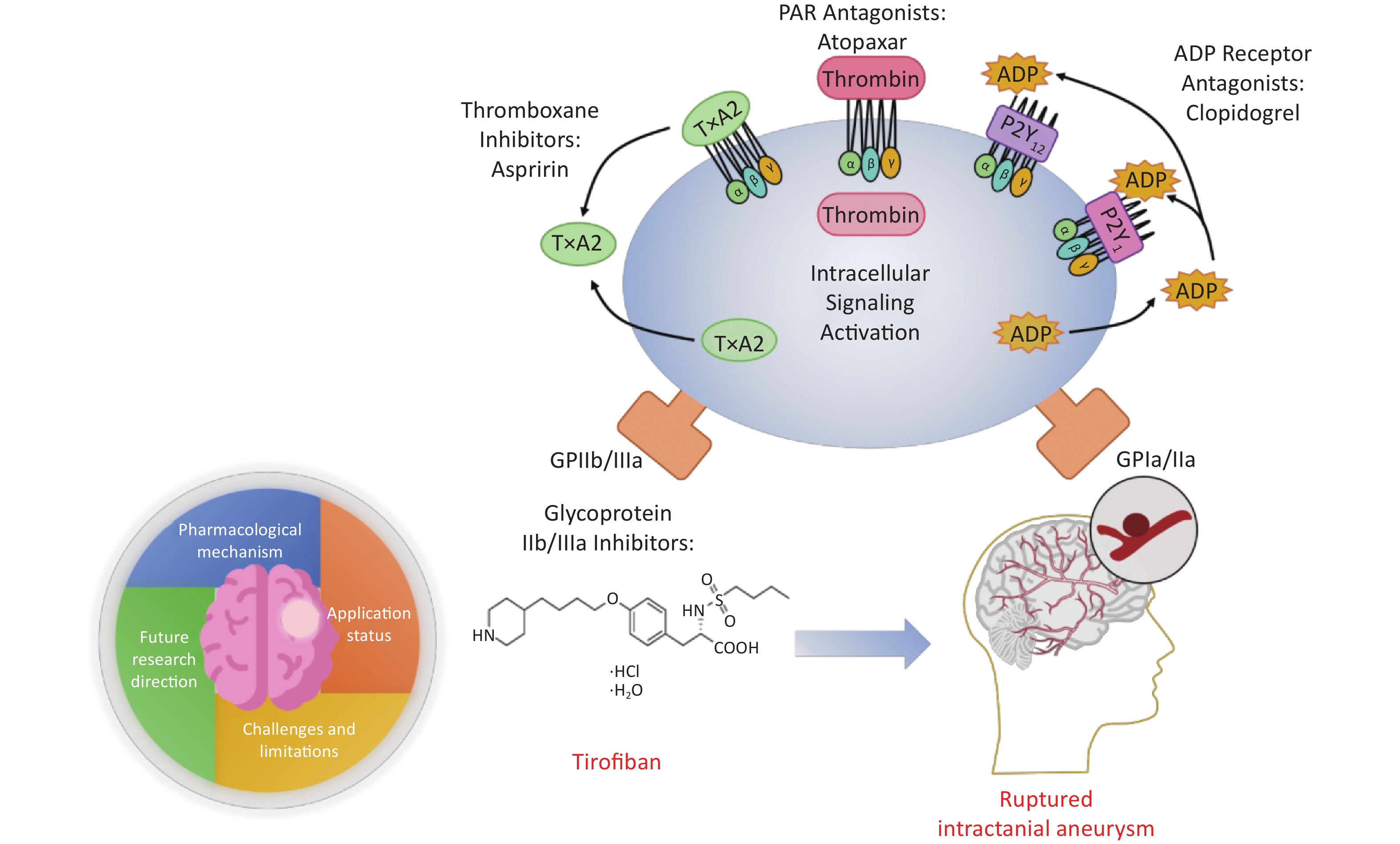
图 1 替罗非班在治疗破裂颅内动脉瘤中的研究综述图
Fig.1 A review of the study on tirafiban in the treatment of ruptured intracranial aneurysms
| 研究/团队 | 样本量(n) | 给药方案 | 并发症 | 主要发现 |
| Lee等[ | 50 | 静脉负荷0.4 μg·kg?1·min?1(30 min),随后25 μg/kg维持23.5 h | 5例血栓形成,2例延迟出血事件 | 高剂量有效抑制血小板聚集,但与延迟出血风险相关 |
| Li等[ | 46 | 静脉负荷10 μg/kg(3 min),随后 0.1 μg·kg?1·min?1维持12 h | 2例术后血栓事件,2例胃肠道出血 | 较低的血栓事件发生率,但仍有出血事件发生 |
| 梁晓东等[ | 175 | 静脉负荷8 mg/kg(3 min),随后 0.1 mg·kg?1·min?1维持 | 6例血栓栓塞事件,4例替罗非班相关出血事件 | 中等剂量显示一定疗效,但伴随较高出血风险 |
| 王子良等[ | 128 | 静脉负荷8 mg/kg(3 min),随后 0.1 mg·kg?1·min?1维持 | 5例血栓事件,未见明显出血事件 | 安全性较高,血栓事件发生较少 |
| Sayin等[ | 16 | 静脉负荷8 mg/kg(3 min),随后 0.1 mg·kg?1·min?1维持 | 2例血栓形成 | 样本量较小,但表明中等剂量使用安全 |
| 马一辉等[ | 105 | 静脉负荷5 μg/kg,随后0.06~ 0.08 μg·kg?1·min?1维持6~8 h | 无出血事件,3例血栓栓塞事件 | 低剂量替罗非班安全有效,未发生出血并发症 |
| 闫亚洲等[ | 309 | 标准组:静脉负荷10 μg/kg(3 min),随后0.15 μg·kg?1·min?1维持6~8 h;半剂量组:静脉负荷5 μg/kg(3 min),随后0.075 μg·kg?1·min?1维持6~8 h | 15例血栓栓塞事件(标准组:11例,半剂量组:4例),13例出血事件(全部为标准剂量组) | 标准剂量组血栓和出血发生率较高,半剂量组较低 |
| 沈咣晨等[ | 72 | 静脉负荷5 μg/kg(1 min),随后 0.1 μg·kg?1·min?1维持 | 4.17%的血栓并发症,1例出血并发症 | 低剂量方案显示出良好的血栓控制效果,出血事件较少 |
| Kim等[ | 41 | 静脉负荷0.4 μg·kg?1·min?1(30 min),随后0.1 μg·kg?1·min?1维持 | 无出血事件 | 低剂量替罗非班有效且无出血并发症 |
表 1 不同剂量替罗非班在破裂颅内动脉瘤治疗中的疗效与安全性临床研究汇总
Table 1 Summary of clinical studies on the efficacy and safety of tirafiban at different doses in the treatment of ruptured intracranial aneurysms
| 研究/团队 | 样本量(n) | 给药方案 | 并发症 | 主要发现 |
| Lee等[ | 50 | 静脉负荷0.4 μg·kg?1·min?1(30 min),随后25 μg/kg维持23.5 h | 5例血栓形成,2例延迟出血事件 | 高剂量有效抑制血小板聚集,但与延迟出血风险相关 |
| Li等[ | 46 | 静脉负荷10 μg/kg(3 min),随后 0.1 μg·kg?1·min?1维持12 h | 2例术后血栓事件,2例胃肠道出血 | 较低的血栓事件发生率,但仍有出血事件发生 |
| 梁晓东等[ | 175 | 静脉负荷8 mg/kg(3 min),随后 0.1 mg·kg?1·min?1维持 | 6例血栓栓塞事件,4例替罗非班相关出血事件 | 中等剂量显示一定疗效,但伴随较高出血风险 |
| 王子良等[ | 128 | 静脉负荷8 mg/kg(3 min),随后 0.1 mg·kg?1·min?1维持 | 5例血栓事件,未见明显出血事件 | 安全性较高,血栓事件发生较少 |
| Sayin等[ | 16 | 静脉负荷8 mg/kg(3 min),随后 0.1 mg·kg?1·min?1维持 | 2例血栓形成 | 样本量较小,但表明中等剂量使用安全 |
| 马一辉等[ | 105 | 静脉负荷5 μg/kg,随后0.06~ 0.08 μg·kg?1·min?1维持6~8 h | 无出血事件,3例血栓栓塞事件 | 低剂量替罗非班安全有效,未发生出血并发症 |
| 闫亚洲等[ | 309 | 标准组:静脉负荷10 μg/kg(3 min),随后0.15 μg·kg?1·min?1维持6~8 h;半剂量组:静脉负荷5 μg/kg(3 min),随后0.075 μg·kg?1·min?1维持6~8 h | 15例血栓栓塞事件(标准组:11例,半剂量组:4例),13例出血事件(全部为标准剂量组) | 标准剂量组血栓和出血发生率较高,半剂量组较低 |
| 沈咣晨等[ | 72 | 静脉负荷5 μg/kg(1 min),随后 0.1 μg·kg?1·min?1维持 | 4.17%的血栓并发症,1例出血并发症 | 低剂量方案显示出良好的血栓控制效果,出血事件较少 |
| Kim等[ | 41 | 静脉负荷0.4 μg·kg?1·min?1(30 min),随后0.1 μg·kg?1·min?1维持 | 无出血事件 | 低剂量替罗非班有效且无出血并发症 |
| 1 |
Frösen J, Tulamo R, Paetau A, et al. Saccular intracranial aneurysm: pathology and mechanisms[J]. Acta Neuropathol, 2012, 123 (6): 773- 786.
doi: 10.1007/s00401-011-0939-3 |
| 2 |
Chalouhi N, Hoh BL, Hasan D. Review of cerebral aneurysm formation, growth, and rupture[J]. Stroke, 2013, 44 (12): 3613- 3622.
doi: 10.1161/STROKEAHA.113.002390 |
| 3 |
Nieuwkamp DJ, Setz LE, Algra A, et al. Changes in case fatality of aneurysmal subarachnoid haemorrhage over time, according to age, sex, and region: a meta-analysis[J]. Lancet Neurol, 2009, 8 (7): 635- 642.
doi: 10.1016/S1474-4422(09)70126-7 |
| 4 |
Lovelock CE, Rinkel GJ, Rothwell PM. Time trends in outcome of subarachnoid hemorrhage: Population-based study and systematic review[J]. Neurology, 2010, 74 (19): 1494- 1501.
doi: 10.1212/WNL.0b013e3181dd42b3 |
| 5 |
宋英, 刘健, 张亮, 等. 极早期血管内治疗颅内破裂动脉瘤的临床疗效评价[J]. 长春中医药大学学报, 2024, 40 (9): 1024- 1027.
doi: 10.13463/j.cnki.cczyy.2024.09.019 |
| 6 | 覃星悦, 陈圣昌, 秦柱贵, 等. CT及磁共振血管成像诊断颅内动脉瘤的价值[J]. 长春中医药大学学报, 2024, 40 (5): 566- 570. |
| 7 |
Lodi YM, Latorre JG, El-zammar Z, et al. Stent assisted coiling of the ruptured wide necked intracranial aneurysm[J]. J Neurointerv Surg, 2012, 4 (4): 281- 286.
doi: 10.1136/neurintsurg-2011-010035 |
| 8 |
Zhang X, Zuo Q, Tang H, et al. Stent assisted coiling versus non-stent assisted coiling for the management of ruptured intracranial aneurysms: a meta-analysis and systematic review[J]. J Neurointerv Surg, 2019, 11 (5): 489- 496.
doi: 10.1136/neurintsurg-2018-014388 |
| 9 |
Choi HH, Cho YD, Han MH, et al. Antiplatelet premedication-free stent-assisted coil embolization in acutely ruptured aneurysms[J]. World Neurosurg, 2018, 114, e1152- e1160.
doi: 10.1016/j.wneu.2018.03.164 |
| 10 | Tähtinen OI, Vanninen RL, Manninen HI, et al. Wide-necked intracranial aneurysms: treatment with stent-assisted coil embolization during acute (<72 hours) subarachnoid hemorrhage--experience in 61 consecutive patients [J]. Radiology, 2009, 253(1): 199-208. |
| 11 | Kim YH, Kim CH, Lee SW, et al. Clinical safety and efficacy of stent-assisted coil embolization with ACCERO stent in cerebral aneurysm: Short-term follow-up and precaution for use [J]. J Cerebrovasc Endovasc Neurosurg, 2025, doi: 10.7461/jcen.2025.E2025.02.002. |
| 12 |
Chen SD, Yang CB, Wang YX, et al. Safety and efficacy of endovascular embolization combined with external drainage for poor-grade ruptured cerebral aneurysms[J]. ANZ J Surg, 2025, 95 (5): 972- 978.
doi: 10.1111/ans.19349 |
| 13 | Settipalli KP, Dunkerton S, Hilton J, et al. The ELVIS study: Medium and long-term Efficacy of LVIS EVO stent-assisted coil embolisation for unruptured saccular intracranial aneurysms-A tertiary single-centre experience[J]. J Med Imaging Radiat Oncol, 2024, 69 (2): 212- 220. |
| 14 | 黄品芳, 潘冠星, 张菁. 抗血小板药物临床应用现状及研发新进展[J]. 中国临床药理学与治疗学, 2025, 30 (1): 91- 99. |
| 15 |
Kim S, Choi JH, Kang M, et al. Safety and Efficacy of Intravenous Tirofiban as Antiplatelet Premedication for Stent-Assisted Coiling in Acutely Ruptured Intracranial Aneurysms[J]. AJNR Am J Neuroradiol, 2016, 37 (3): 508- 514.
doi: 10.3174/ajnr.A4551 |
| 16 |
贺晓武, 左乔, 黄清海, 等. 不同剂量替罗非班在支架辅助栓塞颅内破裂动脉瘤中的应用比较[J]. 中国脑血管病杂志, 2018, 15 (10): 505- 551.
doi: 10.3969/j.issn.1672-5921.2018.10.001 |
| 17 |
Osgood ML. Aneurysmal Subarachnoid Hemorrhage: Review of the Pathophysiology and Management Strategies[J]. Curr Neurol Neurosci Rep, 2021, 21 (9): 50.
doi: 10.1007/s11910-021-01136-9 |
| 18 |
Tawk RG, Hasan TF, D’souza CE, et al. Diagnosis and treatment of unruptured intracranial aneurysms and aneurysmal subarachnoid hemorrhage[J]. Mayo Clin Proc, 2021, 96 (7): 1970- 2000.
doi: 10.1016/j.mayocp.2021.01.005 |
| 19 |
Sharifi-rad J, Sharopov F, Ezzat SM, et al. An updated review on glycoprotein IIb/IIIa inhibitors as antiplatelet agents: basic and clinical perspectives[J]. High Blood Pressure Cardiovascular Prevention, 2023, 30 (2): 93- 107.
doi: 10.1007/s40292-023-00562-9 |
| 20 | Bennett JS. αIIbβ3 (GPIIb/IIIa) Structure and Function [M]//Gresele P, Kleiman NS, Lopez JA, et al. Platelets in Thrombotic and Non-Thrombotic Disorders: Pathophysiology, Pharmacology and Therapeutics: an Update. Cham; Springer International Publishing. 2017: 99-112. |
| 21 |
Chatterjee M. GPIIb/IIIa-GPVI–commanded platelet patrol[J]. Blood, 2022, 140 (2): 81- 83.
doi: 10.1182/blood.2022016697 |
| 22 |
杨橹, 熊晔, 黄建荣. 人血白蛋白在终末期肝病中的应用[J]. 临床肝胆病杂志, 2022, 38 (4): 936- 941.
doi: 10.3969/j.issn.1001-5256.2022.04.040 |
| 23 |
Scarborough RM, Kleiman NS, Phillips DR. Platelet glycoprotein IIb/IIIa antagonists. What are the relevant issues concerning their pharmacology and clinical use?[J]. Circulation, 1999, 100 (4): 437- 444.
doi: 10.1161/01.CIR.100.4.437 |
| 24 |
Yang M, Huo X, Miao Z, et al. Platelet Glycoprotein IIb/IIIa receptor inhibitor tirofiban in acute ischemic stroke[J]. Drugs, 2019, 79 (5): 515- 529.
doi: 10.1007/s40265-019-01078-0 |
| 25 |
Bernava G, Meling TR, Rosi A, et al. Acute stenting and concomitant tirofiban administration for the endovascular treatment of acute ischemic stroke related to intracranial artery dissections: a single center experience and systematic review of the literature[J]. J Stroke Cerebro Dis, 2021, 30 (8): 105891.
doi: 10.1016/j.jstrokecerebrovasdis.2021.105891 |
| 26 |
Wang M, Li J, Zhang L, et al. The efficacy and safety of continuous intravenous tirofiban for acute ischemic stroke patients treated by endovascular therapy: a meta-analysis[J]. Front Neurol, 2024, 15, 1286079.
doi: 10.3389/fneur.2024.1286079 |
| 27 |
Ribeiro LFS, De freitas LR, Udoma-udofa OC, et al. Efficacy and safety of tirofiban in acute ischemic stroke due to intracranial atherosclerotic disease for patients undergoing endovascular treatment: a systematic review and meta-analysis[J]. Neuroradiol, 2025, 67 (1): 241- 255.
doi: 10.1007/s00234-024-03537-2 |
| 28 |
Al-salihi MM, Ayyad A, Al-jebur MS, et al. Safety and efficacy of tirofiban in the management of stroke: a systematic review and meta-analysis of randomized controlled trials[J]. Clin Neurol Neurosurg, 2023, 232, 107867.
doi: 10.1016/j.clineuro.2023.107867 |
| 29 |
霍晓川, 缪中荣. 《替罗非班在动脉粥样硬化性脑血管疾病中的临床应用专家共识》解读[J]. 中国现代神经疾病杂志, 2020, 20 (5): 381- 385.
doi: 10.3969/j.issn.1672-6731.2020.05.003 |
| 30 |
Li X, Zhang S, Wang Z, et al. Platelet function and risk of bleeding in patients with acute coronary syndrome following tirofiban infusion[J]. Front Pharmacol, 2019, 10, 1158.
doi: 10.3389/fphar.2019.01158 |
| 31 |
Pierot L, Cognard C, Anxionnat R, et al. Ruptured intracranial aneurysms: factors affecting the rate and outcome of endovascular treatment complications in a series of 782 patients (CLARITY study)[J]. Radiol, 2010, 256 (3): 916- 923.
doi: 10.1148/radiol.10092209 |
| 32 |
Chalouhi N, Jabbour P, Singhal S, et al. Stent-assisted coiling of intracranial aneurysms: predictors of complications, recanalization, and outcome in 508 cases[J]. Stroke, 2013, 44 (5): 1348- 1353.
doi: 10.1161/STROKEAHA.111.000641 |
| 33 |
Yamada NK, CRoss DT, 3RD, Pilgram TK, et al. Effect of antiplatelet therapy on thromboembolic complications of elective coil embolization of cerebral aneurysms[J]. AJNR Am J Neuroradiol, 2007, 28 (9): 1778- 1782.
doi: 10.3174/ajnr.A0641 |
| 34 |
Ries T, Buhk JH, Kucinski T, et al. Intravenous administration of acetylsalicylic acid during endovascular treatment of cerebral aneurysms reduces the rate of thromboembolic events[J]. Stroke, 2006, 37 (7): 1816- 1821.
doi: 10.1161/01.STR.0000226933.44962.a6 |
| 35 |
Hochholzer W, Trenk D, Frundi D, et al. Time dependence of platelet inhibition after a 600-mg loading dose of clopidogrel in a large, unselected cohort of candidates for percutaneous coronary intervention[J]. Circulation, 2005, 111 (20): 2560- 2564.
doi: 10.1161/01.CIR.0000160869.75810.98 |
| 36 |
El rouby N, Lima JJ, Johnson JA. Proton pump inhibitors: from CYP2C19 pharmacogenetics to precision medicine[J]. Expert Opin Drug Metab Toxicol, 2018, 14 (4): 447- 460.
doi: 10.1080/17425255.2018.1461835 |
| 37 | 中国医师协会神经介入专业委员会, 中国颅内动脉瘤计划研究组. 中国颅内破裂动脉瘤诊疗指南2021[J]. 中国脑血管病杂志, 2021, 18 (8): 546- 574. |
| 38 |
Ziliang W, Xiaodong L, Tianxiao L, et al. Intravenous administration of tirofiban versus loading dose of oral clopidogrel for preventing thromboembolism in stent-assisted coiling of intracranial aneurysms[J]. Int J Stroke, 2017, 12 (5): 553- 559.
doi: 10.1177/1747493016677989 |
| 39 |
Shen G, Jia Z, Zhao L, et al. The safety and efficacy of a low dose of tirofiban for early complications during and after stent-assisted coiling of ruptured intracranial aneurysms: A propensity matching study[J]. Clin Neurol Neurosurg, 2022, 214, 107132.
doi: 10.1016/j.clineuro.2022.107132 |
| 40 |
Xiang Y, Zhao H, Ding C, et al. The prophylactic use of tirofiban versus oral antiplatelet medications in stent-assisted coiling of intracranial aneurysms: a meta-analysis[J]. AJNR Am J Neuroradiol, 2021, 42 (4): 713- 719.
doi: 10.3174/ajnr.A6996 |
| 41 |
Oliveira M, Jesus AC, Moro I, et al. Abstract TMP35: comparative effect of tirofiban vs dual antiplatelet therapy or aspirin alone on neurological deterioration in patients with ischemic stroke: a systematic review and meta-analysis[J]. Stroke, 2025, 56 (Suppl_1): ATMP35- ATMP.
doi: 10.1161/str.56.suppl_1.tmp35 |
| 42 | Riscado LVS, De pinho JHS, Lobato AC. Efficacy and safety of tirofiban bridge as an alternative to suspension of dual antiplatelet therapy in patients undergoing surgery: a systematic review[J]. J Vasc Bras, 2021, 20, e20210113. |
| 43 |
Guo YZ, Zhao ZW, Li SM, et al. Clinical efficacy and safety of tirofiban combined with conventional dual antiplatelet therapy in ACS patients undergoing PCI[J]. Scientific Reports, 2021, 11 (1): 17144.
doi: 10.1038/s41598-021-96606-y |
| 44 | Wang KS, Chen YJ, Xu Y, et al. Perioperative complications of arteriovenous tirofiban administration versus oral dual antiplatelet therapy for stent-assisted embolization treated aneurysmal subarachnoid hemorrhage: a retrospective, controlled cohort analysis [J]. Brain Behav, 2024, 14 (6): e3439. |
| 45 |
Lordkipanidzé M, So D, Tanguay JF. Platelet function testing as a biomarker for efficacy of antiplatelet drugs[J]. Biomark Med, 2016, 10 (8): 903- 918.
doi: 10.2217/bmm-2016-0070 |
| 46 |
Rocca B, Patrono C. Precision antiplatelet therapy[J]. Res Prac Thromb Haem, 2023, 7 (3): 100138.
doi: 10.1016/j.rpth.2023.100138 |
| 47 |
Bećirović E, Ljuca K, Bećirović M, et al. Prognostic value of a decrease in mean platelet volume, platelet distribution width, and platelet-large cell ratio for major adverse cardiovascular events after myocardial infarction without ST-segment elevation: an observational study[J]. Biomol Biomed, 2023, 23 (5): 866- 872.
doi: 10.17305/bb.2023.9178 |
| 48 |
Lee SH, Park IS, Lee JM, et al. Stent-assisted coil embolization using only a glycoprotein IIb/IIIa inhibitor (Tirofiban) for ruptured wide-necked aneurysm repair[J]. J Cerebrovasc Endovasc Neurosurg, 2018, 20 (1): 14- 23.
doi: 10.7461/jcen.2018.20.1.14 |
| 49 | Li W, Li N, Miao Q, et al. Application of tirofiban for stent-assisted coiling in acutely ruptured intracranial aneurysms [C]. Proceedings of the 2022 12th International Conference on Information Technology in Medicine and Education (ITME), 2022. |
| 50 |
Liang X, Wang ZL, Li TX, et al. Safety and efficacy of a new prophylactic tirofiban protocol without oral intraoperative antiplatelet therapy for endovascular treatment of ruptured intracranial aneurysms[J]. J NeuroInt Surg, 2015, 8 (11): 1148- 1153.
doi: 10.1136/neurintsurg-2015-012055 |
| 51 |
Sayin B, Karaman A, Balci S, et al. Dual stenting with new-generation stents for aneurysm embolization in acute subarachnoid hemorrhage[J]. World Neurosurg, 2021, 154, e102- e108.
doi: 10.1016/j.wneu.2021.06.135 |
| 52 |
Ma Y, Jia C, Zhang T, et al. Safety and efficacy of intravenous tirofiban for stent-assisted coiling in acutely ruptured intracranial aneurysms: a single center experience[J]. Interv Neuroradiol, 2022, 28 (4): 476- 481.
doi: 10.1177/15910199211042463 |
| 53 |
Yan Y, He X, Fang Y, et al. The safety and efficacy of low-dosage tirofiban for stent-assisted coiling of ruptured intracranial aneurysms[J]. Neurosurg Rev, 2021, 44 (4): 2211- 2218.
doi: 10.1007/s10143-020-01398-w |
| 54 |
Feng L, Chen J, Lv CF, et al. Intra-arterial infusion of tirofiban and urokinase for thromboembolic complications during coil embolization of ruptured intracranial aneurysms[J]. Turk Neurosurg, 2014, 24 (6): 929- 936.
doi: 10.5137/1019-5149.jtn.12006-14.1 |
| 55 |
Kang HS, Kwon BJ, Roh HG, et al. Intra-arterial tirofiban infusion for thromboembolism during endovascular treatment of intracranial aneurysms[J]. Neurosurgery, 2008, 63 (2): 230- 237.
doi: 10.1227/01.NEU.0000320440.85178.CC |
| 56 |
Cho YD, Lee JY, Seo JH, et al. Intra-arterial tirofiban infusion for thromboembolic complication during coil embolization of ruptured intracranial aneurysms[J]. Eur J Radiol, 2012, 81 (10): 2833- 2838.
doi: 10.1016/j.ejrad.2011.11.023 |
| 57 |
Jeong HW, Jin SC. Intra-arterial infusion of a glycoprotein IIb/IIIa antagonist for the treatment of thromboembolism during coil embolization of intracranial aneurysm: a comparison of abciximab and tirofiban[J]. AJNR Am J Neuroradiol, 2013, 34 (8): 1621- 1625.
doi: 10.3174/ajnr.A3501 |
| 58 |
Wang J, Zou D. Tirofiban-induced thrombocytopenia[J]. Ann Med, 2023, 55 (1): 2233425.
doi: 10.1080/07853890.2023.2233425 |
| 59 |
Yang C, Liao Y, Peng G, et al. Onyx prevents the bleeding of ruptured aneurysms during interventional embolization[J]. Neuro Rev, 2024, 47 (1): 770.
doi: 10.1007/s10143-024-02953-5 |
| 60 | 贾媛, 白世茹, 李如意, 等. 血小板功能检测的常用方法及容易忽略的影响因素[J]. 中国心血管杂志, 2020, 25 (2): 197- 200. |
| 61 |
Gurney D. Platelet function testing: from routine to specialist testing[J]. Br J Biomed Sci, 2016, 73 (1): 10- 20.
doi: 10.1080/09674845.2016.1156865 |
| 62 |
Paniccia R, Priora R, Liotta AA, et al. Platelet function tests: a comparative review[J]. Vasc Health Risk Manag, 2015, 11, 133- 148.
doi: 10.2147/vhrm.s44469 |
| 63 |
Kellert L, Hametner C, Rohde S, et al. Endovascular stroke therapy: tirofiban is associated with risk of fatal intracerebral hemorrhage and poor outcome[J]. Stroke, 2013, 44 (5): 1453- 1455.
doi: 10.1161/STROKEAHA.111.000502 |
| 64 | 卜香叶, 夏文卿, 蒋琳, 等. 替罗非班在后循环大动脉闭塞性脑梗死机械取栓术中的应用[J]. 浙江临床医学, 2022, 24 (2): 176- 178. |
| 65 |
Gong J, Shang J, Yu H, et al. Tirofiban for acute ischemic stroke: systematic review and meta-analysis[J]. Euro J Clin Pharmacol, 2020, 76 (4): 475- 481.
doi: 10.1007/s00228-019-02817-8 |
| 66 |
Zhu X, Guo Z, Tian L, et al. Efficacy and safety of tirofiban combined with endovascular therapy for basilar artery occlusion stroke due to large artery atherosclerosis[J]. J Stroke Cerebrovas Dis, 2024, 33 (2): 107526.
doi: 10.1016/j.jstrokecerebrovasdis.2023.107526 |
| 67 |
Sun Y, Guo ZN, Yan X, et al. Safety and efficacy of tirofiban combined with endovascular therapy compared with endovascular therapy alone in acute ischemic stroke: a meta-analysis[J]. Neuroradiology, 2021, 63 (1): 17- 25.
doi: 10.1007/s00234-020-02530-9 |
| 68 |
Tigen MK, Özdil MH, Çinçin A, et al. Bleeding risk with concomitant use of tirofiban and third-generation P2Y12 receptor antagonists in patients with acute myocardial infarction: a real-life data[J]. Anatol J Cardiol, 2021, 25 (10): 699- 705.
doi: 10.5152/AnatolJCardiol.2021.27974 |
| 69 | 郝静, 赵娜, 孔孟丹, 等. 替罗非班治疗进展性缺血性卒中的疗效和安全性观察[J]. 解放军医学院学报, 2017, 38 (5): 409- 413. |
| 70 |
阿布都喀哈尔·阿布都拉, 哈力木拉提·吾布力卡斯木, 段绍斌. 胆道支架的研究现状[J]. 临床肝胆病杂志, 2023, 39 (10): 2491- 2496.
doi: 10.3969/j.issn.1001-5256.2023.10.031 |
| 71 | 姚欣, 周昊, 汤善宏, 等. 肝硬化门静脉高压患者行经颈静脉肝内门体分流术术中置入Viatorr支架分流门静脉左、右支血流对疗效的影响[J]. 临床肝胆病杂志, 2020, 36 (9): 1970- 1974. |
| [1] | 涂汉明, 徐国强, 陈永康. 替罗非班、丁苯酞联合支架取栓术治疗超时间窗急性脑梗死患者的临床效果[J]. 中国临床药理学与治疗学, 2025, 30(3): 398-403. |
| [2] | 何胜虎,周胜华,张 晶,王雪飞,王大新. 急性ST段抬高型心肌梗死急诊PCI发生恶性心律失常临床特点及替罗非班的影响[J]. 中国临床药理学与治疗学, 2016, 21(4): 432-435. |
| [3] | 李益民, 黄进, 陆治平, 李翔宇, 何胜虎. 替罗非班对ST段抬高型急性心肌梗死患者血小板微粒的影响[J]. 中国临床药理学与治疗学, 2014, 19(12): 1403-1406. |
| [4] | 周勇, 黄松群, 徐飞. 术前与术中使用替罗非班对急性ST段抬高心肌梗死急诊介入治疗慢血流的比较及安全性[J]. 中国临床药理学与治疗学, 2014, 19(11): 1268-1271. |
| [5] | 邓少雄, 郭南鸥, 郑渊, 黄文森. 替罗非班对急性ST段抬高型心肌梗死并糖尿病患者急诊经皮冠状动脉介入治疗术后血清MMP-9水平的影响及临床意义[J]. 中国临床药理学与治疗学, 2011, 16(7): 807-811. |
| [6] | 谢双锋, 尹松梅, 聂大年, 李益清, 肖洁, 马丽萍, 王秀菊, 王景峰. 替罗非班在体外对P-选择素、白介素-6、白介素-1β的影响[J]. 中国临床药理学与治疗学, 2010, 15(7): 732-736. |
| [7] | 邱丽颖, 余涓, 周宇, 陈崇宏. 小剂量阿司匹林对脑缺血-再灌注损伤的保护作用及机制[J]. 中国临床药理学与治疗学, 2006, 11(6): 659-664. |
| 阅读次数 | ||||||
|
全文 |
|
|||||
|
摘要 |
|
|||||