中国临床药理学与治疗学 ›› 2026, Vol. 31 ›› Issue (5): 607-616.doi: 10.12092/j.issn.1009-2501.2026.05.004
曹荣香( ), 李勇()
收稿日期:2025-06-02
修回日期:2025-08-28
出版日期:2026-05-26
发布日期:2026-06-02
通讯作者:
李勇
E-mail:1286905404@qq.com;yongli10@163.com
作者简介:曹荣香,女,硕士,主治医师,研究方向:中西医结合。E-mail:基金资助:
Rongxiang CAO(), Yong LI()
Received:2025-06-02
Revised:2025-08-28
Online:2026-05-26
Published:2026-06-02
Contact:
Yong LI
E-mail:1286905404@qq.com;yongli10@163.com
摘要:
目的: 探究云芝多糖对急性肺损伤(ALI)小鼠的保护作用及对肠道菌群的影响。方法: 将24只小鼠随机分成三组,FC组(空白组)、FM组(LPS模型组)、FY组(云芝多糖预防组)。FY组的小鼠每天灌胃200 mg/kg云芝多糖,FC组和FM组的小鼠每天灌胃等量的生理盐水,连续灌胃处理15 d;24 h后对FM组和FY组的小鼠进行气管滴注13 mg/kg LPS,建立ALI模型。造模12 h后,对小鼠采样。检测小鼠血清中IL-6、IL-10、IL-β、TNF-α、T-AOC、SOD、GSH-Px和MDA的水平;采用HE染色观察肺组织病理形态学变化;采用测序技术分析小鼠肠道中菌群变化。结果: 与FM组比较,FY组小鼠肺组织的炎症细胞浸润均减少,肺泡隔增厚、肺泡水肿和毛细血管充血等情况均有所改善;血液中IL-6、IL-1β、TNF-α水平均显著降低,抗氧化能力显著提高。肠道菌群分析发现云芝多糖调节了小鼠肠道菌群的相对丰度,增加乳酸杆菌、放线菌、双歧杆菌等益生菌的相对丰度,并降低了普雷沃菌等有害菌的相对丰度,维持了肠道稳态。结论: 云芝多糖可以通过减轻炎症反应、增强抗氧化能力和调节小鼠肠道菌群来发挥抗ALI的作用。
中图分类号:
曹荣香, 李勇. 云芝多糖对急性肺损伤小鼠的保护作用及对肠道菌群的影响[J]. 中国临床药理学与治疗学, 2026, 31(5): 607-616.
Rongxiang CAO, Yong LI. Coriolus versicolor polysaccharide's protective effect on mice with acute lung injury and its influence on gut microbiota[J]. Chinese Journal of Clinical Pharmacology and Therapeutics, 2026, 31(5): 607-616.

图 1
Fig.1 Tracheal instillation method and experimental process
| Item | FC | FM | FY |
| Initial body weight (g) | 23.03±0.59 | 23.03±0.51 | 23.04±0.65 |
| Final body weight (g) | 28.49±2.01 | 28.47±1.93 | 29.49±1.97 |
| Total weight gain (g) | 5.46±1.53 | 5.44±1.81 | 6.44±1.75b |
| Average daily weight gain (g) | 0.30±0.08 | 0.30±0.10 | 0.35±0.10 |
| Relative growth rate (%) | 23.60±6.04 | 23.63±7.72 | 27.95±7.59cf |
表 1
Table 1 Body weight of mice in each group ($\bar x \pm s$, n=8)
| Item | FC | FM | FY |
| Initial body weight (g) | 23.03±0.59 | 23.03±0.51 | 23.04±0.65 |
| Final body weight (g) | 28.49±2.01 | 28.47±1.93 | 29.49±1.97 |
| Total weight gain (g) | 5.46±1.53 | 5.44±1.81 | 6.44±1.75b |
| Average daily weight gain (g) | 0.30±0.08 | 0.30±0.10 | 0.35±0.10 |
| Relative growth rate (%) | 23.60±6.04 | 23.63±7.72 | 27.95±7.59cf |
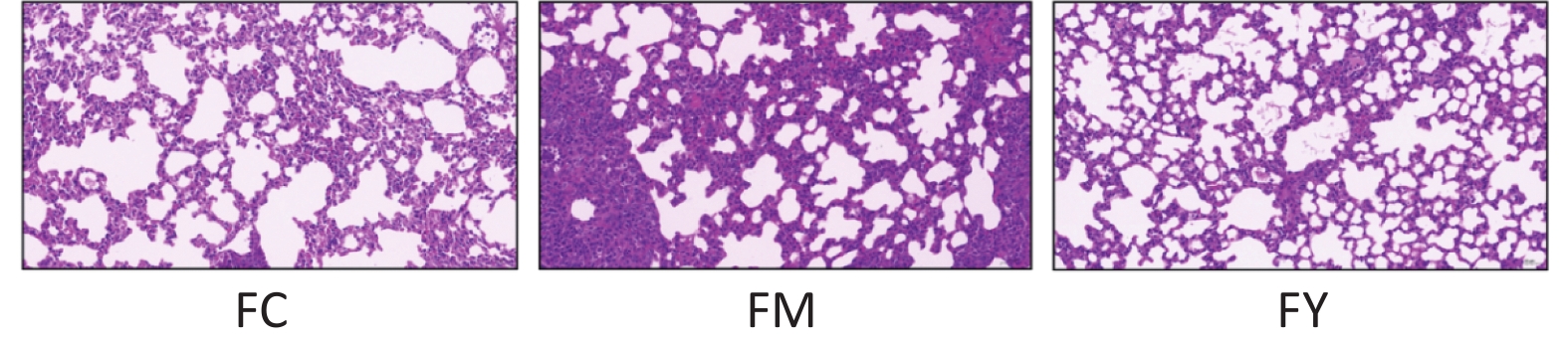
图 2
Fig.2 Morphological changes in lung tissue of mice in each group (HE staining, 200×)
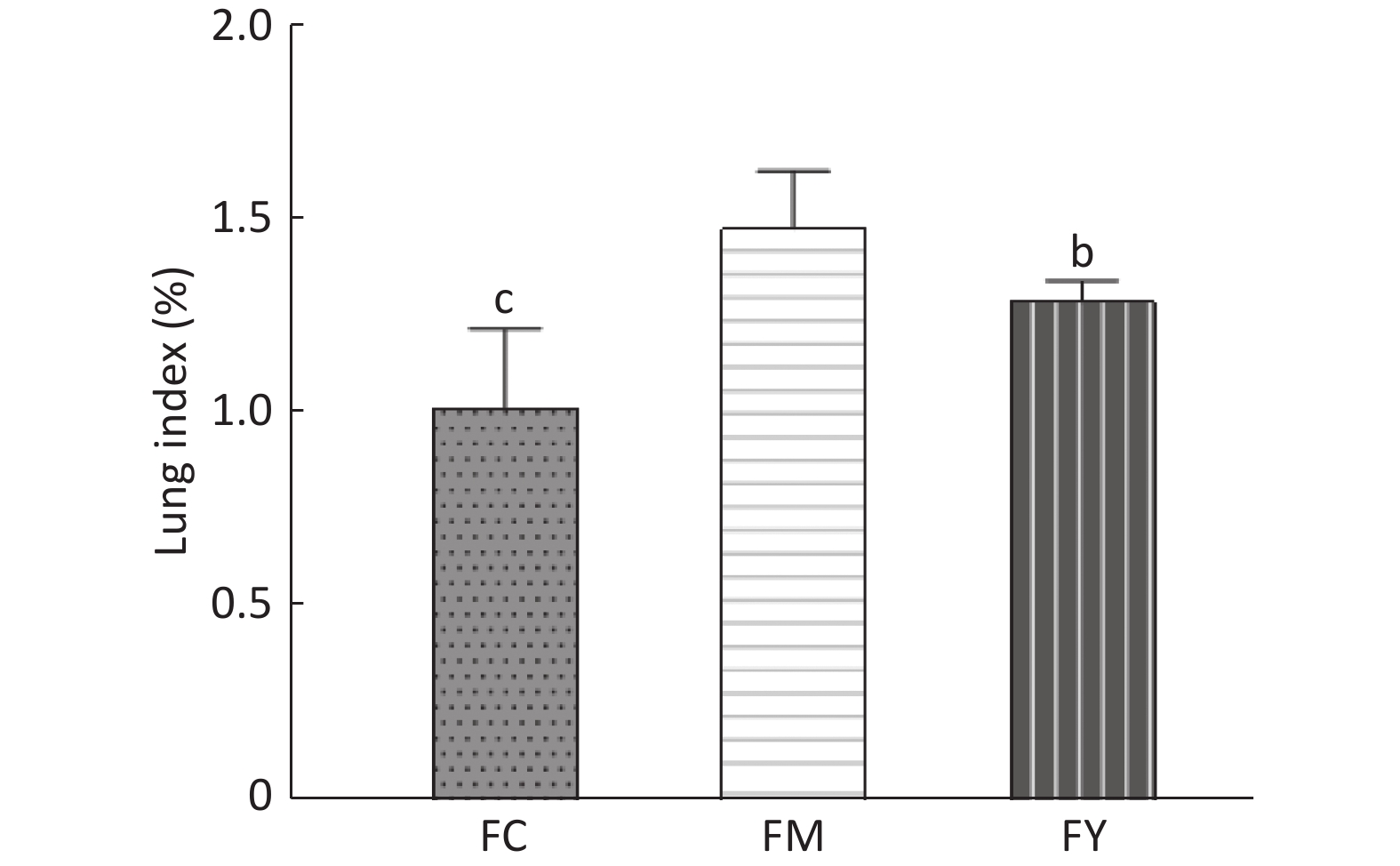
图 3
Fig.3 Lung indices of mice in each group ($\bar x \pm s $, n=8) bP<0.05, cP<0.01, compared with FM group.
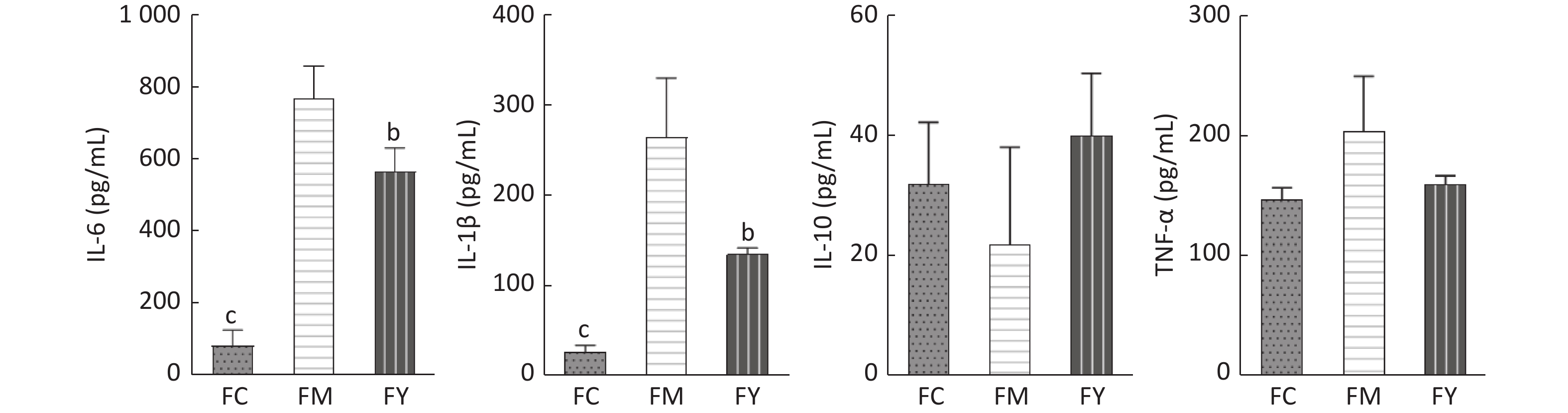
图 4
Fig.4 Inflammatory cytokine levels in each group of mice ($ \overline{x} $±s, n=8) bP<0.05, cP<0.01, compared with FM group.
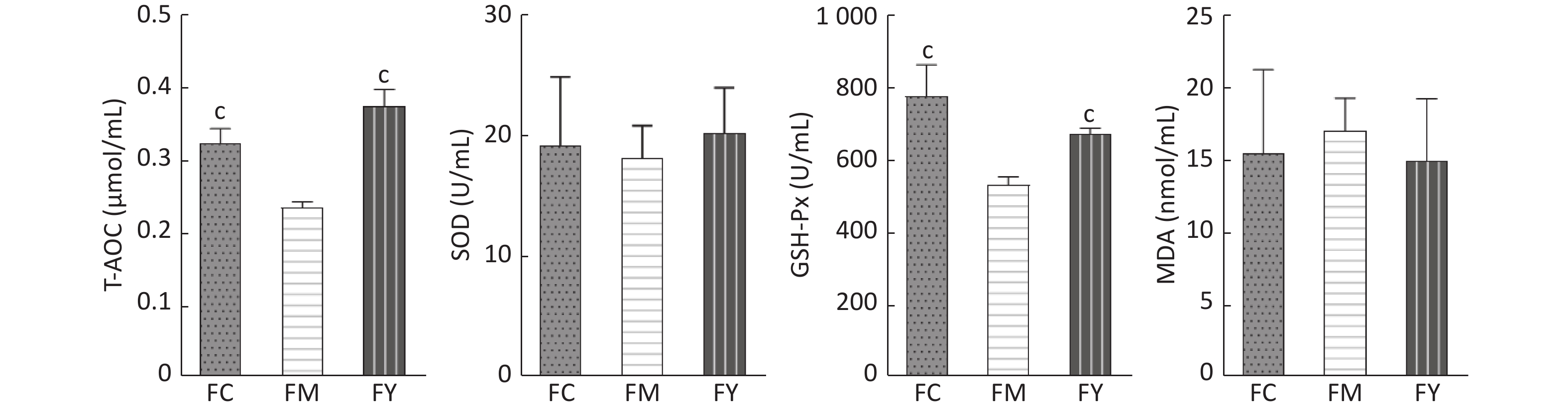
图 5
Fig.5 Antioxidant indicators of mice in each group ($ \overline{x} $±s, n=8) cP<0.01, compared with FM group.
| Sample | Input | Filtered | Denoised | Merged | Non-chimeric | Non-singleton |
| FC1 | ||||||
| FC2 | ||||||
| FC3 | ||||||
| FM1 | ||||||
| FM2 | ||||||
| FM3 | ||||||
| FY1 | ||||||
| FY2 | ||||||
| FY3 |
表 2
Table 2 Statistical table of sequencing quantity of mouse samples in each group
| Sample | Input | Filtered | Denoised | Merged | Non-chimeric | Non-singleton |
| FC1 | ||||||
| FC2 | ||||||
| FC3 | ||||||
| FM1 | ||||||
| FM2 | ||||||
| FM3 | ||||||
| FY1 | ||||||
| FY2 | ||||||
| FY3 |
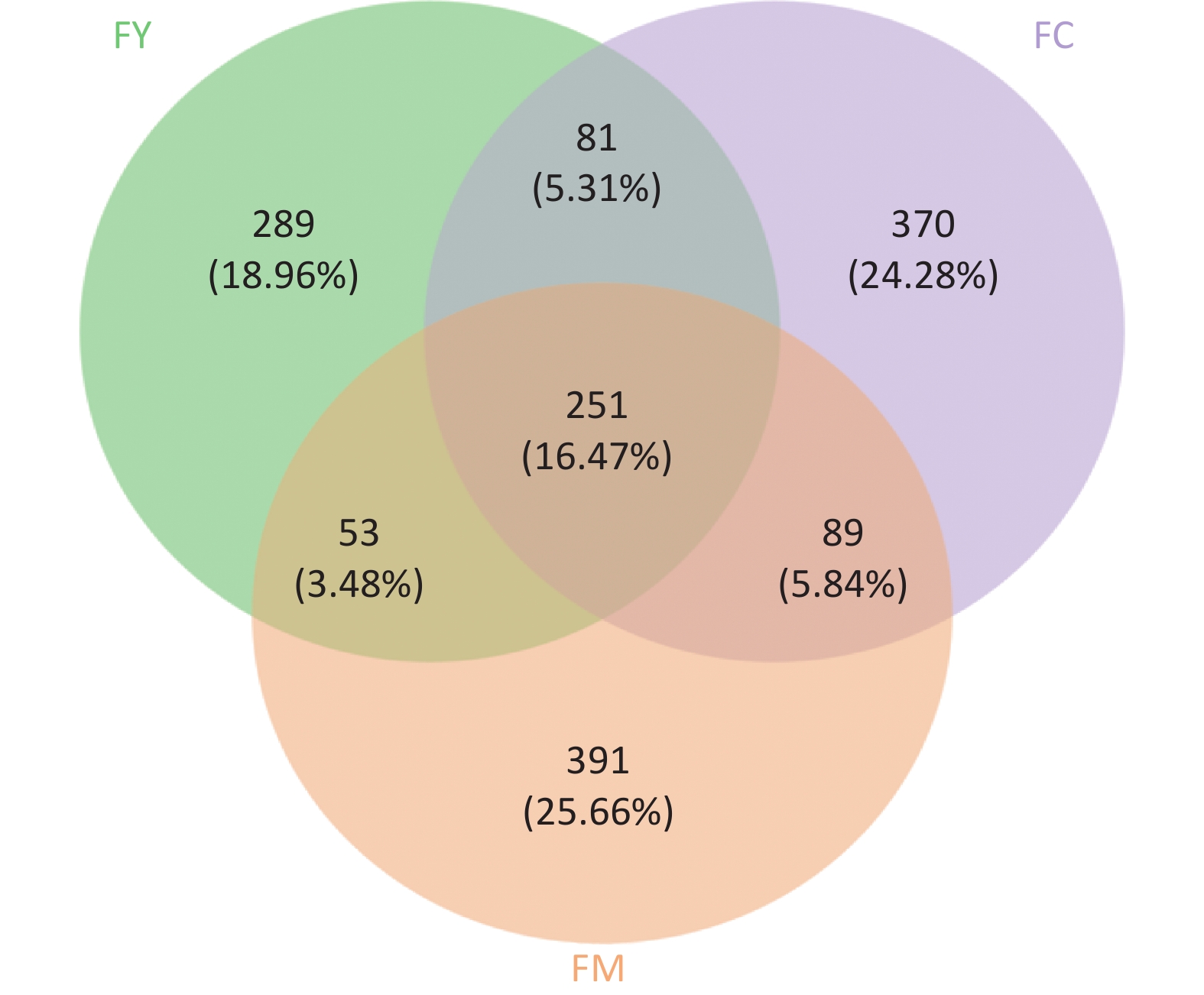
图 6
Fig.6 Venn diagram Each ellipse represents a sample (group), and the overlapping area between ellipses indicates the common ASV/OTU between samples (groups). The number of each block indicates the number of ASV/OTUs contained in that block.
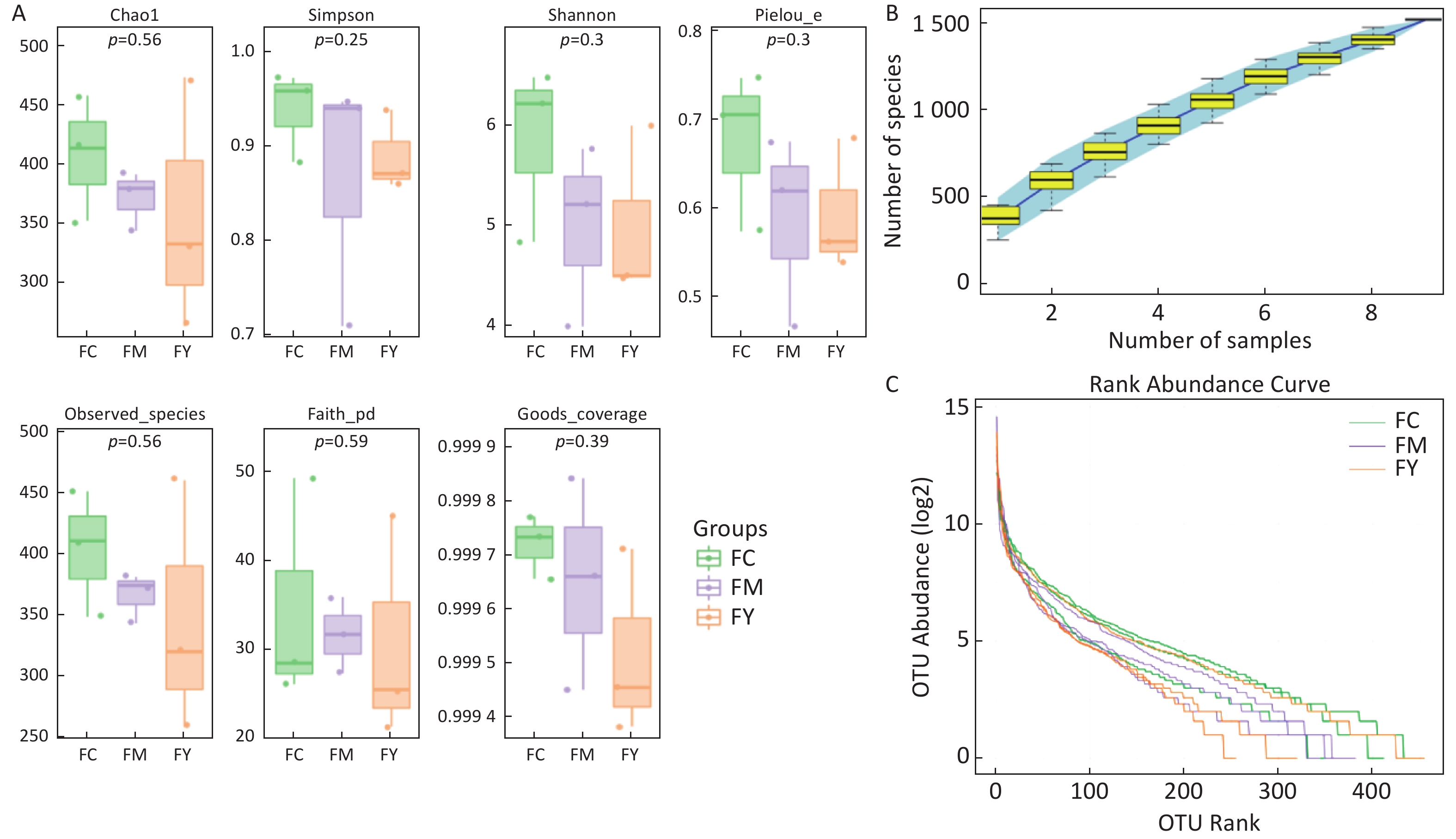
图 7
Fig.7 Alpha Diversity Analysis A: Grouping box plot of Alpha diversity index; B: Species accumulation curve plot; C: Abundance level curve plot.

图 8
Fig.8 Beta diversity analysis

图 9
Fig.9 Bar chart of species composition of mice in each group at the phylum (A) and genus (B) levels
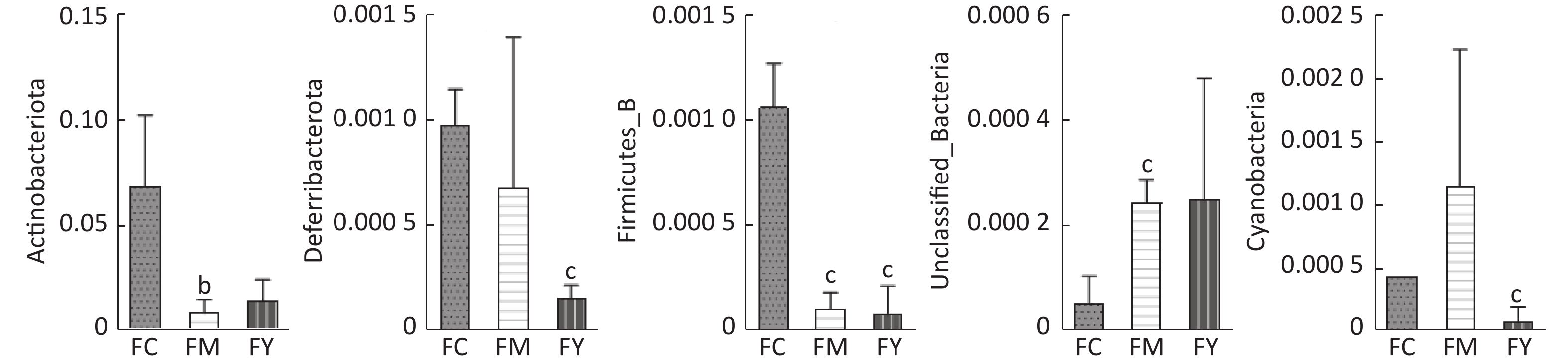
图 10
Fig.10 Microbial communities with significant differences at the phylum level among different groups of mice ($ \overline{x} $±s, n=8) bP<0.05, cP<0.01, compared with FC group.

图 11
Fig.11 Microbial communities with significant differences at the genus level among different groups of mice ($ \overline{x} $±s, n=8) bP<0.05, cP<0.01, compared with FC group; eP<0.05, fP<0.01, compared with FM group.
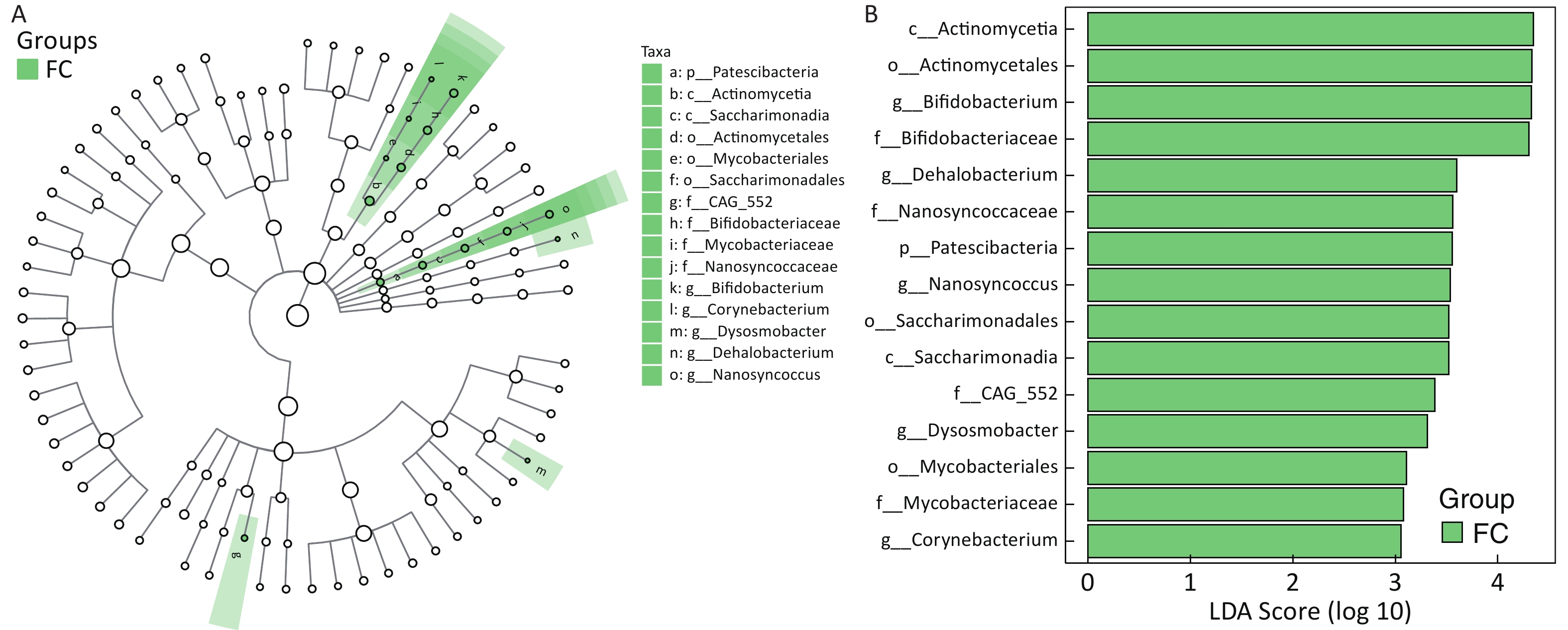
图 12
Fig.12 LEfSe analysis A: display of inter group difference classification units based on classification level tree Figure; B: LDA effect value bar chart of marker species.
| 1 | 孙婧, 辛灵恩, 冯贤珍, 等. 白芍总苷对脂多糖诱导的小鼠急性肺损伤的保护作用及机制[J]. 首都医科大学学报, 2024, 45 (2): 302- 311. |
| 2 | Mokrá D. Acute lung injury-from pathophysiology to treatment [J]. Physiol Res, 2020, 69(Suppl 3): S353-S366. |
| 3 |
Long ME, Mallampalli RK, Horowitz JC, et al. Pathogenesis of pneumonia and acute lung injury[J]. Clin Sci: Lond, 2022, 136 (10): 747- 769.
doi: 10.1042/CS20210879 |
| 4 | 肖凌, 高春蕾, 郭伟, 等. 党参多糖通过调控MAPK/NF-κB信号通路对脂多糖诱导的急性肺损伤小鼠肺组织的保护作用[J]. 实用医学杂志, 2024, 40 (7): 948- 954. |
| 5 |
Sandeep B, Xiao Z, Zhao F, et al. Role of platelets in acute lung injury after extracorporeal circulation in cardiac surgery patients: a systemic review[J]. Curr Probl Cardiol, 2022, 47 (11): 101088.
doi: 10.1016/j.cpcardiol.2021.101088 |
| 6 | 刘澈, 马源, 董旭鹏, 等. 柚皮苷对脓毒症引起的急性肺损伤小鼠保护作用的研究[J]. 中国临床药理学杂志, 2024, 40 (5): 693- 697. |
| 7 | 刘天涯. 地塞米松棕榈酸酯固体脂质纳米粒治疗急性肺损伤的研究 [D]. 成都: 成都大学, 2023. |
| 8 | 柴新义, 朱文东, 陈美玲, 等. 野生云芝主要营养成分及其多糖抑菌效果[J]. 集宁师范学院学报, 2019, 41 (6): 10- 15. |
| 9 | 葛唯佳. 杂色云芝多糖的提取、分离及药理活性研究 [D]. 吉林农业大学, 2019. |
| 10 | 陈镕坤, 池延添, 易永旺, 等. 云芝多糖对肠道益生菌生长的影响[J]. 食品工业, 2024, 45 (1): 76- 79. |
| 11 | Mitoml T, Ogosh K. Clinical study of PSK as an adjuvant immunochemotherapeutic agent against gastric cancer[J]. Gan To Kagaku Ryoho, 1986, 13 (8): 252- 2537. |
| 12 | 徐思源, 叶碧娴, 窦永会, 等. 云芝多糖调节炎症因子的表达并改善小鼠高脂血症[J]. 南开大学学报(自然科学版), 2016, 49 (3): 81- 87. |
| 13 |
Jiang L, Zhang L, Kang K, et al. Resveratrol ameliorates LPS-induced acute lung injury via NLRP3inflammasome modulation[J]. Biomed Pharmacother, 2016, 84, 130- 138.
doi: 10.1016/j.biopha.2016.09.020 |
| 14 | 张亚平, 张广平, 苏萍, 等. 不同途径吸入脂多糖致大鼠急性肺炎模型的优选[J]. 中国实验方剂学杂志, 2018, 24 (7): 82- 88. |
| 15 | 杨健莉, 刘佳, 郑志红. 常用实验大小鼠采血方法及其对实验动物福利的影响[J]. 中国比较医学杂志, 2019, 29 (1): 90- 94. |
| 16 | 张永玉, 龚娅, 刘荣碧, 等. 基于16S rRNA高通量测序技术初步探讨双歧杆菌乳杆菌三联活菌片对系统性红斑狼疮模型小鼠MRL/lpr肠道菌群的影响[J]. 风湿病与关节炎, 2024, 13 (1): 1- 7. |
| 17 | 张茂福, 张志明, 宋忠阳, 等. 中药调控氧化应激防治急性肺损伤的研究进展[J]. 中草药, 2024, 55 (9): 3190- 3201. |
| 18 | Kapur R, Rebetz J, Velden SVD, et al. Pancreatic involvement in murine antibody-mediated transfusion-related acute lung injury ?[J]. Transfusion, 2021, 61 (3): 987- 989. |
| 19 | 俞莉, 叶苗云, 陈少丹, 等. 基于肠道菌群和代谢组学研究桦褐孔菌多糖对急性肺损伤小鼠的保护作用[J]. 中国实验方剂学杂志, 2024, 30 (13): 86- 94. |
| 20 |
Yuan Q, Basit A, Liang W, et al. Pazopanib ameliorates acute lung injuries via inhibition of MAP3K2 and MAP3K3[J]. Sci Transl Med, 2021, 13 (591): 132- 138.
doi: 10.1126/scitranslmed.abc2499 |
| 21 | Zhong WJ, Liu T, Yang HH, et al. TREM-1 governs NLRP3 inflammasome activation of macrophages by firing up glycolysis in acute lung injury[J]. Int J Biol Sci, 2023, 19 (1): 242- 257. |
| 22 | 夏彦民, 王文辰, 张鸿, 等. 人羊膜上皮细胞气管内滴注对脂多糖诱导小鼠急性肺损伤的保护作用[J]. 细胞与分子免疫学杂志, 2017, 33 (1): 7- 11. |
| 23 | 杨开燕, 魏惠平, 王记, 等. 基于肠心轴学说探讨肠道菌群在心血管疾病中的作用[J]. 中国现代应用药学, 2023, 40 (24): 3467- 3472. |
| 24 | 瞿光友, 彭友飞, 陈怡名, 等. 基于16S rDNA测序技术分析益气活血方对脑缺血损伤大鼠肠道菌群多样性的影响[J]. 现代中药研究与实践, 2024, 38 (4): 24- 30. |
| 25 | Jones SE, Lennon JT. Dormancy contributes to the maintenance of microbial diversity[J]. Proc Natl Acad Sci USA, 2010, 107 (13): 5881- 5886. |
| 26 | 邵兰, 徐进步. 肠道菌群通过戊酸调节脂多糖诱导的急性肺损伤[J]. 中国微生态学杂志, 2024, 36 (10): 1163- 1169. |
| 27 | 马鸣, 汪坤, 杨艳华, 等. 基于p38 MAPK/MLCK信号通路探讨通腑泻肺灌肠液对急性肺损伤大鼠肠道屏障及肠道菌群的影响[J]. 中国中药杂志, 2024, 49 (21): 5919- 5931. |
| 28 | Li Y, Liu XY, Ma MM, et al. Changes in intestinal microflora in rats with acute respiratory distress syndrome[J]. World J Gastroenterol, 2014, 20 (19): 5849- 5858. |
| 29 | 邓贵凤. 芍药甘草汤通过重塑肠道菌群调节TLR4/NF-KB信号通路改善多囊卵巢综合征的作用机制研究 [D]. 太原: 山西医科大学, 2021. |
| 30 | 钟海. 三叶苷对LPS诱导急性肺损伤小鼠的保护作用及机理研究 [D]. 广州: 南方医科大学, 2021. |
| 31 | Li W, Ding ZH, Chen Y, et al. Integrated pharmacology reveals the molecular mechanism of Gegen qinlian decoction against lipopolysaccharide-induced acute lung injury[J]. Front Pharmacol, 2022, 13, 854544. |
| 32 | Ma PJ, Wang MM, Wang Y. Gut microbiota: a new insight into lung diseases[J]. Biomed Pharmacother, 2022, 155, 113810. |
| 33 | 张甘纯, 刘文, 宋信莉, 等. 芍药甘草汤对急性肺损伤大鼠肠道菌群的影响[J]. 中国药房, 2023, 34 (17): 2063- 2068. |
| 34 | Boweeman KL, Rehman SF, Vaughan A, et al. Disease-associated gut microbiome and metabolome changes in patients with chronic obstructive pulmonary disease[J]. Nat Commun, 2020, 11 (1): 5886. |
| 35 | Chang ZP, Deng GF, Shao YY, et al. Shaoyao-Gancao Decoction ameliorates the inflammation statein polycystic ovary syndrome rats via remodeling gut microbiota and suppressing the TLR4/NF-kB pathway[J]. Front Pharmacol, 2021, 12, 670054. |
| 36 | 王平, 赵澄, 卢芳国, 等. 麻杏石甘汤对流感病毒感染小鼠肠道菌群及趋化因子CCL5、CXCL10的影响[J]. 中草药, 2021, 52 (1): 160- 175. |
| 37 | Sanadat J, Hosomi K, Shoj H, et al. Gut microbiota modification suppresses the development ofpulmonary arterial hypertension in an SU5416/hypoxia rat model [J]. Pulm Circ, 2020, 10(3): 2045894020929147. |
| [1] | 孙立亚, 李嘉鑫, 孙贵炎, 陈志超, 王庆峰, 杨宇峰, 石岩. 基于肠道菌群和支链氨基酸探讨中医药防治糖尿病肾病的研究进展[J]. 中国临床药理学与治疗学, 2026, 31(4): 527-535. |
| [2] | 文一如, 杨金拉姆, 美嘎, 李娜, 录亚鹏, 张琰, 刘婕婷. 巨噬细胞极化与肠道菌群及其代谢产物在器官损伤中相关研究进展[J]. 中国临床药理学与治疗学, 2026, 31(1): 125-132. |
| [3] | 姜建湘, 杜珮琰, 刘玉荣, 吕海宏. 三甲胺N-氧化物与桥本甲状腺炎的相关性研究[J]. 中国临床药理学与治疗学, 2025, 30(9): 1208-1214. |
| [4] | 林艺燕, 吴月莹, 严锐, 吴东. 槲皮素防治急性肺损伤作用机制的研究进展[J]. 中国临床药理学与治疗学, 2025, 30(9): 1272-1280. |
| [5] | 邢英, 郑嵘炅, 姜春晖, 玛依拉·卡哈尔, 木胡牙提·乌拉斯汉. 利拉鲁肽治疗后2型糖尿病合并冠心病患者肠道菌群变化及其与糖、脂代谢指标相关性[J]. 中国临床药理学与治疗学, 2025, 30(8): 1084-1091. |
| [6] | 杜丽娟, 林建华, 叶景焕, 宋璐, 彭燕芬, 刘玉平. 益气通腑泻热方对脂多糖诱导的小鼠急性肺损伤的作用及机制研究[J]. 中国临床药理学与治疗学, 2025, 30(5): 599-607. |
| [7] | 常鸿, 刘军超, 陈斯洁, 赵建清, 赵自刚. 右美托咪啶减轻脓毒症肺损伤的作用与机制[J]. 中国临床药理学与治疗学, 2025, 30(5): 695-701. |
| [8] | 吴义锟, 郭红敏, 李艳, 穆伟歌, 黄淑芸, 朱久玲, 杨竹, 钟树志. 基于调节肠道菌群的疏风解毒胶囊改善甲型流感病毒肺炎小鼠肺损伤的机制研究[J]. 中国临床药理学与治疗学, 2025, 30(10): 1351-1360. |
| [9] | 李泽朋, 顾文强, 陈晓, 王银华, 李先伟. 依帕司他对放射性肺炎小鼠线粒体氧化应激损伤的保护作用[J]. 中国临床药理学与治疗学, 2024, 29(7): 809-818. |
| [10] | 王梦珂, 甘超, 袁玥, 邹婧怡, 王珍, 李淑云, 吕海宏. 2型糖尿病肾脏病与TMAO的相关性研究[J]. 中国临床药理学与治疗学, 2024, 29(6): 661-670. |
| [11] | 俞家旺, 俞婷婷, 高华新, 柯洁, 音弦. 基于TLR4/NF-κB信号通路研究蜂毒肽对急性肺损伤小鼠的作用及机制[J]. 中国临床药理学与治疗学, 2024, 29(11): 1232-1239. |
| [12] | 齐晓风, 骆亚莉, 肖孟勇, 周世琴, 周雯, 安方玉, 魏本君, 刘永琦. “卫气营血”理论辨证防治急性肺损伤研究现状[J]. 中国临床药理学与治疗学, 2023, 28(4): 429-437. |
| [13] | 张强, 郑华军, 李权. 基于肠道菌群干预在治疗自闭症谱系障碍中的研究进展[J]. 中国临床药理学与治疗学, 2023, 28(4): 475-480. |
| [14] | 张蕾, 肖兴鹏, 丁煌. 沉默ZKSCAN3基因表达加重脂多糖诱导的小鼠肺损伤[J]. 中国临床药理学与治疗学, 2023, 28(2): 164-170. |
| [15] | 王丹, 鄢晓丽, 张渊. 幽门螺杆菌感染影响胃癌免疫治疗的研究进展[J]. 中国临床药理学与治疗学, 2023, 28(2): 228-234. |
| 阅读次数 | ||||||
|
全文 |
|
|||||
|
摘要 |
|
|||||