中国临床药理学与治疗学 ›› 2026, Vol. 31 ›› Issue (9): 1162-1172.doi: 10.12092/j.issn.1009-2501.2026.09.002
• 基础研究 • 上一篇
尹新新1( ), 谢昌鹏1, 李雪静1, 张丽萍1, 苏占海1, 王海燕1, 吴穹1, 潘元明2,*(), 安娟1,*()
收稿日期:2025-10-27
修回日期:2026-03-11
出版日期:2026-09-26
发布日期:2026-10-08
通讯作者:
潘元明,安娟
E-mail:xinxin991209@163.com;peterfpan2020@mail.ccmu.edu.cn;anjuan@qhu.edu.cn
作者简介:尹新新,女,硕士研究生,研究方向:高原医学。E-mail:基金资助:
Xinxin YIN1(), Changpeng XIE1, Xuejing LI1, Liping ZHANG1, Zhanhai SU1, Haiyan WANG1, Qiong WU1, Yuanming PAN2,*(), Juan AN1,*()
Received:2025-10-27
Revised:2026-03-11
Online:2026-09-26
Published:2026-10-08
Contact:
Yuanming PAN,Juan AN
E-mail:xinxin991209@163.com;peterfpan2020@mail.ccmu.edu.cn;anjuan@qhu.edu.cn
摘要:
目的: 探究脐带间充质干细胞外泌体修复四氯化碳(CCl4)诱导急性肝损伤的代谢机制,分析关键代谢物在调控修复中的作用。方法: 实验分为CCl4组、CCl4+外泌体低剂量组和CCl4+外泌体高剂量组,检测各组HL-7702的细胞活力,谷草转氨酶(AST)、谷丙转氨酶(ALT)和丙二醛(MDA)的水平,靶向代谢组学分析CCl4组和CCl4+外泌体组的差异代谢物,激光共聚焦显微镜观察HL7702细胞核和线粒体与外泌体的共定位关系,透射电镜观察各组细胞的线粒体结构变化。结果: 外泌体在CCl4浓度为25 mmol/L时显著逆转了细胞活性下降趋势,外泌体显著降低细胞AST、ALT和MDA水平,CCl4组和CCl4+外泌体组共存在73种显著差异代谢物,其中包括甘氨脱氧胆酸与十四烷二酸。荧光染色后观察到外泌体与细胞核及线粒体的共定位现象。结论: 外泌体显著逆转了CCl4诱导的HL-7702细胞AST、ALT和MDA水平异常,并保护线粒体结构和氧化应激损伤。代谢组学结果表明外泌体可能通过介导线粒体与脂肪酸代谢修复肝细胞损伤。
中图分类号:
尹新新, 谢昌鹏, 李雪静, 张丽萍, 苏占海, 王海燕, 吴穹, 潘元明, 安娟. 干细胞外泌体介导线粒体与脂肪酸代谢修复肝细胞损伤的作用机制[J]. 中国临床药理学与治疗学, 2026, 31(9): 1162-1172.
Xinxin YIN, Changpeng XIE, Xuejing LI, Liping ZHANG, Zhanhai SU, Haiyan WANG, Qiong WU, Yuanming PAN, Juan AN. Mechanism of stem cell exosome-mediated repair of hepatocyte injury via mitochondrial and fatty acid metabolism[J]. Chinese Journal of Clinical Pharmacology and Therapeutics, 2026, 31(9): 1162-1172.

图 1
Fig.1 Identification and characterization of human umbilical cord-derived mesenchymal stem cells and their-derived exosomes A: flow cytometry detection of MSC surface markers: HUMSCs exhibit high expression of CD29, CD44, CD90, and CD105, while low expression of CD34, CD45, and HLA-DR. B: morphology and multipotential differentiation potential of live HUMSCs (left: uninduced HUMSCs exhibit spindle and fibroblast-like morphological characteristics, 10×; middle: oil red O staining indicates adipogenic differentiation; right: Alcian blue staining indicates osteogenic differentiation). All data are from three independent experiments. C: Characterization and identification of stem cell-derived exosomes: nanoparticle tracking analysis (NTA): determination of exosome particle size distribution (50-200 nm) and concentration. Western blotting (WB): detection of exosome surface markers (CD9, CD63, CD81) and intracellular protein TSG101, with negative marker calnexin not detected, confirming exosome purity. Transmission electron microscopy (TEM): negative staining reveals a typical bilayer membrane structure and cup-like morphology.
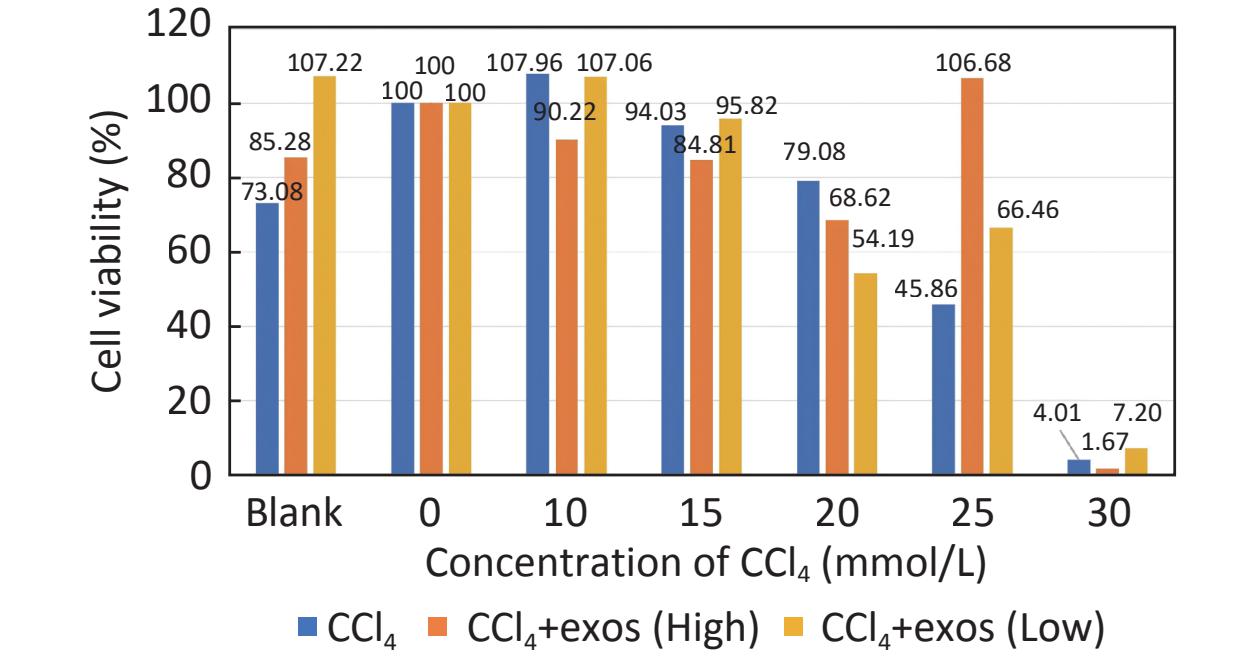
图 2
Fig.2 Both low-dose and high-dose exosome treatments exhibited significant therapeutic effects
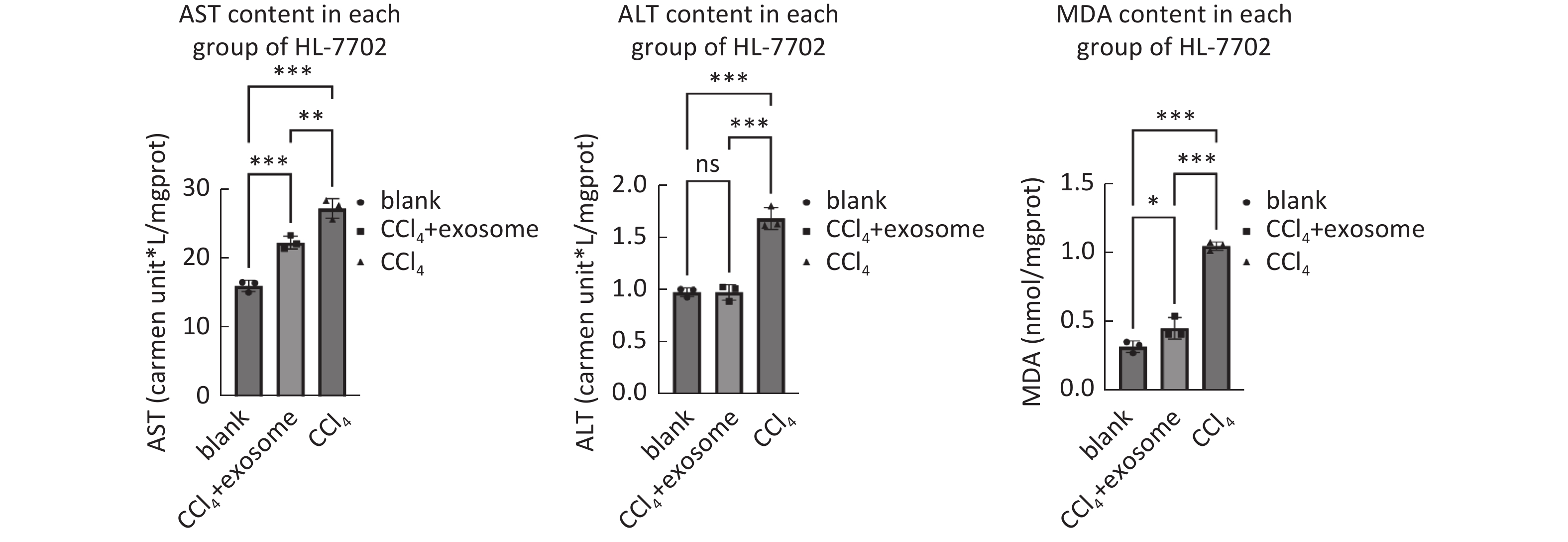
图 3
Fig.3 Detection of hepatocyte injury markers in homogenates of HL-7702 cells in each group ($\bar x \pm s $, n=3) ns: P>0.05, *: P<0.05, **: P<0.01, ***: P<0.001.
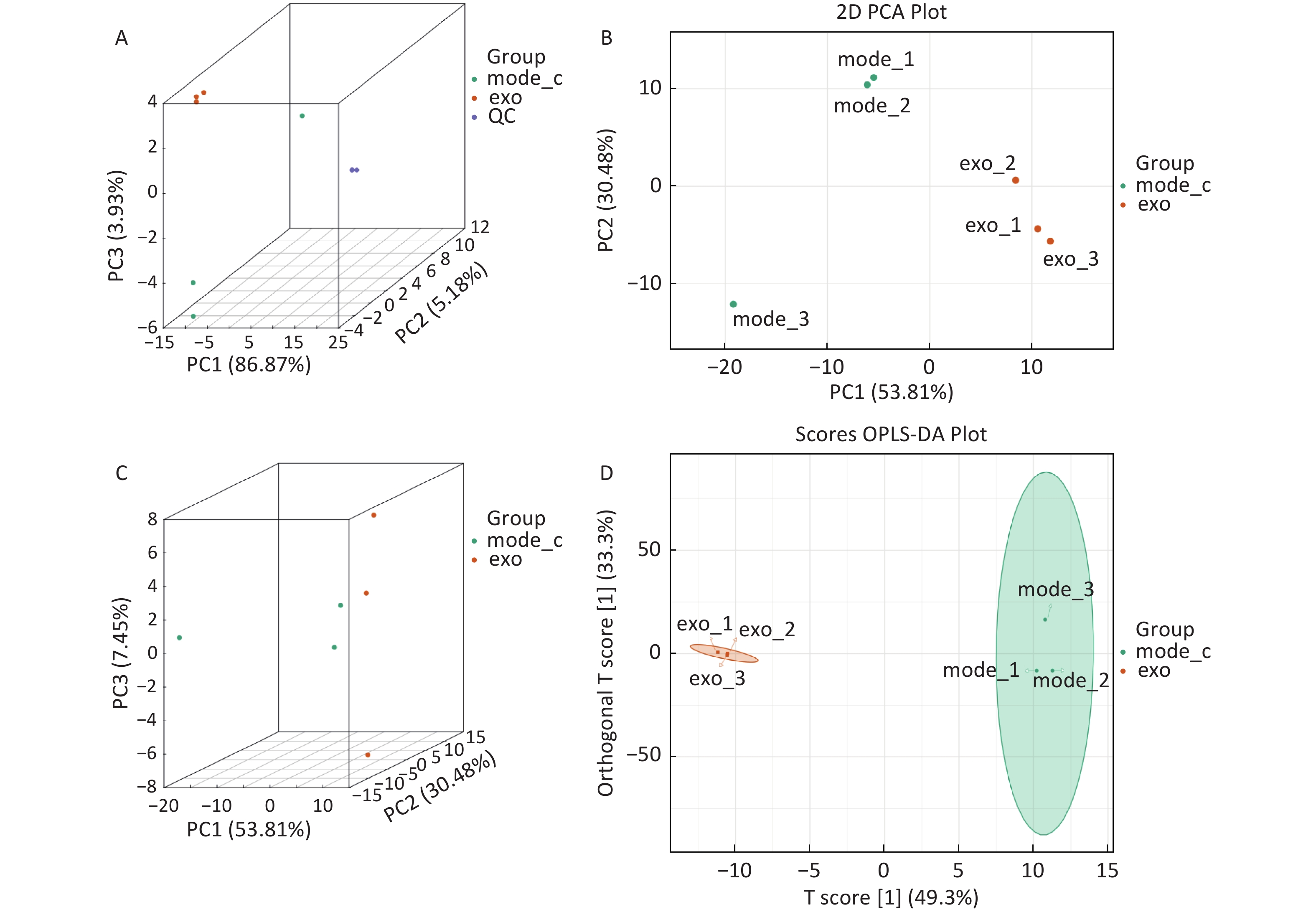
图 4
Fig.4 Metabolomic PCA and OPLS-DA analysis A: 3D-PCA score plot of mass spectrometry data from each group. mode_c: CCl4 model group; exo: CCl4+exosome intervention group; QC: quality control group (mixed solution from each group); the same below PC1 represents the first principal component, PC2 represents the second principal component, and the percentage indicates the explanatory power of that principal component to the dataset; each point in the figure represents a sample, and samples from the same group are represented by the same color. B: grouped 2D-PCA analysis plot. C: grouped 3D-PCA analysis plot. D: OPLS-DA score plot. The abscissa represents the predictive principal component, and the direction of the abscissa indicates the differences between groups; the ordinate represents the orthogonal principal component, and the direction of the ordinate indicates the differences within groups; the percentage indicates the explanatory power of that component to the dataset.
| Compounds | Class | VIP | P value | FDR | Fold Change | Log2FC | Type |
| 4-Guanidinobutanoic acid | Organic acids and their derivatives | 1.124 | 0.122 | 0.284 | 3.364 | 1.750 | Up |
| Oleoylethanolamide | Lipid amide | 1.341 | 0.006 | 0.116 | 2.321 | 1.215 | Up |
| Trigonelline | Coenzyme and vitamin | 1.352 | 0.023 | 0.140 | 6.466 | 2.693 | Up |
| Betaine | other | 1.177 | 0.086 | 0.239 | 2.366 | 1.243 | Up |
| Deoxycholic acid | Bile acid | 1.416 | 0.001 | 0.038 | 2.540 | 1.345 | Up |
| Betaine aldehyde chloride | Other | 1.387 | 0.001 | 0.038 | 2.208 | 1.143 | Up |
| Oleylcarnitine | Acylcarnitine | 1.401 | 0.007 | 0.116 | 4.905 | 2.294 | Up |
| DL-carnitine | Acylcarnitine | 1.386 | 0.010 | 0.116 | 3.105 | 1.635 | Up |
| Acetyl-carnitine | Acylcarnitine | 1.121 | 0.124 | 0.285 | 2.802 | 1.486 | Up |
| Myristoyl-L-carnitine | Acylcarnitine | 1.321 | 0.038 | 0.166 | 2.837 | 1.504 | Up |
| L-palmitoylcarnitine | Acylcarnitine | 1.415 | 0.002 | 0.054 | 5.234 | 2.388 | Up |
| Stearoyl-carnitine | Acylcarnitine | 1.421 | 0.000 | 0.001 | 6.883 | 2.783 | Up |
| Taurine | Sulfonic acid compounds | 1.037 | 0.167 | 0.331 | 5.679 | 2.506 | Up |
| N6-threonylcarbamoyladenosine | Nucleotides and their metabolites | 1.295 | 0.041 | 0.166 | 2.150 | 1.104 | Up |
| 2'-O-methylcytidine | Nucleotides and their metabolites | 1.411 | 0.000 | 0.012 | 2.490 | 1.316 | Up |
| 5'-Deoxy-5'-methylthioadensine | Nucleotides and their metabolites | 1.041 | 0.161 | 0.325 | 2.377 | 1.249 | Up |
| 2'-O-methyluridine | Nucleotides and their metabolites | 1.352 | 0.017 | 0.125 | 2.701 | 1.434 | Up |
| 5,2'-O-dimethyluridine | Nucleotides and their metabolites | 1.320 | 0.037 | 0.166 | 5.325 | 2.413 | Up |
| Pseudouridine | Nucleotides and their metabolites | 1.319 | 0.041 | 0.166 | 2.305 | 1.205 | Up |
| Uric acid | Purine and pyrimidine | 1.004 | 0.187 | 0.336 | 6.589 | 2.720 | Up |
| N,N-Dimethylguanosine | Nucleotides and their metabolites | 1.255 | 0.066 | 0.204 | 2.725 | 1.446 | Up |
| Thyroxine | Hormones and hormone-related substances | 1.352 | 0.019 | 0.128 | 2.129 | 1.090 | Up |
| Prostaglandin E2(PGE2) | Hormones and hormone-related substances | 1.043 | 0.145 | 0.303 | 2.142 | 1.099 | Up |
| Acetoacetic acid sodium salt | Organic acids and their derivatives | 1.351 | 0.013 | 0.122 | 2.248 | 1.169 | Up |
| Fumaric acid | Organic acids and their derivatives | 1.242 | 0.069 | 0.206 | 2.694 | 1.430 | Up |
| 3-methylcytidine | Nucleotides and their metabolites | 1.206 | 0.036 | 0.166 | 2.719 | 1.443 | Up |
| Cyclic-AMP | Nucleotides and their metabolites | 1.104 | 0.140 | 0.300 | 2.696 | 1.431 | Up |
| Pyridoxine | Pyridine and its derivatives | 1.088 | 0.140 | 0.300 | 19.293 | 4.270 | Up |
| N-Palmitoylglycine | Amino acid derivatives | 1.223 | 0.074 | 0.216 | 2.003 | 1.002 | Up |
| N-A-Acetyl-L-Arginine | Amino acid derivatives | 1.279 | 0.016 | 0.125 | 2.783 | 1.477 | Up |
| 4-Aminobutyric Acid | Amino acid derivatives | 1.349 | 0.025 | 0.147 | 4.746 | 2.247 | Up |
| Beta-Alanine | Amino acid derivatives | 1.144 | 0.114 | 0.280 | 5.453 | 2.447 | Up |
| L-Cystine | Amino acid | 1.210 | 0.065 | 0.201 | 2.033 | 1.024 | Up |
| Ribonic acid | Sugar acid | 1.376 | 0.016 | 0.125 | 3.987 | 1.995 | Up |
| Sphinganine | Amines | 1.067 | 0.150 | 0.306 | 2.719 | 1.443 | Up |
| gama-Glutamate-Cysteine | Small peptide | 1.130 | 0.121 | 0.284 | 2.084 | 1.059 | Up |
| Trans-4-Hydroxy-L-Proline | Amino acid derivatives | 1.086 | 0.140 | 0.300 | 7.293 | 2.867 | Up |
| Stachydrine hydrochloride | Organic acids and their derivatives | 1.229 | 0.063 | 0.200 | 11.336 | 3.503 | Up |
| Anserine | Small peptide | 1.100 | 0.108 | 0.270 | 3.582 | 1.841 | Up |
| Indolelactic acid | Indole and its derivatives | 1.076 | 0.117 | 0.283 | 7.036 | 2.815 | Up |
| 1-Methyladenine | Nucleotides and their metabolites | 1.385 | 0.016 | 0.125 | Inf | Inf | Up |
| Myo-Inositol | Alcohol and polyol | 1.023 | 0.172 | 0.336 | Inf | Inf | Up |
| 5-hydroxymethylcytidine | Nucleotides and their metabolites | 1.277 | 0.052 | 0.186 | Inf | Inf | Up |
| Glycodeoxycholic acid | Bile acid | 1.422 | 0.001 | 0.038 | Inf | Inf | Up |
| Allantoin | Imidazoles | 1.258 | 0.064 | 0.201 | Inf | Inf | Up |
| Arachidonylcarnitine | acylcarnitine | 1.401 | 0.009 | 0.116 | Inf | Inf | Up |
| Glycolithocholic acid | Bile acid | 1.416 | 0.002 | 0.060 | Inf | Inf | Up |
| Dodecanoylcarnitine | Acylcarnitine | 1.161 | 0.106 | 0.270 | Inf | Inf | Up |
| Deoxyuridine | Nucleotides and their metabolites | 1.006 | 0.184 | 0.336 | Inf | Inf | Up |
| Salicylic acid | Benzene and its derivatives | 1.006 | 0.185 | 0.336 | Inf | Inf | Up |
| 3-hydroxymethylglutaric acid | Amino acid derivatives | 1.002 | 0.188 | 0.336 | Inf | Inf | Up |
| 7a,27-Dihydroxycholesterol | Hormones and hormone-related substances | 1.003 | 0.188 | 0.336 | Inf | Inf | Up |
| Cholic acid | bile acid | 1.005 | 0.184 | 0.336 | Inf | Inf | Up |
| L-Cystathionine | Amino acid derivative | 1.006 | 0.184 | 0.336 | Inf | Inf | Up |
| 3-Hydroxy-9-hexadecenoyl-L-carnitine | Acylcarnitine | 1.006 | 0.184 | 0.336 | Inf | Inf | Up |
| Vitamin B3 | Coenzyme and vitamin | 1.072 | 0.142 | 0.301 | 0.479 | ?1.061 | Down |
| Tridecanedioic acid | Fatty acyl | 1.286 | 0.050 | 0.182 | 0.413 | ?1.275 | Down |
| Tetradecanedioic acid | Fatty acyl | 1.331 | 0.030 | 0.159 | 0.394 | ?1.343 | Down |
| Thiamine pyrophosphate | Coenzyme and vitamin | 1.378 | 0.001 | 0.038 | 0.361 | ?1.471 | Down |
| BPG | Phosphoric acid compounds | 1.185 | 0.037 | 0.166 | 0.421 | ?1.248 | Down |
| 2-Picolinic Acid | Pyridine and its derivatives | 1.166 | 0.096 | 0.250 | 0.426 | ?1.233 | Down |
| Gly-Trp | Small peptide | 1.255 | 0.055 | 0.188 | 0.392 | ?1.350 | Down |
| Phe Leu | Small peptide | 1.315 | 0.009 | 0.116 | 0.413 | ?1.275 | Down |
| N,N-dimethylarginine | Amino acid derivatives | 1.401 | 0.007 | 0.116 | 0.142 | ?2.819 | Down |
| L-Alanyl-L-proline | Small peptide | 1.288 | 0.032 | 0.159 | 0.474 | ?1.077 | Down |
| Gly-Val | Small peptide | 1.286 | 0.014 | 0.125 | 0.316 | ?1.661 | Down |
| Mannitol | Sugar alcohol | 1.208 | 0.060 | 0.196 | 0.424 | ?1.239 | Down |
| Ser-Glu | Small peptide | 1.342 | 0.019 | 0.128 | 0.311 | ?1.683 | Down |
| Thr-Leu | Small peptide | 1.294 | 0.012 | 0.121 | 0.452 | ?1.146 | Down |
| Phe Val | Small peptide | 1.319 | 0.014 | 0.125 | 0.351 | ?1.509 | Down |
| Dodecanedioic Acid | Fatty acyl | 1.226 | 0.027 | 0.152 | 0.304 | ?1.716 | Down |
| Adenine | Nucleotides and their metabolites | 1.139 | 0.087 | 0.239 | 0.120 | ?3.062 | Down |
| Benzoic acid | Benzene and its derivatives | 1.016 | 0.184 | 0.336 | 0.000 | ?Inf | Down |
表 1
Table 1 Differential metabolite table (CCl4 group vs. CCl4+exosome group)
| Compounds | Class | VIP | P value | FDR | Fold Change | Log2FC | Type |
| 4-Guanidinobutanoic acid | Organic acids and their derivatives | 1.124 | 0.122 | 0.284 | 3.364 | 1.750 | Up |
| Oleoylethanolamide | Lipid amide | 1.341 | 0.006 | 0.116 | 2.321 | 1.215 | Up |
| Trigonelline | Coenzyme and vitamin | 1.352 | 0.023 | 0.140 | 6.466 | 2.693 | Up |
| Betaine | other | 1.177 | 0.086 | 0.239 | 2.366 | 1.243 | Up |
| Deoxycholic acid | Bile acid | 1.416 | 0.001 | 0.038 | 2.540 | 1.345 | Up |
| Betaine aldehyde chloride | Other | 1.387 | 0.001 | 0.038 | 2.208 | 1.143 | Up |
| Oleylcarnitine | Acylcarnitine | 1.401 | 0.007 | 0.116 | 4.905 | 2.294 | Up |
| DL-carnitine | Acylcarnitine | 1.386 | 0.010 | 0.116 | 3.105 | 1.635 | Up |
| Acetyl-carnitine | Acylcarnitine | 1.121 | 0.124 | 0.285 | 2.802 | 1.486 | Up |
| Myristoyl-L-carnitine | Acylcarnitine | 1.321 | 0.038 | 0.166 | 2.837 | 1.504 | Up |
| L-palmitoylcarnitine | Acylcarnitine | 1.415 | 0.002 | 0.054 | 5.234 | 2.388 | Up |
| Stearoyl-carnitine | Acylcarnitine | 1.421 | 0.000 | 0.001 | 6.883 | 2.783 | Up |
| Taurine | Sulfonic acid compounds | 1.037 | 0.167 | 0.331 | 5.679 | 2.506 | Up |
| N6-threonylcarbamoyladenosine | Nucleotides and their metabolites | 1.295 | 0.041 | 0.166 | 2.150 | 1.104 | Up |
| 2'-O-methylcytidine | Nucleotides and their metabolites | 1.411 | 0.000 | 0.012 | 2.490 | 1.316 | Up |
| 5'-Deoxy-5'-methylthioadensine | Nucleotides and their metabolites | 1.041 | 0.161 | 0.325 | 2.377 | 1.249 | Up |
| 2'-O-methyluridine | Nucleotides and their metabolites | 1.352 | 0.017 | 0.125 | 2.701 | 1.434 | Up |
| 5,2'-O-dimethyluridine | Nucleotides and their metabolites | 1.320 | 0.037 | 0.166 | 5.325 | 2.413 | Up |
| Pseudouridine | Nucleotides and their metabolites | 1.319 | 0.041 | 0.166 | 2.305 | 1.205 | Up |
| Uric acid | Purine and pyrimidine | 1.004 | 0.187 | 0.336 | 6.589 | 2.720 | Up |
| N,N-Dimethylguanosine | Nucleotides and their metabolites | 1.255 | 0.066 | 0.204 | 2.725 | 1.446 | Up |
| Thyroxine | Hormones and hormone-related substances | 1.352 | 0.019 | 0.128 | 2.129 | 1.090 | Up |
| Prostaglandin E2(PGE2) | Hormones and hormone-related substances | 1.043 | 0.145 | 0.303 | 2.142 | 1.099 | Up |
| Acetoacetic acid sodium salt | Organic acids and their derivatives | 1.351 | 0.013 | 0.122 | 2.248 | 1.169 | Up |
| Fumaric acid | Organic acids and their derivatives | 1.242 | 0.069 | 0.206 | 2.694 | 1.430 | Up |
| 3-methylcytidine | Nucleotides and their metabolites | 1.206 | 0.036 | 0.166 | 2.719 | 1.443 | Up |
| Cyclic-AMP | Nucleotides and their metabolites | 1.104 | 0.140 | 0.300 | 2.696 | 1.431 | Up |
| Pyridoxine | Pyridine and its derivatives | 1.088 | 0.140 | 0.300 | 19.293 | 4.270 | Up |
| N-Palmitoylglycine | Amino acid derivatives | 1.223 | 0.074 | 0.216 | 2.003 | 1.002 | Up |
| N-A-Acetyl-L-Arginine | Amino acid derivatives | 1.279 | 0.016 | 0.125 | 2.783 | 1.477 | Up |
| 4-Aminobutyric Acid | Amino acid derivatives | 1.349 | 0.025 | 0.147 | 4.746 | 2.247 | Up |
| Beta-Alanine | Amino acid derivatives | 1.144 | 0.114 | 0.280 | 5.453 | 2.447 | Up |
| L-Cystine | Amino acid | 1.210 | 0.065 | 0.201 | 2.033 | 1.024 | Up |
| Ribonic acid | Sugar acid | 1.376 | 0.016 | 0.125 | 3.987 | 1.995 | Up |
| Sphinganine | Amines | 1.067 | 0.150 | 0.306 | 2.719 | 1.443 | Up |
| gama-Glutamate-Cysteine | Small peptide | 1.130 | 0.121 | 0.284 | 2.084 | 1.059 | Up |
| Trans-4-Hydroxy-L-Proline | Amino acid derivatives | 1.086 | 0.140 | 0.300 | 7.293 | 2.867 | Up |
| Stachydrine hydrochloride | Organic acids and their derivatives | 1.229 | 0.063 | 0.200 | 11.336 | 3.503 | Up |
| Anserine | Small peptide | 1.100 | 0.108 | 0.270 | 3.582 | 1.841 | Up |
| Indolelactic acid | Indole and its derivatives | 1.076 | 0.117 | 0.283 | 7.036 | 2.815 | Up |
| 1-Methyladenine | Nucleotides and their metabolites | 1.385 | 0.016 | 0.125 | Inf | Inf | Up |
| Myo-Inositol | Alcohol and polyol | 1.023 | 0.172 | 0.336 | Inf | Inf | Up |
| 5-hydroxymethylcytidine | Nucleotides and their metabolites | 1.277 | 0.052 | 0.186 | Inf | Inf | Up |
| Glycodeoxycholic acid | Bile acid | 1.422 | 0.001 | 0.038 | Inf | Inf | Up |
| Allantoin | Imidazoles | 1.258 | 0.064 | 0.201 | Inf | Inf | Up |
| Arachidonylcarnitine | acylcarnitine | 1.401 | 0.009 | 0.116 | Inf | Inf | Up |
| Glycolithocholic acid | Bile acid | 1.416 | 0.002 | 0.060 | Inf | Inf | Up |
| Dodecanoylcarnitine | Acylcarnitine | 1.161 | 0.106 | 0.270 | Inf | Inf | Up |
| Deoxyuridine | Nucleotides and their metabolites | 1.006 | 0.184 | 0.336 | Inf | Inf | Up |
| Salicylic acid | Benzene and its derivatives | 1.006 | 0.185 | 0.336 | Inf | Inf | Up |
| 3-hydroxymethylglutaric acid | Amino acid derivatives | 1.002 | 0.188 | 0.336 | Inf | Inf | Up |
| 7a,27-Dihydroxycholesterol | Hormones and hormone-related substances | 1.003 | 0.188 | 0.336 | Inf | Inf | Up |
| Cholic acid | bile acid | 1.005 | 0.184 | 0.336 | Inf | Inf | Up |
| L-Cystathionine | Amino acid derivative | 1.006 | 0.184 | 0.336 | Inf | Inf | Up |
| 3-Hydroxy-9-hexadecenoyl-L-carnitine | Acylcarnitine | 1.006 | 0.184 | 0.336 | Inf | Inf | Up |
| Vitamin B3 | Coenzyme and vitamin | 1.072 | 0.142 | 0.301 | 0.479 | ?1.061 | Down |
| Tridecanedioic acid | Fatty acyl | 1.286 | 0.050 | 0.182 | 0.413 | ?1.275 | Down |
| Tetradecanedioic acid | Fatty acyl | 1.331 | 0.030 | 0.159 | 0.394 | ?1.343 | Down |
| Thiamine pyrophosphate | Coenzyme and vitamin | 1.378 | 0.001 | 0.038 | 0.361 | ?1.471 | Down |
| BPG | Phosphoric acid compounds | 1.185 | 0.037 | 0.166 | 0.421 | ?1.248 | Down |
| 2-Picolinic Acid | Pyridine and its derivatives | 1.166 | 0.096 | 0.250 | 0.426 | ?1.233 | Down |
| Gly-Trp | Small peptide | 1.255 | 0.055 | 0.188 | 0.392 | ?1.350 | Down |
| Phe Leu | Small peptide | 1.315 | 0.009 | 0.116 | 0.413 | ?1.275 | Down |
| N,N-dimethylarginine | Amino acid derivatives | 1.401 | 0.007 | 0.116 | 0.142 | ?2.819 | Down |
| L-Alanyl-L-proline | Small peptide | 1.288 | 0.032 | 0.159 | 0.474 | ?1.077 | Down |
| Gly-Val | Small peptide | 1.286 | 0.014 | 0.125 | 0.316 | ?1.661 | Down |
| Mannitol | Sugar alcohol | 1.208 | 0.060 | 0.196 | 0.424 | ?1.239 | Down |
| Ser-Glu | Small peptide | 1.342 | 0.019 | 0.128 | 0.311 | ?1.683 | Down |
| Thr-Leu | Small peptide | 1.294 | 0.012 | 0.121 | 0.452 | ?1.146 | Down |
| Phe Val | Small peptide | 1.319 | 0.014 | 0.125 | 0.351 | ?1.509 | Down |
| Dodecanedioic Acid | Fatty acyl | 1.226 | 0.027 | 0.152 | 0.304 | ?1.716 | Down |
| Adenine | Nucleotides and their metabolites | 1.139 | 0.087 | 0.239 | 0.120 | ?3.062 | Down |
| Benzoic acid | Benzene and its derivatives | 1.016 | 0.184 | 0.336 | 0.000 | ?Inf | Down |

图 5
Fig.5 Clustering and KEGG enrichment of differential metabolites in the CCl4 group and CCl4+exosome group A: VIP value plot of differential metabolites. The x-axis represents the VIP value, and the y-axis represents metabolites. Red represents upregulated differential metabolites, and green represents downregulated differential metabolites. B: Heatmap of differential metabolite clustering. The horizontal axis represents sample names, and the vertical axis represents metabolite information. Scale represents the expression level after normalization (the redder the color, the higher the expression level; the greener the color, the lower the expression level). Group represents the grouping, and Class represents the substance classification. C: KEGG enrichment plot of differential metabolites. The x-axis represents the Rich factor corresponding to each pathway, and the y-axis represents the pathway name. The color of the points represents the P-value, with red indicating more significant enrichment. The size of the points represents the number of differential metabolites enriched.

图 6
Fig.6 Cellular colocalization of exosomes with mitochondria and protective effects of exosomes on mitochondrial ultrastructure A: three-color fluorescence colocalization analysis. Blue: cell nucleus (DAPI staining); green: mitochondria (MitoTracker labeling); red: DiR or DiR-labeled exosomes. TD: bright-field observation. In the DiR+ exosome group, the overlap of red and green signals produces an orange-yellow signal, and 3D fluorescence imaging confirms the spatial colocalization of the red signal (DiR+ exosomes) and the mitochondrial marker within the cell. B: transmission electron microscopy (TEM) observation of mitochondrial ultrastructure. The CCl4 group shows disruption of the mitochondrial cristae structure, while partial structural restoration is observed in the CCl4+ exosome group.
| 1 |
Jacques G, Sensébé Luc. Mesenchymal stromal cells: clinical challenges and therapeutic opportunities[J]. Cell Stem Cell, 2018, 22 (6): 824- 833.
doi: 10.1016/j.stem.2018.05.004 |
| 2 |
Liang X, Zhang Y, Ding Y, et al. Paracrine mechanisms of mesenchymal stem cell-based therapy: current status and perspectives[J]. Cell Transplantation, 2013, 23 (9): 1045.
doi: 10.3727/096368913x667709 |
| 3 |
Karantalis V, Hare JM. Use of mesenchymal stem cells for therapy of cardiac disease[J]. Circ Res, 2015, 116 (8): 1413- 1430.
doi: 10.1161/CIRCRESAHA.116.303614 |
| 4 |
李光宇, 周庆, 李宏达, 等. 间充质干细胞来源外泌体在肝纤维化中的治疗机制[J]. 安徽医药, 2025, 29 (4): 641- 647.
doi: 10.3969/j.issn.1009-6469.2025.04.002 |
| 5 | Kovach TK, Dighe AS, Lobo PI, et al. Interactions between MSCs and immune cells: implications for bone healing[J]. J Immunol Res, 2015, 2015, 1- 17. |
| 6 | Mortada I, Mortada R. Epigenetic changes in mesenchymal stem cells differentiation [J]. Euro J Med Gene, 2017: S1769721217304445. |
| 7 |
Zhao Z, Lin CY, Cheng K, et al. siRNA- and miRNA-based therapeutics for liver fibrosis[J]. Transl Res, 2019, 214, 17- 29.
doi: 10.1016/j.trsl.2019.07.007 |
| 8 |
Shao M, Xu Q, Wu Z, et al. Exosomes derived from human umbilical cord mesenchymal stem cells ameliorate IL-6-induced acute liver injury through miR-455-3p[J]. Stem Cell Res Thera, 2020, 11 (1): 191.
doi: 10.1186/s13287-020-01671-1 |
| 9 |
Br VK, Sarin SK. Acute-on-chronic liver failure: terminology, mechanisms and management[J]. Clin Mol Hepatol, 2023, 29 (3): 670- 689.
doi: 10.3350/cmh.2022.0103 |
| 10 |
Dai C, Xiao X, Li D, et al. Chloroquine ameliorates carbon tetrachloride-induced acute liver injury in mice via the concomitant inhibition of inflammation and induction of apoptosis[J]. Cell Death Dis, 2018, 9 (12): 1136- 1142.
doi: 10.1038/s41419-018-1136-2 |
| 11 | Mihajlovic M, Vinken M. Mitochondria as the target of hepatotoxicity and drug-induced liver injury: molecular mechanisms and detection methods [J/OL]. Int J Mol Sci, 2022, 23(6): 3315. |
| 12 | Morio B, Panthu B, Bassot A, et al. Role of mitochondria in liver metabolic health and diseases[J]. Cell Calcium, 2020, 94, 102336. |
| 13 |
Poirier Y, ANtonenkov VD, Glumoff T, et al. Peroxisomal beta-oxidation-a metabolic pathway with multiple functions[J]. Biochim Et Biophys Acta Mol Cell Res, 2006, 1763 (12): 1413- 1426.
doi: 10.1016/j.bbamcr.2006.08.034 |
| 14 |
Picard M, Taivassalo T, Ritchie D, et al. Mitochondrial structure and function are disrupted by standard isolation methods[J]. PLoS ONE, 2011, 6 (3): e18317.
doi: 10.1371/journal.pone.0018317 |
| 15 | Bernardi P, Gerle C, Halestrap AP, et al. Identity, structure, and function of the mitochondrial permeability transition pore: controversies, consensus, recent advances, and future directions [J]. Cell Death Diff, 30(8): 1869-1885. |
| 16 |
Palmeira CM, Rolo AP. Mitochondrially-mediated toxicity of bile acids[J]. Toxicology, 2004, 203 (1-3): 1- 15.
doi: 10.1016/j.tox.2004.06.001 |
| 17 |
Woolbright BL, McGill MR, Staggs VS, et al. Glycodeoxycholic acid levels as prognostic biomarker in acetaminophen-induced acute liver failure patients[J]. Toxicol Sci, 2014, 142 (2): 436- 444.
doi: 10.1093/toxsci/kfu195 |
| 18 | Huang WF, Kang GF, Tu ZG. Glycodeoxycholic acid changes the membrane fluidity and superoxides of lipids in hepatocytes[J]. Chin J Hepatol, 1999, 7 (1): 46- 47. |
| 19 |
Nolfi-Donegan B, Baseler WA, Bowman CE, et al. Mitochondrial electron transport chain: oxidative phosphorylation, oxidant production, and methods of measurement[J]. Redox Biol, 2020, 37, 101674.
doi: 10.1016/j.redox.2020.101674 |
| 20 |
Juan CA, Pérez De La Lastra JM, Plou FJ, et al. The chemistry of reactive oxygen species (ROS) revisited: outlining their role in biological macromolecules (DNA, lipids and proteins) and induced pathologies[J]. Int J Mol Sci, 2021, 22 (9): 4642.
doi: 10.3390/ijms22094642 |
| 21 |
Ma K, Chen G, Li W, et al. Mitophagy, mitochondrial homeostasis, and cell fate[J]. Front Cell Devel Biol, 2020, 8, 467.
doi: 10.3389/fcell.2020.00467 |
| 22 |
Shpilka T, Haynes CM. The mitochondrial UPR: mechanisms, physiological functions and implications in ageing[J]. Nat Rev Mol Cell Biol, 2018, 19 (2): 109.
doi: 10.1038/nrm.2017.110 |
| [1] | 方怡萌, 雷昕宜, 马思涵, 石文博, 岑露泽, 代曼云. 雷公藤甲素通过激活JNK通路诱发肝细胞损伤的机制研究[J]. 中国临床药理学与治疗学, 2026, 31(8): 1027-1033. |
| [2] | 祁光伟, 仝婉昱, 王冀鲁, 郭靖文, 黎瑞巧, 王启隆. 血栓通对糖尿病内皮细胞线粒体动态平衡、内皮功能损伤和动脉粥样硬化的保护作用研究[J]. 中国临床药理学与治疗学, 2026, 31(6): 798-807. |
| [3] | 王玮辰, 马雅萍, 王萌, 李庆林, 程卉. 基于CYP7A1/FXR/SHP途径探究大黄素对胆汁淤积性肝损伤小鼠的治疗作用[J]. 中国临床药理学与治疗学, 2026, 31(2): 204-212. |
| [4] | 曾祥昌, 饶泰, 陈露露, 李超鹏, 曾贵荣, 陈军, 欧阳冬生. 药物性肝损伤的免疫遗传学机制研究进展[J]. 中国临床药理学与治疗学, 2025, 30(8): 1133-1146. |
| [5] | 何怡然, 何阳, 邓国艳, 樊志强, 汤紫照, 魏凤, 欧阳林旗. 蛇床子素通过上调Tif1γ抑制TGF-β1/ Smad通路保护APAP诱导的小鼠肝损伤[J]. 中国临床药理学与治疗学, 2025, 30(7): 889-898. |
| [6] | 贾东晔, 潘志. 线粒体稳态在类风湿关节炎致病中的作用[J]. 中国临床药理学与治疗学, 2025, 30(4): 541-547. |
| [7] | 王亮, 邓银栓, 屈涛, 达朝明, 贺云飞, 刘锐, 牛伟民, 颜维舜, 陈真, 李硕, 杨志云, 郭斌斌, 赖学倩. 线粒体质量控制在骨关节炎中的作用机制及应用前景[J]. 中国临床药理学与治疗学, 2025, 30(2): 282-288. |
| [8] | 郭丹丹, 杭鹏洲, 赵静, 朱华. 7,8-二羟基黄酮加剧三氧化二砷诱导的心肌细胞毒性及线粒体呼吸功能障碍[J]. 中国临床药理学与治疗学, 2025, 30(11): 1500-1507. |
| [9] | 付晓艳, 巩子汉, 高广淼, 杨必乾, 邓毅, 王立平, 杨秀娟, 杨志军. 基于网络药理学、分子对接和动物实验探讨甘草缓解马钱子肝损伤的作用机制[J]. 中国临床药理学与治疗学, 2025, 30(10): 1326-1341. |
| [10] | 柯佳杰, 沈煜洲, 许雅苹, 陈煜沛, 陈培元, 吴黉坦. 当归乙醇提取物抑制黑色素瘤B16-F10细胞增殖、诱导凋亡的作用及机制研究[J]. 中国临床药理学与治疗学, 2025, 30(1): 51-60. |
| [11] | 苏琪辉, 王婧, 雒荣荣, 黄玉荣, 李欣, 王颖莉, 贾颖. 基于代谢组学与网络药理学研究四黑方对斑马鱼黑色素的作用机制[J]. 中国临床药理学与治疗学, 2024, 29(9): 988-1001. |
| [12] | 刘丽桦, 刘德伍. 脂肪间充质干细胞外泌体源非编码RNA在创面愈合中的作用[J]. 中国临床药理学与治疗学, 2024, 29(9): 1049-1056. |
| [13] | 李泽朋, 顾文强, 陈晓, 王银华, 李先伟. 依帕司他对放射性肺炎小鼠线粒体氧化应激损伤的保护作用[J]. 中国临床药理学与治疗学, 2024, 29(7): 809-818. |
| [14] | 赵婷婷, 李俊峰, 张立婷. 间充质干细胞源性外泌体对肝纤维化潜在治疗机制的研究进展[J]. 中国临床药理学与治疗学, 2024, 29(4): 475-480. |
| [15] | 徐兰, 海洋, 任珂, 张雅荣, 曹浩时, 刘东玲. 基于代谢组学研究黄芪甘草汤调控SIRT1/FOXO1通路预防三氧化二砷诱导的QT间期延长的作用机制[J]. 中国临床药理学与治疗学, 2024, 29(2): 130-138. |
| 阅读次数 | ||||||
|
全文 |
|
|||||
|
摘要 |
|
|||||