中国临床药理学与治疗学 ›› 2026, Vol. 31 ›› Issue (10): 1363-1376.doi: 10.12092/j.issn.1009-2501.2026.10.007
• 临床药理学 • 上一篇
房秋1,2( ), 蒋双妙1, 王晶3, 罗雪梅3, 金路3, 朱怀军1,3,4,*()
收稿日期:2025-09-25
修回日期:2025-11-13
出版日期:2026-10-26
发布日期:2026-11-11
通讯作者:
朱怀军
E-mail:fangqiu5027@163.com;huaijun.zhu@gmail.com
作者简介:房秋,女,硕士研究生,主管药师,研究方向:临床药理学。E-mail:基金资助:
Qiu FANG1,2(), Shuangmiao JIANG1, Jing WANG3, Xuemei LUO3, Lu JIN3, Huaijun ZHU1,3,4,*()
Received:2025-09-25
Revised:2025-11-13
Online:2026-10-26
Published:2026-11-11
Contact:
Huaijun ZHU
E-mail:fangqiu5027@163.com;huaijun.zhu@gmail.com
摘要:
目的: 评估已发表利奈唑胺群体药代动力学模型的预测性能,探索模型的适用性与局限性。方法: 系统检索PubMed、中国知网等数据库(建库至2025年6月),提取模型信息;收集南京鼓楼医院111例成人感染患者的223个稳态血药浓度数据,通过拟合优度、预测误差检验及可视化预测检验进行外部验证。结果: 本研究共纳入25个利奈唑胺群体药代动力学模型,验证显示:群体预测表现欠佳,最优模型R2仅0.28,预测误差在±30%(F30)范围内均低于35%,所有模型均未达到既定标准;个体预测能力较好,最优模型R2达0.92,IF30值最高82.11%,大部分模型展现出良好的预测能力;亚组分析提示,特定临床环境可改善群体预测,高精度个体预测模型稳定性强。结论: 现有的利奈唑胺群体药代动力学模型在本中心患者中预测误差大、外推能力有限,临床适用性不足;个体预测有助于提高模型预测的准确性。未来需纳入更多协变量、扩大特殊人群样本,通过前瞻性研究增强模型泛化能力。
中图分类号:
房秋, 蒋双妙, 王晶, 罗雪梅, 金路, 朱怀军. 成人患者利奈唑胺群体药代动力学模型的外部验证[J]. 中国临床药理学与治疗学, 2026, 31(10): 1363-1376.
Qiu FANG, Shuangmiao JIANG, Jing WANG, Xuemei LUO, Lu JIN, Huaijun ZHU. External validation of population pharmacokinetic models for linezolid in adult patients[J]. Chinese Journal of Clinical Pharmacology and Therapeutics, 2026, 31(10): 1363-1376.
| Characteristic | Values |
| Sex (M/F) | 77/34 |
| Age (years) | 63.27±16.54 |
| Weight (kg) | 65.41±12.89 |
| Single dose (mg) | 600 (400-600) |
| Concentrations (μg/mL) | 5.5 (0.3-26.7) |
| CRRT [n(%)] | 18 (16.22%) |
| Rifampin [n(%)] | 1 (0.90%) |
| ICU [n(%)] | 56 (50.45%) |
| ALT (U/L) | 23.9 (2-508.3) |
| ALB (g/L) | 33.27±4.84 |
| SCR (μmol/L) | 73 (20-912) |
| eGFR [mL/(min·1.73 m2)] | 98.5 (6.4-428) |
| UA (μmol/L) | 256.19 (71- |
| WBC (109/L) | 10 (0.4-33.1) |
| HGB (g/L) | 104 (67-155) |
| PLT (109/L) | 208 (70-546) |
| CrCL (mL/min) | 58.61(45.20-122.84) |
表 1
Table 1 Main characteristics of patients (n=111)
| Characteristic | Values |
| Sex (M/F) | 77/34 |
| Age (years) | 63.27±16.54 |
| Weight (kg) | 65.41±12.89 |
| Single dose (mg) | 600 (400-600) |
| Concentrations (μg/mL) | 5.5 (0.3-26.7) |
| CRRT [n(%)] | 18 (16.22%) |
| Rifampin [n(%)] | 1 (0.90%) |
| ICU [n(%)] | 56 (50.45%) |
| ALT (U/L) | 23.9 (2-508.3) |
| ALB (g/L) | 33.27±4.84 |
| SCR (μmol/L) | 73 (20-912) |
| eGFR [mL/(min·1.73 m2)] | 98.5 (6.4-428) |
| UA (μmol/L) | 256.19 (71- |
| WBC (109/L) | 10 (0.4-33.1) |
| HGB (g/L) | 104 (67-155) |
| PLT (109/L) | 208 (70-546) |
| CrCL (mL/min) | 58.61(45.20-122.84) |
| Model | Study | Year | n | Route | Software | CMT | Retained covariates | Fixed effect parameters | BSV* | RUV# |
| Model1 | Whitehouse[ | 2005 | 28 | IV | NONMEM | 2 | CL: WT V1: WT | CL (L/h) = V2 (L)=240 Q (L/h) =7.48 | CL=0.231 V1= V2=2.132 | Prob= Add=5.476 |
| Model2 | Plock[ | 2007 | 34 | PO/IV | NONMEM | 2 | — | CL (L/h) =11.1 V1 (L) = 20 V2 (L) =28.9 Q (L / h) =75 RCLF=0.764 KIC= | CL=0.174 V2=0.161 V3=0.121 RCLF=0.118 | Prob=0.008 Add= |
| Model3 | Abe[ | 2009 | 455 | PO/IV | NONMEM | 1 | CL: WT, AGE V: WT | CL (L/h) = 1.28× (WT/69.5)1.91 + V (L) =47.0× (WT/69.5)0.903 | CL=0.217 V= | Prob= |
| Model4 | Zhang[ | 2011 | 31 | IV | Phoenix NLME | 2 | V2: WT | CL (L/h) =7.99 V1 (L) =26.99 V2 (L) =22.22+ 0.617×(WT-66) Q (L/h) =101.28 | CL= 0.054 V1= V2= Q= | Prob= |
| Model5 | Zhang[ | 2011 | 57 | PO/IV | Phoenix NLME | 1 | CL: WT, AGE V: WT | CL (L/h) =4.70+ V (L) = 38.85+ 0.790×(WT-60) | CL= V= | Prob= |
| Model6 | Tsuji[ | 2013 | 14 | IV | NONMEM | 1 | CL: eGFR,WT, HGB, ALT V: WT | CL (L/h) = V (L) = 1.310×WT | CL=0.098 V=0.115 | Prob=0.047 |
| Model7 | Matsumoto[ | 2014 | 44 | PO/IV | NONMEM | 1 | CL: CrCL | CL (L/h) = V (L) = 27.6 | CL= | Prob= |
| Model8 | Boak[ | 2014 | 41 | PO/IV | S-ADAPT | 1 | CL: WT, eGFR V: WT | CL (L/h) = (WT/65)0.75×(eGFR/120×2.17 +4.55) V (L) =(WT/65)× 44.3 | CL=0.239 V= | Prob=0.051 Add=0.309 |
| Model9 | T?pper[ | 2016 | 20 | IV | NONMEM | 1 | — | CL (L/h) =5.71 V (L) = 41.1 | CL=0.775 V=0.253 | Prob= Add=0.347 |
| Model10 | Tsuji[ | 2017 | 81 | IV | NONMEM | 2 | CL: Age, CrCL, WT V1: WT V2: WT Q: WT | CL (L/h) =(1.86× e? 1.44×(CrCL/100)× (WT/70)0.75 V1 (L) =22.9× (WT/70) V2 (L) =24.7×(WT/70) Q (L/h) =10.9× (WT/70)0.75 | CL= 0.136 V1=2.019 V2= Q=3.320 | Prob=0.101 Add=0.063 |
| Model11 | Ide[ | 2018 | 27 | IV | NONMEM | 2 | — | CLpreserved (L/h) =6.36 CLdysfunction(L/h) = 2.06 CLCRRT(L/h) =2.74 V1 (L) =19.6 V2 (L) =22.4 Q (L/h) =26.4 | CLp=0.448 CLd=0.161 CLc=0.308 V1=0.323 V2=0.123 Q=0.194 | Prob= |
| Model12 | Xie[ | 2019 | 15 | IV | NONMEM | 2 | CL: Age, WT V1: WT V2: WT Q: WT | CL (L/h) = 7.8×(1- V1 (L) = 14.3× (WT/70);V2(L)=23.8×(WT/ 70) Q (L/h) =65.1× (WT/70)0.75 | CL= 0.370 V1=0.173 BR=0.965 | Prob= |
| Model13 | Dong[ | 2019 | 27 | IV | NONMEM | 1 | CL: AGE | CL (L/h) = 6.8× (1+ V (L) = 78.6 | CL= V=0.135 | Prob= Add=0.227 |
| Model14 | Wang[ | 2019 | 37 | IV | NONMEM | 1 | CL: PLT | CL (L/h) = 11.8× (PLT/200)0.261 V (L) =209 | CL= V= | Prob=1.040 |
| Model15 | Wang[ | 2021 | 117 | IV | NONMEM | 1 | CL: CrCL | CL (L/h) = 5.60× (CrCL/61)0.386 V (L) = 43.4 | CL=0.408 V=0.031 | Prob=0.131 Add= |
| Model16 | Fang[ | 2021 | 152 | PO/IV | NONMEM | 1 | CL: CrCL,WBC V: ALB | CL (L/h) = 3.07+ 2.37×(CrCL/73)+ 0.559×(WBC/9.63) V (L) = 93.1-1.33× ALB | CL= V=0.107 | Prob= |
| Model17 | Wicha[ | 2022 | 120 | IV | NONMEM | 1 | CL: CrCL,WT | CL (L/h) = 6.82× (1+ (WT/75)0.75 V (L) =40× (WT/75) | CL=0.279 | Prob=0.087 |
| Model18 | Wu[ | 2022 | 83 | IV | NONMEM | 1 | CL: CrCL | CL (L/h) =3.66+ 2.18×CrCL/65.38 V (L) = 54 | CL=0.123 | Prob= |
| Model19 | Bock[ | 2023 | 62 | PO/IV | Monolix | 1 | CL: RIF, WT V: WT | CL (L/h) = 2.81× (WT/70)0.75×2.50RIF V (L) = 30.4× (WT/70)1.0 | CL=0.502 V=0.32 | Prob= Add=2.434 |
| Model20 | Liu[ | 2023 | 69 | IV | NONMEM | 2 | CL: CrCL,WT | CL (L/h) = 4.11× (1+1.6)×(1+(WT-79)×0.02) V1 (L) = 37.4×(1-0.277) V2 (L) =15.5 Q (L/h) =10.5 | CL=0.273 V1= | Prob= Add=2.102 |
| Model21 | Bock[ | 2023 | 91 | PO/IV | — | 1 | — | CL (L/h) = 3.5 V (L) = 37.9 | CL=0.434 V=0.130 | Prob=0.08 Add=1.32 |
| Model22 | Li[ | 2024 | 120 | IV | NONMEM | 1 | CL: UA | CL (L/h) = 4.22× e(- V (L) = 45.8 | CL=0.155 | Add=4.63 |
| Model23 | Xu[ | 2024 | 166 | IV | NONMEM | 1 | CL: Age, CrCL | CL (L/h) = 2.7× (AGE/82)?0.56× (CrCL/42.0)0.50 V (L) = 57.1 | CL=0.1 | Add=11.56 |
| Model24 | Milakovi′c[ | 2024 | 9 | IV | NONMEM | 1 | — | CL (L/h) = 5.9 V (L) = 41.1 | CL= V=0.132 | Prob= |
| Model25 | Maha[ | 2025 | 59 | IV | NONMEM | 1 | CL: CrCL | CL (L/h) = 3.72×(1+ V (L) = 36.9 | CL=0.135 V=0.278 | Prob= |
表 2
Table 2 Basic information of published LZD PPK models
| Model | Study | Year | n | Route | Software | CMT | Retained covariates | Fixed effect parameters | BSV* | RUV# |
| Model1 | Whitehouse[ | 2005 | 28 | IV | NONMEM | 2 | CL: WT V1: WT | CL (L/h) = V2 (L)=240 Q (L/h) =7.48 | CL=0.231 V1= V2=2.132 | Prob= Add=5.476 |
| Model2 | Plock[ | 2007 | 34 | PO/IV | NONMEM | 2 | — | CL (L/h) =11.1 V1 (L) = 20 V2 (L) =28.9 Q (L / h) =75 RCLF=0.764 KIC= | CL=0.174 V2=0.161 V3=0.121 RCLF=0.118 | Prob=0.008 Add= |
| Model3 | Abe[ | 2009 | 455 | PO/IV | NONMEM | 1 | CL: WT, AGE V: WT | CL (L/h) = 1.28× (WT/69.5)1.91 + V (L) =47.0× (WT/69.5)0.903 | CL=0.217 V= | Prob= |
| Model4 | Zhang[ | 2011 | 31 | IV | Phoenix NLME | 2 | V2: WT | CL (L/h) =7.99 V1 (L) =26.99 V2 (L) =22.22+ 0.617×(WT-66) Q (L/h) =101.28 | CL= 0.054 V1= V2= Q= | Prob= |
| Model5 | Zhang[ | 2011 | 57 | PO/IV | Phoenix NLME | 1 | CL: WT, AGE V: WT | CL (L/h) =4.70+ V (L) = 38.85+ 0.790×(WT-60) | CL= V= | Prob= |
| Model6 | Tsuji[ | 2013 | 14 | IV | NONMEM | 1 | CL: eGFR,WT, HGB, ALT V: WT | CL (L/h) = V (L) = 1.310×WT | CL=0.098 V=0.115 | Prob=0.047 |
| Model7 | Matsumoto[ | 2014 | 44 | PO/IV | NONMEM | 1 | CL: CrCL | CL (L/h) = V (L) = 27.6 | CL= | Prob= |
| Model8 | Boak[ | 2014 | 41 | PO/IV | S-ADAPT | 1 | CL: WT, eGFR V: WT | CL (L/h) = (WT/65)0.75×(eGFR/120×2.17 +4.55) V (L) =(WT/65)× 44.3 | CL=0.239 V= | Prob=0.051 Add=0.309 |
| Model9 | T?pper[ | 2016 | 20 | IV | NONMEM | 1 | — | CL (L/h) =5.71 V (L) = 41.1 | CL=0.775 V=0.253 | Prob= Add=0.347 |
| Model10 | Tsuji[ | 2017 | 81 | IV | NONMEM | 2 | CL: Age, CrCL, WT V1: WT V2: WT Q: WT | CL (L/h) =(1.86× e? 1.44×(CrCL/100)× (WT/70)0.75 V1 (L) =22.9× (WT/70) V2 (L) =24.7×(WT/70) Q (L/h) =10.9× (WT/70)0.75 | CL= 0.136 V1=2.019 V2= Q=3.320 | Prob=0.101 Add=0.063 |
| Model11 | Ide[ | 2018 | 27 | IV | NONMEM | 2 | — | CLpreserved (L/h) =6.36 CLdysfunction(L/h) = 2.06 CLCRRT(L/h) =2.74 V1 (L) =19.6 V2 (L) =22.4 Q (L/h) =26.4 | CLp=0.448 CLd=0.161 CLc=0.308 V1=0.323 V2=0.123 Q=0.194 | Prob= |
| Model12 | Xie[ | 2019 | 15 | IV | NONMEM | 2 | CL: Age, WT V1: WT V2: WT Q: WT | CL (L/h) = 7.8×(1- V1 (L) = 14.3× (WT/70);V2(L)=23.8×(WT/ 70) Q (L/h) =65.1× (WT/70)0.75 | CL= 0.370 V1=0.173 BR=0.965 | Prob= |
| Model13 | Dong[ | 2019 | 27 | IV | NONMEM | 1 | CL: AGE | CL (L/h) = 6.8× (1+ V (L) = 78.6 | CL= V=0.135 | Prob= Add=0.227 |
| Model14 | Wang[ | 2019 | 37 | IV | NONMEM | 1 | CL: PLT | CL (L/h) = 11.8× (PLT/200)0.261 V (L) =209 | CL= V= | Prob=1.040 |
| Model15 | Wang[ | 2021 | 117 | IV | NONMEM | 1 | CL: CrCL | CL (L/h) = 5.60× (CrCL/61)0.386 V (L) = 43.4 | CL=0.408 V=0.031 | Prob=0.131 Add= |
| Model16 | Fang[ | 2021 | 152 | PO/IV | NONMEM | 1 | CL: CrCL,WBC V: ALB | CL (L/h) = 3.07+ 2.37×(CrCL/73)+ 0.559×(WBC/9.63) V (L) = 93.1-1.33× ALB | CL= V=0.107 | Prob= |
| Model17 | Wicha[ | 2022 | 120 | IV | NONMEM | 1 | CL: CrCL,WT | CL (L/h) = 6.82× (1+ (WT/75)0.75 V (L) =40× (WT/75) | CL=0.279 | Prob=0.087 |
| Model18 | Wu[ | 2022 | 83 | IV | NONMEM | 1 | CL: CrCL | CL (L/h) =3.66+ 2.18×CrCL/65.38 V (L) = 54 | CL=0.123 | Prob= |
| Model19 | Bock[ | 2023 | 62 | PO/IV | Monolix | 1 | CL: RIF, WT V: WT | CL (L/h) = 2.81× (WT/70)0.75×2.50RIF V (L) = 30.4× (WT/70)1.0 | CL=0.502 V=0.32 | Prob= Add=2.434 |
| Model20 | Liu[ | 2023 | 69 | IV | NONMEM | 2 | CL: CrCL,WT | CL (L/h) = 4.11× (1+1.6)×(1+(WT-79)×0.02) V1 (L) = 37.4×(1-0.277) V2 (L) =15.5 Q (L/h) =10.5 | CL=0.273 V1= | Prob= Add=2.102 |
| Model21 | Bock[ | 2023 | 91 | PO/IV | — | 1 | — | CL (L/h) = 3.5 V (L) = 37.9 | CL=0.434 V=0.130 | Prob=0.08 Add=1.32 |
| Model22 | Li[ | 2024 | 120 | IV | NONMEM | 1 | CL: UA | CL (L/h) = 4.22× e(- V (L) = 45.8 | CL=0.155 | Add=4.63 |
| Model23 | Xu[ | 2024 | 166 | IV | NONMEM | 1 | CL: Age, CrCL | CL (L/h) = 2.7× (AGE/82)?0.56× (CrCL/42.0)0.50 V (L) = 57.1 | CL=0.1 | Add=11.56 |
| Model24 | Milakovi′c[ | 2024 | 9 | IV | NONMEM | 1 | — | CL (L/h) = 5.9 V (L) = 41.1 | CL= V=0.132 | Prob= |
| Model25 | Maha[ | 2025 | 59 | IV | NONMEM | 1 | CL: CrCL | CL (L/h) = 3.72×(1+ V (L) = 36.9 | CL=0.135 V=0.278 | Prob= |
| Model | MDPE (%) | MAPE (%) | F20 (%) | F30 (%) | MDIPE (%) | MAIPE (%) | IF20 | IF30 (%) |
| Model1 | 25.85 | 58.43 | 17.94 | 26.46 | 8.84 | 21.17 | 48.43 | 62.78 |
| Model2 | 46.99 | 68.63 | 17.49 | 26.46 | ?0.23 | 10.94 | 65.02 | 74.44 |
| Model3 | ?38.34 | 57.48 | 17.04 | 22.87 | 0.04 | 15.06 | 56.95 | 71.75 |
| Model4 | ?65.53 | 71.67 | 8.97 | 11.21 | ?12.59 | 21.68 | 43.50 | 70.40 |
| Model5 | ?8.41 | 52.39 | 17.94 | 27.35 | 0.91 | 15.24 | 62.78 | 78.92 |
| Model6 | ?78.74 | 79.48 | 3.14 | 5.83 | ?0.14 | 7.57 | 70.40 | 80.27 |
| Model7 | ?16.21 | 49.66 | 17.94 | 27.80 | 2.48 | 19.02 | 51.12 | 67.26 |
| Model8 | ?44.34 | 57.81 | 15.70 | 23.77 | ?5.57 | 16.42 | 56.95 | 78.48 |
| Model9 | ?41.21 | 59.22 | 13.45 | 20.63 | ?2.60 | 11.07 | 65.92 | 79.37 |
| Model10 | 61.36 | 72.78 | 17.49 | 22.87 | ?1.53 | 13.50 | 61.88 | 81.61 |
| Model11 | ?1.15 | 62.87 | 13.00 | 24.22 | 0.07 | 6.64 | 70.40 | 80.72 |
| Model12 | ?31.85 | 76.52 | 11.66 | 17.94 | ?5.11 | 47.61 | 17.04 | 24.66 |
| Model13 | ?36.47 | 61.82 | 13.45 | 19.73 | 0.04 | 8.96 | 72.20 | 81.17 |
| Model14 | ?57.17 | 63.76 | 10.76 | 15.70 | ?42.57 | 47.70 | 14.80 | 26.46 |
| Model15 | ?36.47 | 55.77 | 17.04 | 26.01 | ?10.23 | 17.32 | 57.40 | 78.03 |
| Model16 | ?40.44 | 52.94 | 17.49 | 25.56 | ?2.94 | 13.58 | 65.47 | 81.61 |
| Model17 | ?22.22 | 51.81 | 16.59 | 26.46 | ?5.79 | 17.26 | 60.09 | 78.48 |
| Model18 | ?38.34 | 54.15 | 17.04 | 22.87 | ?3.85 | 16.12 | 60.09 | 78.48 |
| Model19 | 58.92 | 63.26 | 23.32 | 30.49 | 1.63 | 14.58 | 60.09 | 71.75 |
| Model20 | ?65.34 | 71.24 | 7.62 | 13.90 | ?10.36 | 19.51 | 52.02 | 73.99 |
| Model21 | 19.08 | 49.25 | 23.32 | 32.29 | ?2.46 | 16.85 | 56.05 | 74.44 |
| Model22 | ?3.84 | 49.32 | 16.14 | 27.35 | 6.04 | 18.83 | 51.12 | 62.33 |
| Model23 | 32.62 | 59.35 | 17.94 | 27.35 | 12.57 | 32.28 | 34.08 | 47.53 |
| Model24 | ?48.78 | 61.35 | 11.21 | 18.83 | ?1.55 | 16.38 | 57.85 | 72.20 |
| Model25 | 40.81 | 60.31 | 22.42 | 32.29 | 5.97 | 19.35 | 51.12 | 67.71 |
表 3
Table 3 Prediction errors of LZD PPK models
| Model | MDPE (%) | MAPE (%) | F20 (%) | F30 (%) | MDIPE (%) | MAIPE (%) | IF20 | IF30 (%) |
| Model1 | 25.85 | 58.43 | 17.94 | 26.46 | 8.84 | 21.17 | 48.43 | 62.78 |
| Model2 | 46.99 | 68.63 | 17.49 | 26.46 | ?0.23 | 10.94 | 65.02 | 74.44 |
| Model3 | ?38.34 | 57.48 | 17.04 | 22.87 | 0.04 | 15.06 | 56.95 | 71.75 |
| Model4 | ?65.53 | 71.67 | 8.97 | 11.21 | ?12.59 | 21.68 | 43.50 | 70.40 |
| Model5 | ?8.41 | 52.39 | 17.94 | 27.35 | 0.91 | 15.24 | 62.78 | 78.92 |
| Model6 | ?78.74 | 79.48 | 3.14 | 5.83 | ?0.14 | 7.57 | 70.40 | 80.27 |
| Model7 | ?16.21 | 49.66 | 17.94 | 27.80 | 2.48 | 19.02 | 51.12 | 67.26 |
| Model8 | ?44.34 | 57.81 | 15.70 | 23.77 | ?5.57 | 16.42 | 56.95 | 78.48 |
| Model9 | ?41.21 | 59.22 | 13.45 | 20.63 | ?2.60 | 11.07 | 65.92 | 79.37 |
| Model10 | 61.36 | 72.78 | 17.49 | 22.87 | ?1.53 | 13.50 | 61.88 | 81.61 |
| Model11 | ?1.15 | 62.87 | 13.00 | 24.22 | 0.07 | 6.64 | 70.40 | 80.72 |
| Model12 | ?31.85 | 76.52 | 11.66 | 17.94 | ?5.11 | 47.61 | 17.04 | 24.66 |
| Model13 | ?36.47 | 61.82 | 13.45 | 19.73 | 0.04 | 8.96 | 72.20 | 81.17 |
| Model14 | ?57.17 | 63.76 | 10.76 | 15.70 | ?42.57 | 47.70 | 14.80 | 26.46 |
| Model15 | ?36.47 | 55.77 | 17.04 | 26.01 | ?10.23 | 17.32 | 57.40 | 78.03 |
| Model16 | ?40.44 | 52.94 | 17.49 | 25.56 | ?2.94 | 13.58 | 65.47 | 81.61 |
| Model17 | ?22.22 | 51.81 | 16.59 | 26.46 | ?5.79 | 17.26 | 60.09 | 78.48 |
| Model18 | ?38.34 | 54.15 | 17.04 | 22.87 | ?3.85 | 16.12 | 60.09 | 78.48 |
| Model19 | 58.92 | 63.26 | 23.32 | 30.49 | 1.63 | 14.58 | 60.09 | 71.75 |
| Model20 | ?65.34 | 71.24 | 7.62 | 13.90 | ?10.36 | 19.51 | 52.02 | 73.99 |
| Model21 | 19.08 | 49.25 | 23.32 | 32.29 | ?2.46 | 16.85 | 56.05 | 74.44 |
| Model22 | ?3.84 | 49.32 | 16.14 | 27.35 | 6.04 | 18.83 | 51.12 | 62.33 |
| Model23 | 32.62 | 59.35 | 17.94 | 27.35 | 12.57 | 32.28 | 34.08 | 47.53 |
| Model24 | ?48.78 | 61.35 | 11.21 | 18.83 | ?1.55 | 16.38 | 57.85 | 72.20 |
| Model25 | 40.81 | 60.31 | 22.42 | 32.29 | 5.97 | 19.35 | 51.12 | 67.71 |
| Model | MDPE (%) | MAPE (%) | F20 (%) | F30 (%) | MDIPE (%) | MAIPE (%) | IF20 (%) | IF30 (%) |
| Model11 | 87.41 | 87.41 | 21.21 | 33.33 | 0.81 | 10.18 | 66.67 | 81.82 |
| Model20 | ?77.56 | 77.56 | 0 | 3.03 | ?14.67 | 17.93 | 57.58 | 72.73 |
表 4
Table 4 Prediction errors of different models for 18 patients in the CRRT group
| Model | MDPE (%) | MAPE (%) | F20 (%) | F30 (%) | MDIPE (%) | MAIPE (%) | IF20 (%) | IF30 (%) |
| Model11 | 87.41 | 87.41 | 21.21 | 33.33 | 0.81 | 10.18 | 66.67 | 81.82 |
| Model20 | ?77.56 | 77.56 | 0 | 3.03 | ?14.67 | 17.93 | 57.58 | 72.73 |
| Model | MDPE (%) | MAPE (%) | F20 (%) | F30 (%) | MDIPE (%) | MAIPE (%) | IF20 (%) | IF30 (%) |
| Model1 | 29.42 | 59.33 | 17.89 | 25.79 | 11.94 | 21.37 | 47.89 | 61.58 |
| Model2 | 50.55 | 71.52 | 17.89 | 26.32 | ?0.20 | 11.42 | 64.21 | 74.21 |
| Model3 | ?38.76 | 59.37 | 15.26 | 22.11 | 0.06 | 15.62 | 56.32 | 70.53 |
| Model4 | ?64.46 | 72.92 | 8.95 | 10.53 | ?12.39 | 21.48 | 44.74 | 70.00 |
| Model5 | ?10.98 | 53.05 | 16.84 | 25.26 | 1.23 | 15.89 | 62.11 | 78.95 |
| Model7 | ?22.86 | 49.69 | 18.95 | 27.89 | 1.50 | 19.82 | 50.53 | 67.37 |
| Model8 | ?47.27 | 58.74 | 14.74 | 22.63 | ?5.65 | 17.25 | 54.21 | 77.89 |
| Model9 | ?38.93 | 60.61 | 12.11 | 20.00 | ?2.36 | 11.25 | 66.32 | 79.47 |
| Model10 | 52.61 | 64.72 | 17.37 | 22.63 | ?2.36 | 15.20 | 60.53 | 81.05 |
| Model11 | ?22.00 | 60.86 | 11.58 | 22.63 | 0.04 | 6.09 | 71.05 | 80.53 |
| Model13 | ?32.62 | 65.32 | 13.16 | 20.53 | 0.32 | 9.61 | 72.63 | 82.11 |
| Model14 | ?57.62 | 64.68 | 10.53 | 15.79 | ?42.66 | 49.39 | 15.26 | 26.84 |
| Model16 | ?42.75 | 56.83 | 15.79 | 22.63 | ?3.24 | 14.79 | 63.16 | 80.53 |
| Model18 | ?41.46 | 54.81 | 16.32 | 22.63 | ?3.77 | 17.20 | 58.42 | 77.89 |
| Model19 | 60.28 | 64.93 | 23.68 | 30.00 | 1.59 | 14.76 | 58.95 | 71.05 |
| Model21 | 18.16 | 49.91 | 23.68 | 31.05 | ?2.46 | 17.34 | 54.21 | 73.68 |
| Model22 | ?3.44 | 49.60 | 15.26 | 25.26 | 6.87 | 19.99 | 50.00 | 60.53 |
| Model23 | 17.88 | 55.46 | 18.95 | 28.95 | 10.13 | 31.84 | 34.21 | 48.42 |
| Model25 | 30.61 | 55.46 | 22.63 | 32.63 | 5.27 | 19.24 | 51.58 | 67.89 |
表 5
Table 5 Prediction errors of different models for 93 patients in the Non-CRRT group
| Model | MDPE (%) | MAPE (%) | F20 (%) | F30 (%) | MDIPE (%) | MAIPE (%) | IF20 (%) | IF30 (%) |
| Model1 | 29.42 | 59.33 | 17.89 | 25.79 | 11.94 | 21.37 | 47.89 | 61.58 |
| Model2 | 50.55 | 71.52 | 17.89 | 26.32 | ?0.20 | 11.42 | 64.21 | 74.21 |
| Model3 | ?38.76 | 59.37 | 15.26 | 22.11 | 0.06 | 15.62 | 56.32 | 70.53 |
| Model4 | ?64.46 | 72.92 | 8.95 | 10.53 | ?12.39 | 21.48 | 44.74 | 70.00 |
| Model5 | ?10.98 | 53.05 | 16.84 | 25.26 | 1.23 | 15.89 | 62.11 | 78.95 |
| Model7 | ?22.86 | 49.69 | 18.95 | 27.89 | 1.50 | 19.82 | 50.53 | 67.37 |
| Model8 | ?47.27 | 58.74 | 14.74 | 22.63 | ?5.65 | 17.25 | 54.21 | 77.89 |
| Model9 | ?38.93 | 60.61 | 12.11 | 20.00 | ?2.36 | 11.25 | 66.32 | 79.47 |
| Model10 | 52.61 | 64.72 | 17.37 | 22.63 | ?2.36 | 15.20 | 60.53 | 81.05 |
| Model11 | ?22.00 | 60.86 | 11.58 | 22.63 | 0.04 | 6.09 | 71.05 | 80.53 |
| Model13 | ?32.62 | 65.32 | 13.16 | 20.53 | 0.32 | 9.61 | 72.63 | 82.11 |
| Model14 | ?57.62 | 64.68 | 10.53 | 15.79 | ?42.66 | 49.39 | 15.26 | 26.84 |
| Model16 | ?42.75 | 56.83 | 15.79 | 22.63 | ?3.24 | 14.79 | 63.16 | 80.53 |
| Model18 | ?41.46 | 54.81 | 16.32 | 22.63 | ?3.77 | 17.20 | 58.42 | 77.89 |
| Model19 | 60.28 | 64.93 | 23.68 | 30.00 | 1.59 | 14.76 | 58.95 | 71.05 |
| Model21 | 18.16 | 49.91 | 23.68 | 31.05 | ?2.46 | 17.34 | 54.21 | 73.68 |
| Model22 | ?3.44 | 49.60 | 15.26 | 25.26 | 6.87 | 19.99 | 50.00 | 60.53 |
| Model23 | 17.88 | 55.46 | 18.95 | 28.95 | 10.13 | 31.84 | 34.21 | 48.42 |
| Model25 | 30.61 | 55.46 | 22.63 | 32.63 | 5.27 | 19.24 | 51.58 | 67.89 |
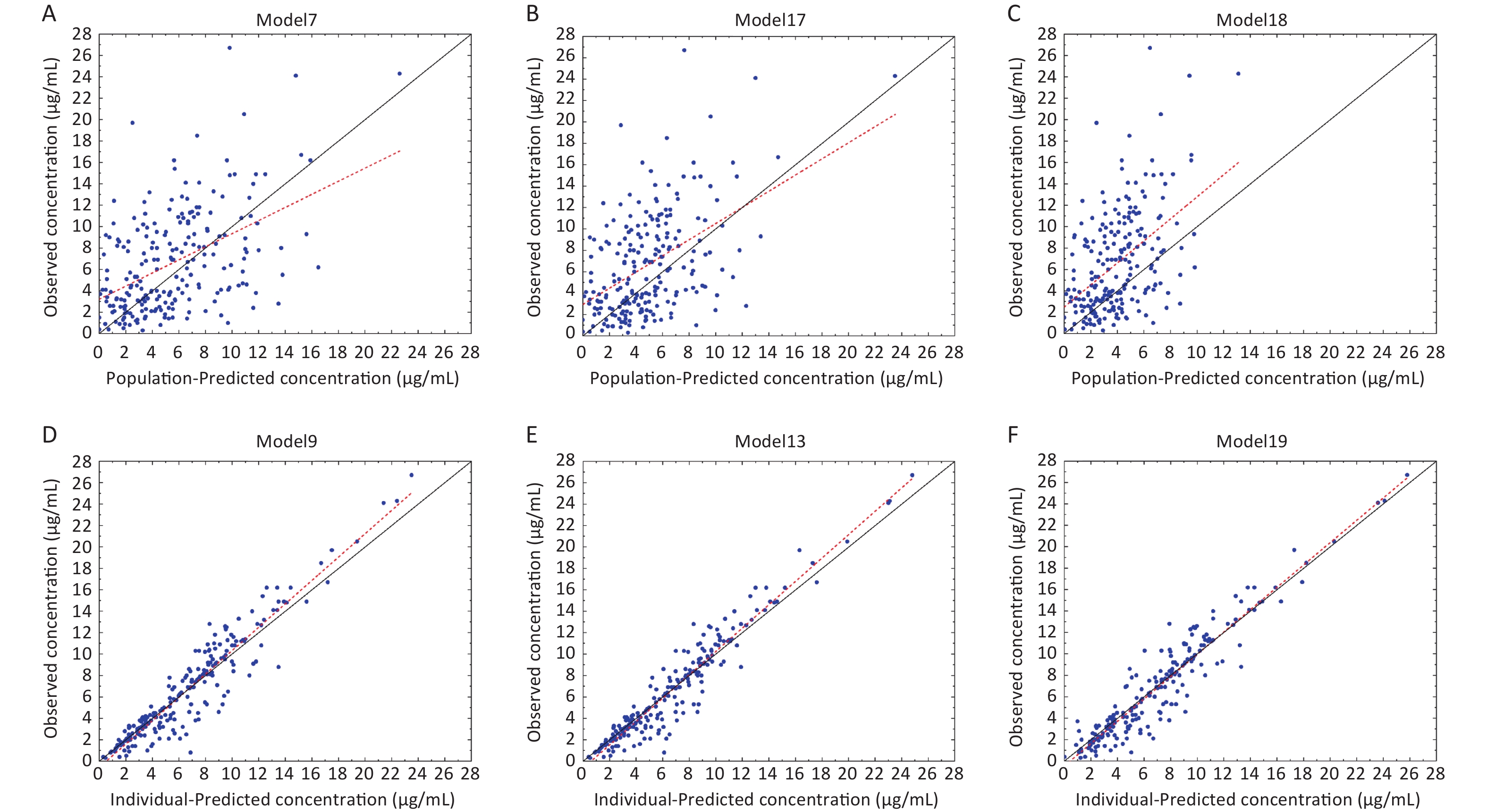
图 1
Fig.1 Goodness -of -fit graphs for some LZD PPK models A-C: DV-PRED scatter plot. D-F: DV-IPRED scatter plot. The solid black line is the line of identity (observed = predicted); the red dotted line is the trend line.

图 2
Fig.2 Boxplots of the prediction error with different models A: population prediction error boxplots. B: individual prediction error boxplots. The solid line in the box represents the median, the black dashed line and the pink dashed line represent the 0 and ±30 reference lines, respectively.
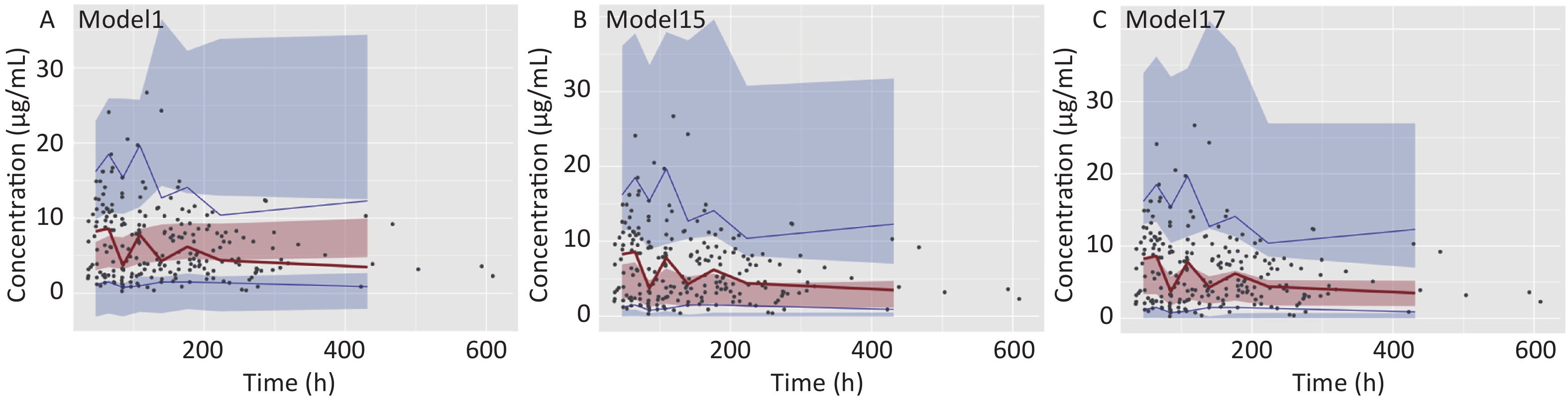
图 3
Fig.3 Visual predicted check result for some LZD PPK models Black solid dots represent observed concentrations, the top, middle and bottom three curves represent the 95th, 50th and 5th percentile of observed concentration, respectively, the three shaded areas represent 95% confidence intervals for the 95th, 50th and 5th percentiles of the simulated concentration, respectively.
| 1 | Clemett D, Markham A. Linezolid [J]. Drugs, 2000, 59(4): 815-27; discussion 28. |
| 2 |
邢贞建, 李祥, 江慧贤, 等. 应用蒙特卡洛模拟评价中国成人耐多药结核患者利奈唑胺给药方案[J]. 实用医学杂志, 2020, 36 (16): 2216- 2219.
doi: 10.3969/j.issn.1006-5725.2020.16.009 |
| 3 | Consensus on linezolid in the treatment of tuberculosis(2022 update)] [J]. Zhonghua Jie He He Hu Xi Za Zhi, 2022, 45(10): 988-995. |
| 4 |
Beringer P, Nguyen M, Hoem N, et al. Absolute bioavailability and pharmacokinetics of linezolid in hospitalized patients given enteral feedings[J]. Antimicrob Agents Chemother, 2005, 49 (9): 3676- 3681.
doi: 10.1128/AAC.49.9.3676-3681.2005 |
| 5 |
Welshman IR, Sisson TA, Jungbluth GL, et al. Linezolid absolute bioavailability and the effect of food on oral bioavailability[J]. Biopharm Drug Dispos, 2001, 22 (3): 91- 97.
doi: 10.1002/bdd.255 |
| 6 |
Lin B, Hu Y, Xu P, et al. Expert consensus statement on therapeutic drug monitoring and individualization of linezolid[J]. Front Public Health, 2022, 10, 967311.
doi: 10.3389/fpubh.2022.967311 |
| 7 |
Pea F, Viale P, Cojutti P, et al. Therapeutic drug monitoring may improve safety outcomes of long-term treatment with linezolid in adult patients[J]. J Antimicrob Chemother, 2012, 67 (8): 2034- 2042.
doi: 10.1093/jac/dks153 |
| 8 |
Sheiner LB, Rosenberg B, Marathe VV. Estimation of population characteristics of pharmacokinetic parameters from routine clinical data[J]. J Pharmacokinet Biopharm, 1977, 5 (5): 445- 79.
doi: 10.1007/BF01061728 |
| 9 | Andrassy KM. Comments on 'KDIGO 2012 clinical practice guideline for the evaluation and management of chronic kidney disease'[J]. Kidney Int, 2013, 84 (3): 622- 623. |
| 10 |
Cockcroft DW, Gault MH. Prediction of creatinine clearance from serum creatinine[J]. Nephron, 1976, 16 (1): 31- 41.
doi: 10.1159/000180580 |
| 11 |
Cai X, Li R, Sheng C, et al. Systematic external evaluation of published population pharmacokinetic models for tacrolimus in adult liver transplant recipients[J]. Eur J Pharm Sci, 2020, 145, 105237.
doi: 10.1016/j.ejps.2020.105237 |
| 12 |
Whitehouse T, Cepeda JA, Shulman R, et al. Pharmacokinetic studies of linezolid and teicoplanin in the critically ill[J]. J Antimicrob Chemother, 2005, 55 (3): 333- 340.
doi: 10.1093/jac/dki014 |
| 13 |
Plock N, Buerger C, Joukhadar C, et al. Does linezolid inhibit its own metabolism? Population pharmacokinetics as a tool to explain the observed nonlinearity in both healthyvolunteers and septic patients[J]. Drug Metab Dispos, 2007, 35 (10): 1816- 1823.
doi: 10.1124/dmd.106.013755 |
| 14 |
Abe S, Chiba K, Cirincione B, et al. Population pharmacokinetic analysis of linezolid in patients with infectious disease: application to lower body weight and elderly patients[J]. J Clin Pharmacol, 2009, 49 (9): 1071- 1078.
doi: 10.1177/0091270009337947 |
| 15 | 张雷. 利奈唑胺在中国人群的群体药代/药效动力学研究 [D]. 北京: 解放军医学院, 2011. |
| 16 |
Tsuji Y, Yukawa E, Hiraki Y, et al. Population pharmacokinetic analysis of linezolid in low body weight patients with renal dysfunction[J]. J Clin Pharmacol, 2013, 53 (9): 967- 973.
doi: 10.1002/jcph.133 |
| 17 |
Matsumoto K, Shigemi A, Takeshita A, et al. Analysis of thrombocytopenic effects and population pharmacokinetics of linezolid: a dosage strategy according to the trough concentration target and renal function in adult patients[J]. Int J Antimicrob Agents, 2014, 44 (3): 242- 247.
doi: 10.1016/j.ijantimicag.2014.05.010 |
| 18 |
Boak LM, Rayner CR, Grayson ML, et al. Clinical population pharmacokinetics and toxicodynamics of linezolid[J]. Antimicrob Agents Chemother, 2014, 58 (4): 2334- 2343.
doi: 10.1128/AAC.01885-13 |
| 19 |
Töpper C, Steinbach CL, Dorn C, et al. Variable linezolid exposure in intensive care unit patients-possible role of drug-drug interactions[J]. Ther Drug Monit, 2016, 38 (5): 573- 578.
doi: 10.1097/FTD.0000000000000324 |
| 20 |
Tsuji Y, Holford NHG, Kasai H, et al. Population pharmacokinetics and pharmacodynamics of linezolid-induced thrombocytopenia in hospitalized patients[J]. Br J Clin Pharmacol, 2017, 83 (8): 1758- 1772.
doi: 10.1111/bcp.13262 |
| 21 |
Ide T, Takesue Y, Ikawa K, et al. Population pharmacokinetics/ pharmacodynamics of linezolid in sepsis patients with and without continuous renal replacement therapy[J]. Int J Antimicrob Agents, 2018, 51 (5): 745- 751.
doi: 10.1016/j.ijantimicag.2018.01.021 |
| 22 |
Xie F, Mantzarlis K, Malliotakis P, et al. Pharmacokinetic evaluation of linezolid administered intravenously in obese patients with pneumonia[J]. J Antimicrob Chemother, 2019, 74 (3): 667- 674.
doi: 10.1093/jac/dky500 |
| 23 |
Dong H, Xie J, Wang T, et al. Pharmacokinetic/pharmacodynamic evaluation of linezolid for the treatment of staphylococcal infections in critically ill patients[J]. Int J Antimicrob Agents, 2016, 48 (3): 259- 264.
doi: 10.1016/j.ijantimicag.2016.05.009 |
| 24 |
Wang D, Zheng X, Yang Y, et al. Population pharmacokinetic analysis of linezolid in patients with different types of shock: Effect of platelet count[J]. Exp Ther Med, 2019, 18 (3): 1786- 1792.
doi: 10.3892/etm.2019.7747 |
| 25 |
Wang X, Wang Y, Yao F, et al. Pharmacokinetics of linezolid dose adjustment for creatinine clearance in critically Ill patients: a multicenter, prospective, open-label, observational study[J]. Drug Des Devel Ther, 2021, 15, 2129- 2141.
doi: 10.2147/DDDT.S303497 |
| 26 |
Fang J, Zhang XS, Zhang CH, et al. Model based identification of linezolid exposure-toxicity thresholds in hospitalized patients[J]. Front Pharmacol, 2021, 12, 732503.
doi: 10.3389/fphar.2021.732503 |
| 27 |
Wicha SG, Mair A, Chiriac U, et al. Population pharmacokinetics and toxicodynamics of continuously infused linezolid in critically ill patients[J]. Int J Antimicrob Agents, 2022, 59 (5): 106572.
doi: 10.1016/j.ijantimicag.2022.106572 |
| 28 |
Wu F, Zhang XS, Dai Y, et al. Dosage strategy of linezolid according to the trough concentration target and renal function in Chinese critically Ill patients[J]. Front Pharmacol, 2022, 13, 844567.
doi: 10.3389/fphar.2022.844567 |
| 29 |
Bock M, VAN Hasselt JGC, Schwartz F, et al. Rifampicin reduces plasma concentration of linezolid in patients with infective endocarditis[J]. J Antimicrob Chemother, 2023, 78 (12): 2840- 2848.
doi: 10.1093/jac/dkad316 |
| 30 |
Liu Q, Li S, Xie F. Linezolid dosing in critically ill patients undergoing various modalities of renal replacement therapy: a pooled population pharmacokinetic analysis[J]. Int J Antimicrob Agents, 2023, 62 (4): 106949.
doi: 10.1016/j.ijantimicag.2023.106949 |
| 31 |
Bock M, Theut AM, Van Hasselt JGC, et al. Attainment of target antibiotic levels by oral treatment of left-sided infective endocarditis: a POET substudy[J]. Clin Infect Dis, 2023, 77 (2): 242- 251.
doi: 10.1093/cid/ciad168 |
| 32 |
Li Y, Fang Q, Wu Z, et al. Population pharmacokinetics and dosage optimization of linezolid in Chinese older patients[J]. Eur J Clin Pharmacol, 2024, 80 (9): 1295- 1304.
doi: 10.1007/s00228-024-03702-9 |
| 33 |
Xu J, Chen X, Zhang Q, et al. Population pharmacokinetic/pharmacodynamic study of linezolid in hospital-acquired pneumonia patients with renal insufficiency[J]. Drug Des Devel Ther, 2024, 18, 5073- 5086.
doi: 10.2147/DDDT.S474470 |
| 34 |
Milaković D, Kovačević T, Kovačević P, et al. Population pharmacokinetic model of linezolid and probability of target attainment in patients with COVID-19-associated acute respiratory distress syndrome on veno-venous extracorporeal membrane oxygenation-a step toward correct dosing[J]. Pharmaceutics, 2024, 16 (2): 418.
doi: 10.3390/pharmaceutics16020253 |
| 35 | Maha A, Ali M, Bilal H, et al. Population pharmacokinetics of linezolid among post-operative patients: Implications for dosing strategies[J]. Pak J Pharm Sci, 2025, 38 (1): 291- 298. |
| 36 |
Qin Y, Jiao Z, Ye YR, et al. External evaluation of the predictive performance of published population pharmacokinetic models of linezolid in adult patients[J]. J Glob Antimicrob Resist, 2023, 35, 347- 353.
doi: 10.1016/j.jgar.2023.08.003 |
| 37 |
Brier ME, Stalker DJ, Aronoff GR, et al. Pharmacokinetics of linezolid in subjects with renal dysfunction[J]. Antimicrob Agents Chemother, 2003, 47 (9): 2775- 2780.
doi: 10.1128/AAC.47.9.2775-2780.2003 |
| 38 |
林忠, 谢群莉, 戴淑萍, 等. 中国成年患者利奈唑胺治疗群体药动学研究[J]. 中国临床药理学与治疗学, 2020, 25 (9): 992- 999.
doi: 10.12092/j.issn.1009-2501.2020.09.005 |
| 39 |
Gandelman K, Zhu T, Fahmi OA, et al. Unexpected effect of rifampin on the pharmacokinetics of linezolid: in silico and in vitro approaches to explain its mechanism[J]. J Clin Pharmacol, 2011, 51 (2): 229- 236.
doi: 10.1177/0091270010366445 |
| 40 |
Hashimoto S, Honda K, Fujita K, et al. Effect of coadministration of rifampicin on the pharmacokinetics of linezolid: clinical and animal studies[J]. J Pharm Health Care Sci, 2018, 4, 27.
doi: 10.1186/s40780-018-0123-1 |
| 41 | Heffernan AJ, Mohd Sazlly Lim S, Lipman J, et al. A personalised approach to antibiotic pharmacokinetics and pharmacodynamics in critically ill patients[J]. Anaesth Crit Care Pain Med, 2021, 40 (6): 100970. |
| 42 |
Mahmood I, Pettinato M. Impact of intrinsic and extrinsic factors on the pharmacokinetics of peptides: when is the assessment of certain factors warranted?[J]. Antibodies (Basel), 2021, 11 (1): 2.
doi: 10.3390/antib11010002 |
| 43 |
肖莹, 张弋, 李淑娟, 等. 利奈唑胺在重症感染患者中的药动学[J]. 中国医院药学杂志, 2016, 36 (7): 535- 539.
doi: 10.13286/j.cnki.chinhosppharmacyj.2016.07.04 |
| 44 |
Figuera-Figuera A, Navarro J, Sabaté S, et al. SeDeM as a tool to validate drug substance manufacturing processes and assess scalability and suitability for direct compression: supplier screening[J]. Pharmaceutics, 2023, 15 (8): 2034.
doi: 10.3390/pharmaceutics15082034 |
| 45 |
Alihodzic D, Broeker A, Baehr M, et al. Impact of inaccurate documentation of sampling and infusion time in model-informed precision dosing[J]. Front Pharmacol, 2020, 11, 172.
doi: 10.3389/fphar.2020.00172 |
| 46 |
Zhao W, Kaguelidou F, Biran V, et al. External evaluation of population pharmacokinetic models of vancomycin in neonates: the transferability of published models to different clinical settings[J]. Br J Clin Pharmacol, 2013, 75 (4): 1068- 1080.
doi: 10.1111/j.1365-2125.2012.04406.x |
| [1] | 杨建鑫, 俞蕴莉. 阿达木单抗治疗中重度银屑病的PK/PD特征与治疗药物监测应用[J]. 中国临床药理学与治疗学, 2026, 31(7): 921-927. |
| [2] | 陈冰, 左笑丛, 李新刚, 尚德为, 周佩军, 丁俊杰, 相小强, 邱晓燕, 王卓, 李晓宇, 张弋, 赵维, 王玉珠, 高建军, 焦正. 模型引导的抗排异治疗患者他克莫司精准用药专家共识[J]. 中国临床药理学与治疗学, 2025, 30(4): 433-445. |
| [3] | 王学彬, 高丽红, 张凌鹏, 杨云云, 刘红霞, 王卓, 孙华君. 他克莫司治疗药物监测异常结果干预及评价研究[J]. 中国临床药理学与治疗学, 2024, 29(12): 1322-1328. |
| [4] | 袁世轩, 吕子彦, 杨勇, 陈璐, 张丽娟. 模型引导下的万古霉素血药浓度监测临床研究[J]. 中国临床药理学与治疗学, 2024, 29(12): 1344-1352. |
| [5] | 戴友爱, 朱扣柱, 王燕, 卢周, 丁肖梁, 王磊. 酶联免疫法检测司库奇尤单抗血药浓度及在银屑病患者中的应用[J]. 中国临床药理学与治疗学, 2024, 29(11): 1267-1271. |
| [6] | 肖雷, 曹灿, 刘加涛. 地高辛血药浓度和不良反应影响因素分析[J]. 中国临床药理学与治疗学, 2024, 29(11): 1280-1287. |
| [7] | 韦汝华, 曹雯, 陆雅婷, 蒙明薇, 李菊满, 秦艳娥, 蓝晓步, 莫凯. 中枢性神经系统感染患者美罗培南血药浓度达标情况及影响因素分析[J]. 中国临床药理学与治疗学, 2024, 29(10): 1146-1151. |
| [8] | 吴莉莉, 梁 至, 黄思咏, 王 妍. 肾功能亢进对感染性心内膜炎患者万古霉素药动学的影响及有效性与安全性研究[J]. 中国临床药理学与治疗学, 2023, 28(10): 1139-1145. |
| [9] | 林良沫, 符祥俊, 钟莉莉, 王和芳, 吴琼诗, 肖坚. 中性粒细胞缺乏患者万古霉素群体药代动力学模型的建立[J]. 中国临床药理学与治疗学, 2021, 26(9): 1014-1022. |
| [10] | 彭敏, 黄攀豪, 邓银华, 刘文, 李威, 于珍, 夏青, 谢悦良. 造血干细胞移植患者伏立康唑稳态谷浓度监测及其影响因素分析[J]. 中国临床药理学与治疗学, 2021, 26(6): 640-646. |
| [11] | 王晖, 徐晓芳, 李荣. 治疗药物监测在环孢素A个体化给药中的应用及研究进展[J]. 中国临床药理学与治疗学, 2021, 26(6): 707-713. |
| [12] | 章思亮, 胡琳璘, 邵华, 陈西敬. 性别差异对精神药物作用影响的研究进展[J]. 中国临床药理学与治疗学, 2021, 26(3): 324-331. |
| [13] | 林忠, 谢群莉, 戴淑萍, 陈静, 林菲阳, 朱燕舞, 余国亮, 张远怀, 崔可. 中国成年患者利奈唑胺治疗群体药动学研究[J]. 中国临床药理学与治疗学, 2020, 25(9): 992-999. |
| [14] | 张露, 林良沫, 刘可可, 黄娅敏, 黄行行, 杨永榆, 肖坚. 新型冠状病毒肺炎抗病毒药物的治疗药物监测及药代动力学研究进展[J]. 中国临床药理学与治疗学, 2020, 25(5): 566-575. |
| [15] | 张乃菊, 陈天平, 黄睿, 陈重, 张帆, 孔令提, 夏娟, 刘金春. 利奈唑胺致乳酸酸中毒研究进展[J]. 中国临床药理学与治疗学, 2020, 25(12): 1408-1413. |
| 阅读次数 | ||||||
|
全文 |
|
|||||
|
摘要 |
|
|||||