中国临床药理学与治疗学 ›› 2026, Vol. 31 ›› Issue (9): 1256-1264.doi: 10.12092/j.issn.1009-2501.2026.09.012
• 综述与讲座 • 上一篇
金伊楠1,2( ), 李文静1,2, 边丽华1,2, 郭建友1,2,*()
收稿日期:2025-09-16
修回日期:2025-12-22
出版日期:2026-09-26
发布日期:2026-10-08
通讯作者:
郭建友
E-mail:jinyinan@psych.ac.cn;guojy@psych.ac.cn
作者简介:金伊楠,女,硕士研究生,研究方向:心理病理与创伤后应激障碍。E-mail:基金资助:
Yinan JIN1,2(), Wenjing LI1,2, Lihua BIAN1,2, Jianyou GUO1,2,*()
Received:2025-09-16
Revised:2025-12-22
Online:2026-09-26
Published:2026-10-08
Contact:
Jianyou GUO
E-mail:jinyinan@psych.ac.cn;guojy@psych.ac.cn
摘要:
阿尔茨海默病(Alzheimer's disease,AD)是一种进行性神经退行性疾病,其发病机制复杂,且目前治疗手段有限,亟需新的干预靶点。缩醛磷脂(plasmalogen)作为一种天然甘油磷脂,广泛存在于细胞膜(如髓鞘)和某些食物(如海鲜)中,其不仅具有显著的抗炎与抗氧化活性,还被证实参与记忆改善。越来越多的证据表明,缩醛磷脂的减少与AD的发生与发展密切相关。缩醛磷脂能够靶向多种关键机制干预AD的病理过程,包括清除β-淀粉样蛋白(β-amyloid,Aβ)沉积、抑制细胞凋亡、促进神经发生和减少小胶质细胞的过度激活,从而发挥神经保护作用。因此补充缩醛磷脂有望成为一种防治AD的新策略。本文旨在总结并探讨缩醛磷脂在AD发病机制与治疗干预中的最新研究进展,以期为AD进一步研究和治疗提供新的方向。
中图分类号:
金伊楠, 李文静, 边丽华, 郭建友. 缩醛磷脂在阿尔茨海默病中的研究进展[J]. 中国临床药理学与治疗学, 2026, 31(9): 1256-1264.
Yinan JIN, Wenjing LI, Lihua BIAN, Jianyou GUO. Research progress of plasmalogen in Alzheimer's disease[J]. Chinese Journal of Clinical Pharmacology and Therapeutics, 2026, 31(9): 1256-1264.
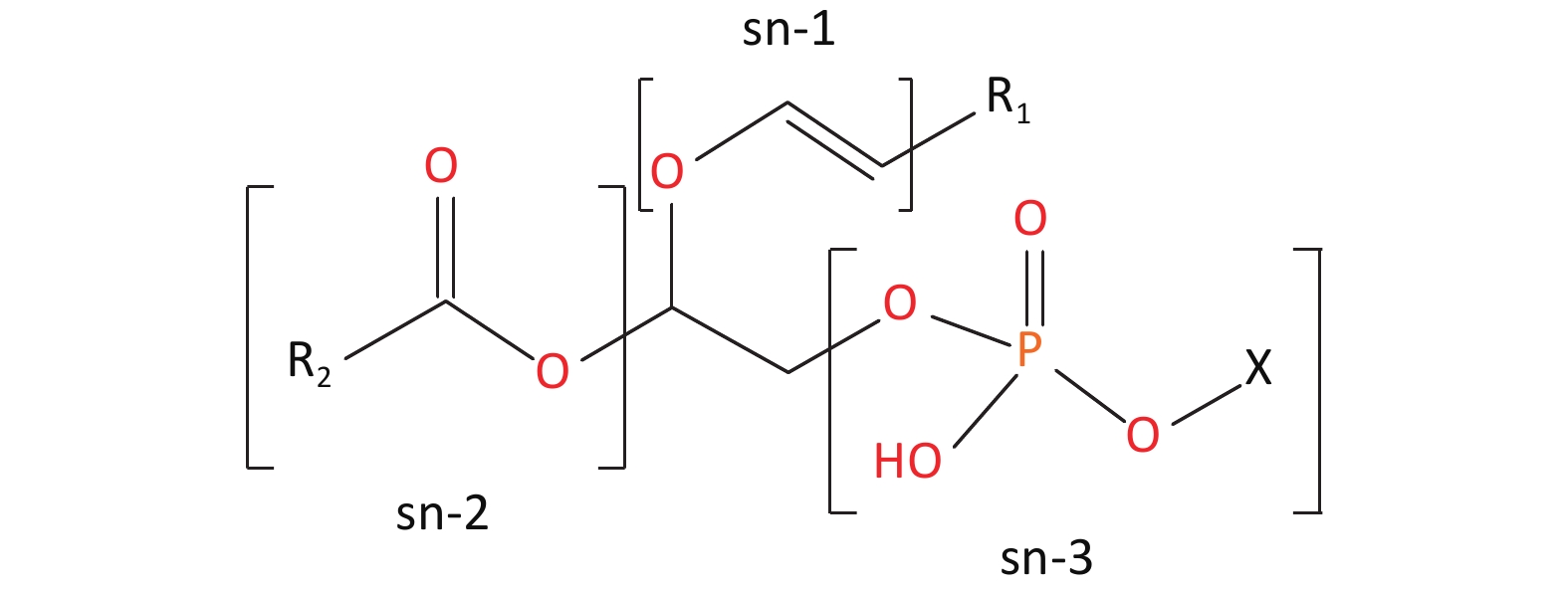
图 1 缩醛磷脂结构式 缩醛磷脂是一类在sn-1位含有特征性乙烯醚键(-O-CH=CH-)的甘油磷脂。sn-2位通常酯化多不饱和脂肪酸(如二十二碳六烯酸,DHA),sn-3位通过磷酸基团(X)连接极性头基,如乙醇胺或胆碱,分别形成缩醛磷脂酰乙醇胺(Pls-Etn)或缩醛磷脂酰胆碱(Pls-Cho)。R1代表sn-1位的烷基链(如棕榈酰基或硬脂酰基)。
Fig.1 Chemical structure of plasmalogens
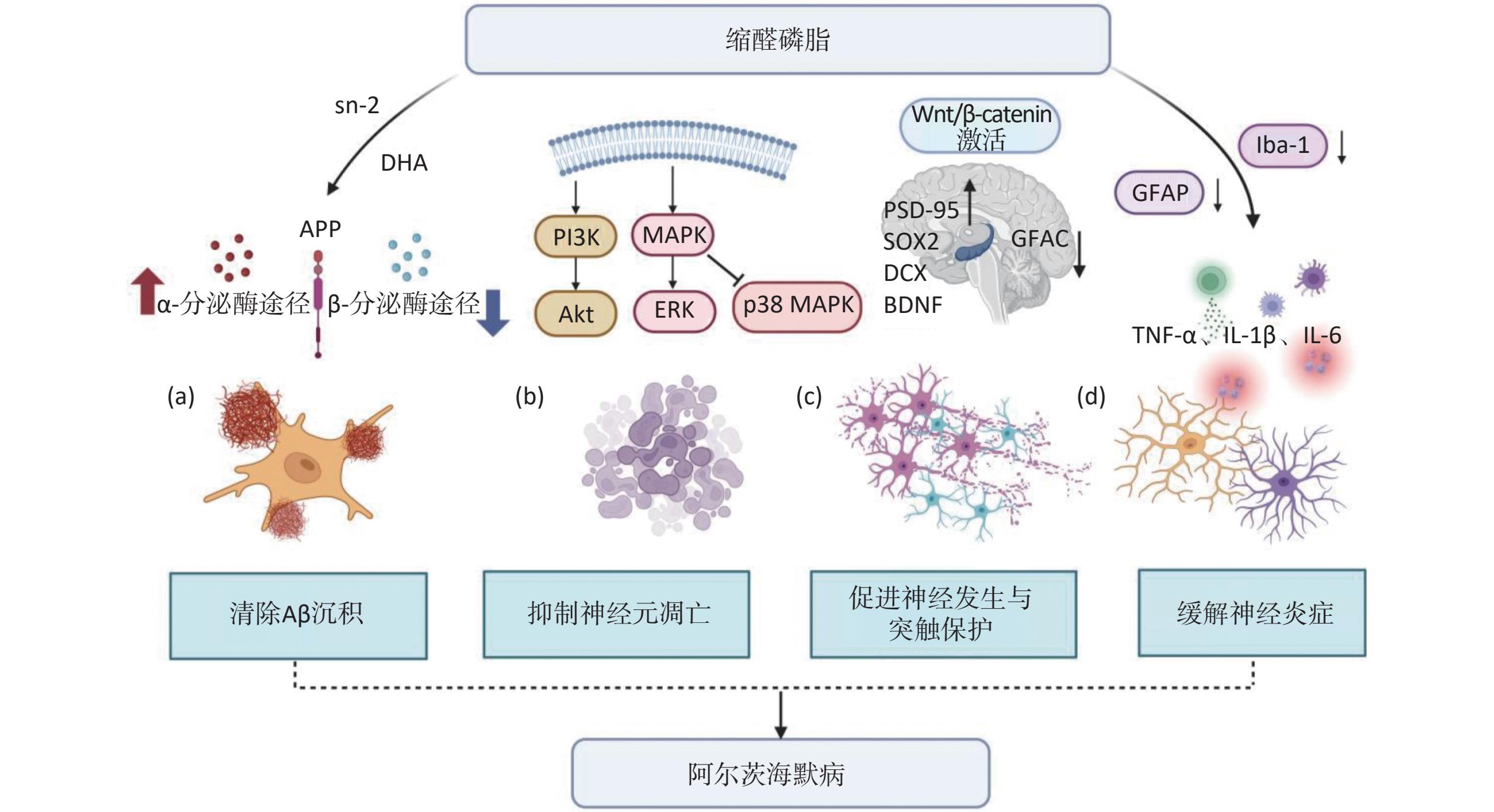
图 2 缩醛磷脂在阿尔茨海默病中的主要作用机制 图2展示了缩醛磷脂通过多条通路干预阿尔茨海默病的核心病理机制。(a) 清除Aβ沉积:通过调节α/β-分泌酶活性减少Aβ生成,并直接解聚Aβ纤维;(b) 抑制神经元凋亡:激活PI3K/Akt和ERK生存信号,抑制线粒体凋亡途径及p38 MAPK/p75NTR等死亡信号;(c) 促进神经发生与突触保护:通过Wnt/β-catenin通路促进海马神经干细胞分化为神经元,并上调BDNF表达增强突触可塑性;(d)缓解神经炎症:抑制小胶质细胞/星形胶质细胞的过度活化,下调GFAP、Iba-1等炎性信号分子。
Fig.2 Major mechanisms of plasmalogens in Alzheimer's disease
| 1 | Scheltens P, De Strooper B, Kivipelto M, et al. Alzheimer's disease[J]. Lancet, 2021, 397 (10284): 1577- 1590. |
| 2 |
Hetz C, Martinon F, Rodriguez D, et al. The unfolded protein response: integrating stress signals through the stress sensor IRE1α[J]. Physiol Rev, 2011, 91 (4): 1219- 1243.
doi: 10.1152/physrev.00001.2011 |
| 3 |
Swerdlow RH, Burns JM, Khan SM. The Alzheimer's disease mitochondrial cascade hypothesis: progress and perspectives[J]. Biochim Biophys Acta, 2014, 1842 (8): 1219- 1231.
doi: 10.1016/j.bbadis.2013.09.010 |
| 4 |
Hashimoto S, Saido TC. Critical review: involvement of endoplasmic reticulum stress in the aetiology of Alzheimer's disease[J]. Open Biol, 2018, 8 (4): 180024.
doi: 10.1098/rsob.180024 |
| 5 |
Huang Z, Jordan JD, Zhang Q. Myelin pathology in Alzheimer's disease: potential therapeutic opportunities[J]. Aging Dis, 2024, 15 (2): 698- 713.
doi: 10.14336/AD.2023.0628 |
| 6 | 2023 Alzheimer's disease facts and figures [J]. Alzheimers Dement, 2023, 19(4): 1598-1695. |
| 7 |
Yin F. Lipid metabolism and Alzheimer's disease: clinical evidence, mechanistic link and therapeutic promise[J]. FEBS J, 2023, 290 (6): 1420- 1453.
doi: 10.1111/febs.16344 |
| 8 |
Honsho M, Yagita Y, Kinoshita N, et al. Isolation and characterization of mutant animal cell line defective in alkyl-dihydroxyacetonephosphate synthase: localization and transport of plasmalogens to post-Golgi compartments[J]. Biochim Biophys Acta, 2008, 1783 (10): 1857- 1865.
doi: 10.1016/j.bbamcr.2008.05.018 |
| 9 |
Nagan N, Zoeller RA. Plasmalogens: biosynthesis and functions[J]. Prog Lipid Res, 2001, 40 (3): 199- 229.
doi: 10.1016/S0163-7827(01)00003-0 |
| 10 |
Braverman NE, Moser AB. Functions of plasmalogen lipids in health and disease[J]. Biochim Biophys Acta, 2012, 1822 (9): 1442- 1452.
doi: 10.1016/j.bbadis.2012.05.008 |
| 11 |
Rog T, Koivuniemi A. The biophysical properties of ethanolamine plasmalogens revealed by atomistic molecular dynamics simulations[J]. Biochim Biophys Acta, 2016, 1858 (1): 97- 103.
doi: 10.1016/j.bbamem.2015.10.023 |
| 12 |
Dorninger F, König T, Scholze P, et al. Disturbed neurotransmitter homeostasis in ether lipid deficiency[J]. Hum Mol Genet, 2019, 28 (12): 2046- 2061.
doi: 10.1093/hmg/ddz040 |
| 13 |
Leßig J, Fuchs B. Plasmalogens in biological systems: their role in oxidative processes in biological membranes, their contribution to pathological processes and aging and plasmalogen analysis[J]. Curr Med Chem, 2009, 16 (16): 2021- 2041.
doi: 10.2174/092986709788682164 |
| 14 |
Sambra V, Echeverria F, Valenzuela A, et al. Docosahexaenoic and arachidonic acids as neuroprotective nutrients throughout the life cycle[J]. Nutrients, 2021, 13 (3): 986.
doi: 10.3390/nu13030986 |
| 15 |
Chen C, Liao J, Xia Y, et al. Gut microbiota regulate Alzheimer's disease pathologies and cognitive disorders via PUFA-associated neuroinflammation[J]. Gut, 2022, 71 (11): 2233- 2252.
doi: 10.1136/gutjnl-2021-326269 |
| 16 | Liu ZG, Hualin W, Limei W, et al. Advances in research on neuron-protective role of polyunsaturated fatty acids[J]. Food Sci, 2016, 37 (7): 239. |
| 17 |
Jan AT, Azam M, Rahman S, et al. Perspective insights into disease progression, diagnostics, and therapeutic approaches in Alzheimer's disease: a judicious update[J]. Front Aging Neurosci, 2017, 9, 356.
doi: 10.3389/fnagi.2017.00356 |
| 18 |
Breijyeh Z, Karaman R. Comprehensive review on Alzheimer's disease: causes and treatment[J]. Molecules, 2020, 25 (24): 5789.
doi: 10.3390/molecules25245789 |
| 19 |
Cras P, Kawai M, Lowery D, et al. Senile plaque neurites in Alzheimer disease accumulate amyloid precursor protein[J]. Proc Natl Acad Sci U S A, 1991, 88 (17): 7552- 7556.
doi: 10.1073/pnas.88.17.7552 |
| 20 | Armstrong RA. The molecular biology of senile plaques and neurofibrillary tangles in Alzheimer's disease[J]. Folia Neuropathol, 2009, 47 (4): 289- 299. |
| 21 |
Chen GF, Xu TH, Yan Y, et al. Amyloid beta: structure, biology and structure-based therapeutic development[J]. Acta Pharmacol Sin, 2017, 38 (9): 1205- 1235.
doi: 10.1038/aps.2017.28 |
| 22 |
Tabaton M, Piccini A. Role of water-soluble amyloid-beta in the pathogenesis of Alzheimer's disease[J]. Int J Exp Pathol, 2005, 86 (3): 139- 145.
doi: 10.1111/j.0959-9673.2005.00428.x |
| 23 |
Metaxas A, Kempf SJ. Neurofibrillary tangles in Alzheimer's disease: elucidation of the molecular mechanism by immunohistochemistry and tau protein phospho-proteomics[J]. Neural Regen Res, 2016, 11 (10): 1579- 1581.
doi: 10.4103/1673-5374.193234 |
| 24 |
Trejo-Lopez JA, Yachnis AT, Prokop S. Neuropathology of Alzheimer's disease[J]. Neurotherapeutics, 2022, 19 (1): 173- 185.
doi: 10.1007/s13311-021-01146-y |
| 25 |
Overk CR, Masliah E. Pathogenesis of synaptic degeneration in Alzheimer's disease and Lewy body disease[J]. Biochem Pharmacol, 2014, 88 (4): 508- 516.
doi: 10.1016/j.bcp.2014.01.015 |
| 26 | Koch G, Spampinato D. Alzheimer disease and neuroplasticity[J]. Handb Clin Neurol, 2022, 184, 473- 479. |
| 27 |
Rajendran K, Krishnan UM. Biomarkers in Alzheimer's disease[J]. Clin Chim Acta, 2024, 562, 119857.
doi: 10.1016/j.cca.2024.119857 |
| 28 | 王刚, 齐金蕾, 刘馨雅, 等. 中国阿尔茨海默病报告2024[J]. 诊断学理论与实践, 2024, 23 (3): 219- 256. |
| 29 |
Ginsberg L, Rafique S, Xuereb JH, et al. Disease and anatomic specificity of ethanolamine plasmalogen deficiency in Alzheimer's disease brain[J]. Brain Res, 1995, 698 (1-2): 223- 226.
doi: 10.1016/0006-8993(95)00931-F |
| 30 |
Han X, Holtzman DM, McKeel DW. Plasmalogen deficiency in early Alzheimer's disease subjects and in animal models: molecular characterization using electrospray ionization mass spectrometry[J]. J Neurochem, 2001, 77 (4): 1168- 1180.
doi: 10.1046/j.1471-4159.2001.00332.x |
| 31 |
Goodenowe DB, Cook LL, Liu J, et al. Peripheral ethanolamine plasmalogen deficiency: a logical causative factor in Alzheimer's disease and dementia[J]. J Lipid Res, 2007, 48 (11): 2485- 2498.
doi: 10.1194/jlr.P700023-JLR200 |
| 32 |
Yamashita S, Kiko T, Fujiwara H, et al. Alterations in the levels of amyloid-β, phospholipid hydroperoxide, and plasmalogen in the blood of patients with Alzheimer's disease: Possible interactions between amyloid-β and these lipids[J]. J Alzheimers Dis, 2016, 50 (2): 527- 537.
doi: 10.3233/JAD-150640 |
| 33 |
Wood PL, Barnette BL, Kaye JA, et al. Non-targeted lipidomics of CSF and frontal cortex grey and white matter in control, mild cognitive impairment, and Alzheimer's disease subjects[J]. Acta Neuropsychiatr, 2015, 27 (5): 270- 278.
doi: 10.1017/neu.2015.18 |
| 34 |
Azad AK, Sheikh AM, Haque MA, et al. Time-dependent analysis of plasmalogens in the hippocampus of an Alzheimer's disease mouse model: a role of ethanolamine plasmalogen[J]. Brain Sci, 2021, 11 (12): 1603.
doi: 10.3390/brainsci11121603 |
| 35 |
Dorninger F, Gundacker A, Zeitler G, et al. Ether lipid deficiency in mice produces a complex behavioral phenotype mimicking aspects of human psychiatric disorders[J]. Int J Mol Sci, 2019, 20 (16): 3929.
doi: 10.3390/ijms20163929 |
| 36 |
Hossain MS, Mawatari S, Fujino T. Plasmalogens, the vinyl ether-linked glycerophospholipids, enhance learning and memory by regulating brain-derived neurotrophic factor[J]. Front Cell Dev Biol, 2022, 10, 828282.
doi: 10.3389/fcell.2022.828282 |
| 37 |
Lee BY, Attwood SJ, Turnbull S, et al. Effect of varying concentrations of docosahexaenoic acid on amyloid beta (1-42) aggregation: an atomic force microscopy study[J]. Molecules, 2018, 23 (12): 3089.
doi: 10.3390/molecules23123089 |
| 38 |
Grimm MOW, Kuchenbecker J, Rothhaar TL, et al. Plasmalogen synthesis is regulated via alkyl-dihydroxyacetonephosphate-synthase by amyloid precursor protein processing and is affected in Alzheimer's disease[J]. J Neurochem, 2011, 116 (5): 916- 925.
doi: 10.1111/j.1471-4159.2010.07070.x |
| 39 |
Rothhaar TL, Grösgen S, Haupenthal VJ, et al. Plasmalogens inhibit APP processing by directly affecting γ-secretase activity in Alzheimer's disease[J]. ScientificWorldJournal, 2012, 2012, 141240.
doi: 10.1100/2012/141240 |
| 40 |
Kou J, Kovacs GG, Höftberger R, et al. Peroxisomal alterations in Alzheimer's disease[J]. Acta Neuropathol, 2011, 122 (3): 271- 283.
doi: 10.1007/s00401-011-0836-9 |
| 41 |
Katafuchi T, Ifuku M, Mawatari S, et al. Effects of plasmalogens on systemic lipopolysaccharide-induced glial activation and β-amyloid accumulation in adult mice[J]. Ann N Y Acad Sci, 2012, 1262, 85- 92.
doi: 10.1111/j.1749-6632.2012.06641.x |
| 42 |
Hossain MS, Tajima A, Kotoura S, et al. Oral ingestion of plasmalogens can attenuate the LPS-induced memory loss and microglial activation[J]. Biochem Biophys Res Commun, 2018, 496 (4): 1033- 1039.
doi: 10.1016/j.bbrc.2018.01.078 |
| 43 |
Li R, Xiong W, Li B, et al. Plasmalogen improves memory function by regulating neurogenesis in a mouse model of Alzheimer's diseases[J]. Int J Mol Sci, 2023, 24 (15): 12234.
doi: 10.3390/ijms241512234 |
| 44 |
Hossain MS, Ifuku M, Take S, et al. Plasmalogens rescue neuronal cell death through an activation of AKT and ERK survival signaling[J]. PLoS One, 2013, 8 (12): e83508.
doi: 10.1371/journal.pone.0083508 |
| 45 |
Che H, Li Q, Zhang T, et al. A comparative study of EPA-enriched ethanolamine plasmalogen and EPA-enriched phosphatidylethanolamine on Aβ42 induced cognitive deficiency in a rat model of Alzheimer's disease[J]. Food Funct, 2018, 9 (5): 3008- 3017.
doi: 10.1039/C8FO00643A |
| 46 |
Abdou HM, Hamaad FA, Elmageed GMA, et al. Efficacy of plasmalogens on monosodium glutamate-induced neurotoxicity in male rats through NF-κB and p38 MAPK signaling pathways[J]. Oxid Med Cell Longev, 2025, 2025, 3673280.
doi: 10.1155/omcl/3673280 |
| 47 |
Liu Y, Cong P, Zhang T, et al. Plasmalogen attenuates the development of hepatic steatosis and cognitive deficit through mechanism involving p75NTR inhibition[J]. Redox Biol, 2021, 43, 102002.
doi: 10.1016/j.redox.2021.102002 |
| 48 |
Yu J, Su J, Zhang Y, et al. Mitigating effects of plasmalogens on age-related cognitive impairment[J]. J Funct Foods, 2025, 128, 106790.
doi: 10.1016/j.jff.2025.106790 |
| 49 | Bestard Escalas J. Role of membrane lipids in colon differentiation unravelled by mass spectrometry imaging: Arachidonic acid beyond inflammation [D]. Palma: Universitat de les Illes Balears, 2019. |
| 50 |
Amemori T, Jendelova P, Ruzicka J, et al. Alzheimer's disease: mechanism and approach to cell therapy[J]. Int J Mol Sci, 2015, 16 (11): 26417- 26451.
doi: 10.3390/ijms161125961 |
| 51 |
Shirokov A, Zlatogosrkaya D, Adushkina V, et al. Plasmalogens improve lymphatic clearance of amyloid beta from mouse brain and cognitive functions[J]. Int J Mol Sci, 2024, 25 (23): 12552.
doi: 10.3390/ijms252312552 |
| 52 |
Takekoshi H, Fujishima M, Miyazawa T, et al. Simultaneous intake of chlorella and ascidian ethanolamine plasmalogen accelerates activation of BDNF-TrkB-CREB signaling in rats[J]. Molecules, 2024, 29 (2): 357.
doi: 10.3390/molecules29020357 |
| 53 |
Ifuku M, Katafuchi T, Mawatari S, et al. Anti-inflammatory/anti-amyloidogenic effects of plasmalogens in lipopolysaccharide-induced neuroinflammation in adult mice[J]. J Neuroinflammation, 2012, 9, 197.
doi: 10.1186/1742-2094-9-197 |
| 54 |
Hossain MS, Abe Y, Ali F, et al. Reduction of ether-type glycerophospholipids, plasmalogens, by NF-κB signal leading to microglial activation[J]. J Neurosci, 2017, 37 (15): 4074- 4092.
doi: 10.1523/JNEUROSCI.3941-15.2017 |
| 55 |
Tremblay MÈ, Almsherqi ZA, Deng Y. Plasmalogens and platelet-activating factor roles in chronic inflammatory diseases[J]. Biofactors, 2022, 48 (6): 1203- 1216.
doi: 10.1002/biof.1916 |
| 56 |
Yamagiwa N, Kobayashi H, Okabayashi H, et al. Phosphatidylcholine-plasmalogen-oleic acid has protective effects against arachidonic acid-induced cytotoxicity[J]. Biol Pharm Bull, 2022, 45 (5): 643- 648.
doi: 10.1248/bpb.b22-00035 |
| 57 |
Gu J, Chen L, Sun R, et al. Plasmalogens eliminate aging-associated synaptic defects and microglia-mediated neuroinflammation in mice[J]. Front Mol Biosci, 2022, 9, 815320.
doi: 10.3389/fmolb.2022.815320 |
| 58 |
Fujino T, Hossain MS, Mawatari S. Therapeutic efficacy of plasmalogens for Alzheimer's disease, mild cognitive impairment, and Parkinson’s disease in conjunction with a new hypothesis for the etiology of Alzheimer's disease[J]. Adv Exp Med Biol, 2020, 1299, 195- 212.
doi: 10.1007/978-3-030-60204-8_14 |
| 59 |
Hossain MS, Mineno K, Katafuchi T. Neuronal orphan G-protein coupled receptor proteins mediate plasmalogens-induced activation of ERK and Akt signaling[J]. PLoS One, 2016, 11 (3): e0150846.
doi: 10.1371/journal.pone.0150846 |
| 60 |
Fujino M, Fukuda J, Isogai H, et al. Orally administered plasmalogens alleviate negative mood states and enhance mental concentration: a randomized, double-blind, placebo-controlled trial[J]. Front Cell Dev Biol, 2022, 10, 894734.
doi: 10.3389/fcell.2022.894734 |
| 61 |
Smith T, Knudsen KJ, Ritchie SA. A novel inducible animal model for studying chronic plasmalogen deficiency associated with Alzheimer's disease[J]. Brain Res, 2024, 1843, 149132.
doi: 10.1016/j.brainres.2024.149132 |
| 62 |
Hossain MS, Mawatari S, Honsho M, et al. KIT-13, a novel plasmalogen derivative, attenuates neuroinflammation and amplifies cognition[J]. Front Cell Dev Biol, 2024, 12, 1443536.
doi: 10.3389/fcell.2024.1443536 |
| 63 |
Fujino T, Yamada T, Asada T, et al. Efficacy and blood plasmalogen changes by oral administration of plasmalogen in patients with mild Alzheimer's disease and mild cognitive impairment: a multicenter, randomized, double-blind, placebo-controlled trial[J]. EBioMedicine, 2017, 17, 199- 205.
doi: 10.1016/j.ebiom.2017.02.012 |
| 64 | Meletis CD. Alkyl-acylglycerols and the important clinical ramifications of raising plasmalogens in dementia and Alzheimer's disease[J]. Integr Med (Encinitas), 2020, 19 (3): 12- 16. |
| 65 | Ouma S, Tsuboi Y, Mawatari S, et al. Effectiveness of blood plasmalogen in differentiation among mild cognitive impairment, mild Alzheimer's disease and normal elderly[J]. J Neurol Sci, 2017, 381, 770. |
| 66 |
Bergstrom S, Blomstrand R. The intestinal absorption and metabolism of chimyl alcohol in the rat[J]. Acta Physiol Scand, 1956, 38 (2): 166- 172.
doi: 10.1111/j.1748-1716.1957.tb01380.x |
| 67 |
Brites P, Ferreira AS, da Silva TF, et al. Alkyl-glycerol rescues plasmalogen levels and pathology of ether-phospholipid deficient mice[J]. PLoS One, 2011, 6 (12): e28539.
doi: 10.1371/journal.pone.0028539 |
| 68 |
Hoffman-Kuczynski B, Reo NV. Administration of myo-inositol plus ethanolamine elevates phosphatidylethanolamine plasmalogen in the rat cerebellum[J]. Neurochem Res, 2005, 30 (1): 47- 60.
doi: 10.1007/s11064-004-9685-4 |
| [1] | 姚景曦, 魏钰舒, 袁文君, 魏星, 孙可馨, 尚菁, 史正刚. 钩藤及其单体干预中枢神经系统疾病的作用机制研究进展[J]. 中国临床药理学与治疗学, 2026, 31(8): 1112-1126. |
| [2] | 蒋艳, 宋沧桑, 王国徽, 毛盼盼, 李兴德. 以lncRNA和miRNA为主在肝癌代谢重编程调控中的作用和机制[J]. 中国临床药理学与治疗学, 2025, 30(9): 1260-1271. |
| [3] | 王之恒, 邢新, 陶桃, 孟恋亲, 王君, 郭平, 柴琳. SCD1抑制剂CAY-10566通过诱导口腔鳞癌细胞铁死亡增敏顺铂的作用及机制研究[J]. 中国临床药理学与治疗学, 2025, 30(8): 1009-1016. |
| [4] | 罗婧予, 吴红, 陈刚, 许梦婷, 张焰统, 李军. 布比卡因脂质体用于臂丛阻滞对肩袖修补术后镇痛及膈肌收缩功能的影响[J]. 中国临床药理学与治疗学, 2025, 30(5): 665-672. |
| [5] | 刘艮, 杨卫东, 李佳, 刘聪, 郝旭亮. 基于网络药理学探讨白连降浊方治疗脂质异常的机理[J]. 中国临床药理学与治疗学, 2025, 30(4): 464-476. |
| [6] | 刘静, 侯凯, 张丽. 紫铆因改善非酒精性脂肪性肝炎及作用机制研究[J]. 中国临床药理学与治疗学, 2025, 30(3): 355-365. |
| [7] | 孙嘉宁, 王瑞麒, 杨卫东, 张潞, 王艳, 程艳刚, 王颖莉, 郝旭亮. 基于转录组学探讨白连降浊方治疗脂质代谢异常的作用机理[J]. 中国临床药理学与治疗学, 2025, 30(12): 1658-1668. |
| [8] | 韩雪, 王丹, 刘会玲. 靶向纳米颗粒在宫颈癌治疗中的研究进展[J]. 中国临床药理学与治疗学, 2025, 30(11): 1569-1577. |
| [9] | 李亚东, 于清崧, 何超, 王静. 超越睡眠觉醒调控:食欲素调控认知与情绪功能研究进展[J]. 中国临床药理学与治疗学, 2025, 30(11): 1453-1466. |
| [10] | 常承天, 刘志华, 程率芳, 王雪可, 赵倩倩, 郜利婷. 中药单体靶向阿尔茨海默病相关通路的药理机制研究进展[J]. 中国临床药理学与治疗学, 2025, 30(10): 1417-1428. |
| [11] | 朱文辉, 陈瑶, 张永刚, 刘鹏. 核受体调控糖尿病肾病脂质积累及中药复方干预的研究进展[J]. 中国临床药理学与治疗学, 2024, 29(6): 680-689. |
| [12] | 秦弦, 王倩, 侯佳, 徐冬梅. 他汀类药物治疗子宫内膜异位症的研究进展[J]. 中国临床药理学与治疗学, 2024, 29(5): 488-494. |
| [13] | 蔡祖欢, 邓桃妹, 魏奶杰, 朱丹, 钱斐, 王广基, 张经纬. 水飞蓟宾改善非酒精性脂肪性肝炎小鼠脂质代谢紊乱[J]. 中国临床药理学与治疗学, 2023, 28(3): 241-248. |
| [14] | 王准, 孙谕莹, 黄汉昌. 以哺乳动物雷帕霉素靶蛋白为靶点治疗阿尔茨海默病的研究进展[J]. 中国临床药理学与治疗学, 2023, 28(12): 1378-1390. |
| [15] | 王凯, 宋敏, 宋志靖, 李金益. 血管内皮细胞铁死亡在椎动脉型颈椎病中的作用机制[J]. 中国临床药理学与治疗学, 2022, 27(5): 588-594. |
| 阅读次数 | ||||||
|
全文 |
|
|||||
|
摘要 |
|
|||||