中国临床药理学与治疗学 ›› 2026, Vol. 31 ›› Issue (3): 420-427.doi: 10.12092/j.issn.1009-2501.2026.03.014
尹晓玉1,2,3( ), 路明4, 于泽芳2,3, 庞国勋1,2,3,*()
收稿日期:2025-06-17
修回日期:2025-08-11
出版日期:2026-03-26
发布日期:2026-04-03
通讯作者:
庞国勋
E-mail:xiaoyu020092@163.com;13503291608@163.com
作者简介:尹晓玉,女,硕士研究生,主管药师,研究方向:临床药学。E-mail:基金资助:
Xiaoyu YIN1,2,3(), Ming LU4, Zefang YU2,3, Guoxun PANG1,2,3,*()
Received:2025-06-17
Revised:2025-08-11
Online:2026-03-26
Published:2026-04-03
Contact:
Guoxun PANG
E-mail:xiaoyu020092@163.com;13503291608@163.com
摘要:
MET外显子14(METex14)跳跃突变是非小细胞肺癌(non-small-cell carcinoma,NSCLC)的重要治疗靶点。谷美替尼是一款中国研发的高选择性口服MET抑制剂,已相继在中国和日本获批用于METex14跳跃突变局部晚期或转移性NSCLC治疗。谷美替尼能够特异性抑制c-Met激酶活性及下游信号通路,临床前研究显示其对MET驱动型肿瘤抑制率超87.7%。关键Ⅱ期研究中的79例METex14阳性NSCLC患者经谷美替尼治疗后的总体客观缓解率达66%,中位无进展生存期达8.5个月。≥3级治疗相关不良事件发生率54%,主要包含水肿、低白蛋白血症及转氨酶升高,仅8%的患者因不良事件停药,安全性可控。谷美替尼为METex14跳跃突变NSCLC提供了新的高效的治疗选择,特别是对脑转移控制方面优势显著,其临床应用正拓展至耐药逆转及联合治疗领域。本文拟对谷美替尼的结构特性、药动学、有效性、安全性、相互作用、联合治疗等方面进行总结,并对该药物的未来应用前景加以展望,以期为临床治疗NSCLC的药物选择提供参考。
中图分类号:
尹晓玉, 路明, 于泽芳, 庞国勋. 治疗METex14跳跃突变非小细胞肺癌新药——谷美替尼[J]. 中国临床药理学与治疗学, 2026, 31(3): 420-427.
Xiaoyu YIN, Ming LU, Zefang YU, Guoxun PANG. A novel drug for the treatment of METex14 skipping mutation non-small cell lung cancer—Glumetinib[J]. Chinese Journal of Clinical Pharmacology and Therapeutics, 2026, 31(3): 420-427.
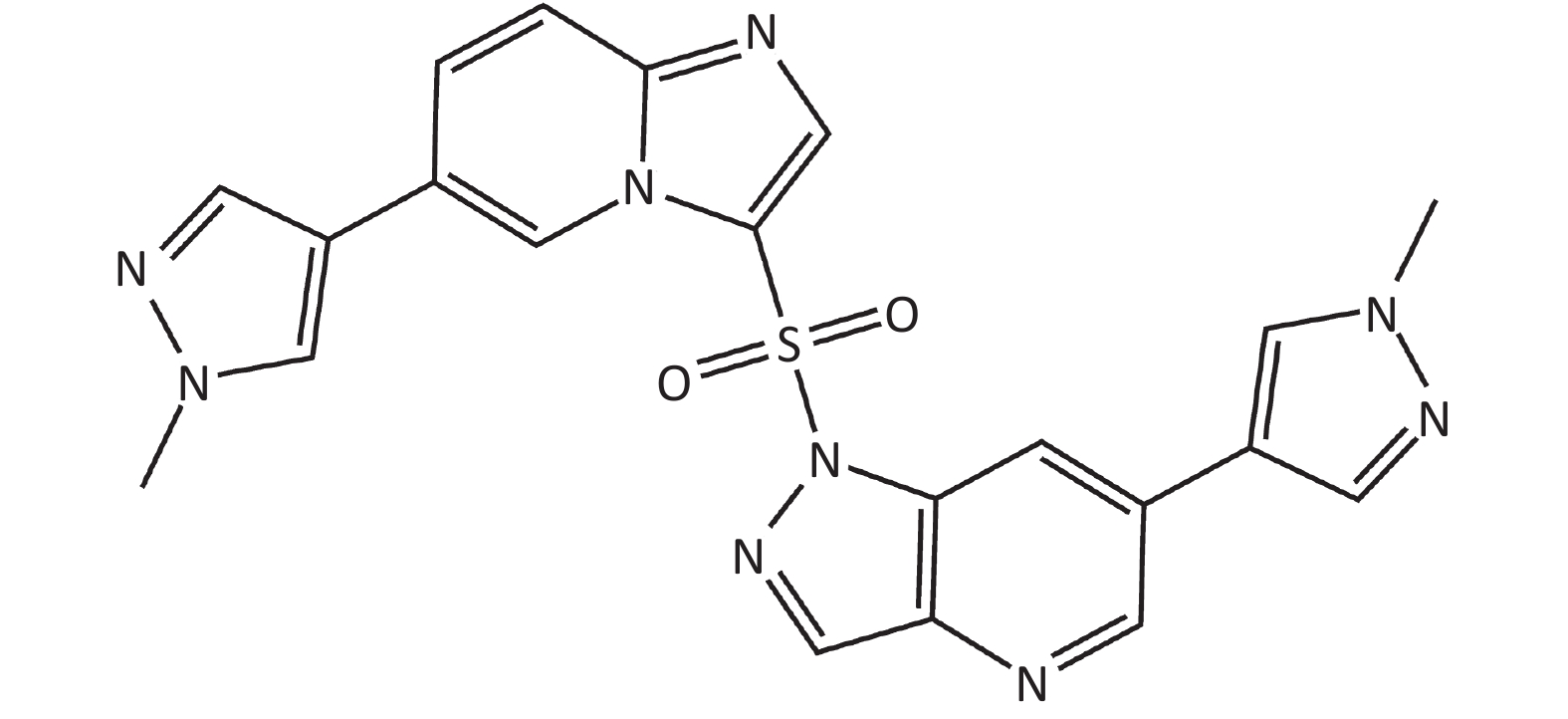
图 1
Fig.1 The chemical structural formula of glumetinib
| Item | MET overexpression [ | METex14 skipping [ | |||||
| Treatment na?ve (n=12) | Previously treated (n=20) | Total (n=32) | Treatment na?ve (n=44) | Previously treated (n=35) | Total (n=79) | ||
| Objective response rate | 5(41.7) | 7(35.0) | 12(37.5) | 31(71) | 21(60) | 52(66) | |
| Complete response | 0 | 0 | 0 | 0 | 0 | 0 | |
| Partial response | 5(41.7) | 7(35.0) | 12(37.5) | 31(71) | 21(60) | 52(66) | |
| Stable disease | 6(50.0) | 8(40.0) | 14(43.8) | 8(18) | 6(17) | 14(18) | |
| Progressive disease | 1(8.3) | 2(10.0) | 3(9.4) | 3(7) | 5(14) | 8(10) | |
| Disease control rate | 11(91.7) | 15(75.0) | 26(81.3) | 39(89) | 27(77) | 66(84) | |
| Duration of response (Median, months) | 10.3 | 13.2 | 10.3 | 15.0 | 8.2 | 8.3 | |
| Progression-free survival (Median, months) | 7.4 | 4.0 | 6.9 | 11.7 | 7.6 | 8.5 | |
| Overall survival (Median, months) | 23.5 | 13.9 | 17.0 | - | 16.2 | 17.3 | |
表 1
Table 1 Efficacy of glumetinib in NSCLC patients harboring MET overexpression and METex14 skipping
| Item | MET overexpression [ | METex14 skipping [ | |||||
| Treatment na?ve (n=12) | Previously treated (n=20) | Total (n=32) | Treatment na?ve (n=44) | Previously treated (n=35) | Total (n=79) | ||
| Objective response rate | 5(41.7) | 7(35.0) | 12(37.5) | 31(71) | 21(60) | 52(66) | |
| Complete response | 0 | 0 | 0 | 0 | 0 | 0 | |
| Partial response | 5(41.7) | 7(35.0) | 12(37.5) | 31(71) | 21(60) | 52(66) | |
| Stable disease | 6(50.0) | 8(40.0) | 14(43.8) | 8(18) | 6(17) | 14(18) | |
| Progressive disease | 1(8.3) | 2(10.0) | 3(9.4) | 3(7) | 5(14) | 8(10) | |
| Disease control rate | 11(91.7) | 15(75.0) | 26(81.3) | 39(89) | 27(77) | 66(84) | |
| Duration of response (Median, months) | 10.3 | 13.2 | 10.3 | 15.0 | 8.2 | 8.3 | |
| Progression-free survival (Median, months) | 7.4 | 4.0 | 6.9 | 11.7 | 7.6 | 8.5 | |
| Overall survival (Median, months) | 23.5 | 13.9 | 17.0 | - | 16.2 | 17.3 | |
| Safety Parameter | MET overexpression (n=32); % (n) [ | METex14 skipping (n=84); % (n) [ |
| Any TRAE | 100(32/32) | 98(82/84) |
| Grade ≥3 TRAE | 34.4(11/32) | 54(45/84) |
| TRAE leading to discontinuation | 9.4(3/32) | 8(7/84) |
| Treatment-related SAE | 21.9(7/32) | 21(18/84) |
| Most Common TRAEs (≥20%) | ||
| Edema | 59.4(19/32) | 80(67/84) |
| Hypoalbuminaemia | 40.6(13/32) | 38(32/84) |
| Increased ALT | 31.3(10/32) | 26(22/84) |
| Increased AST | 25.0(8/32) | 21(18/84) |
| Nausea | 25.0(8/32) | 29(24/84) |
| Vomiting | 25.0(8/32) | 24(20/84) |
| Decreased appetite | 21.9(7/32) | 32(27/84) |
| Headache | 21.9(7/32) | 32(27/84) |
| Selected AEs of interest | ||
| Increased blood creatinine | 13.3(4/30) | 13(11/84) |
| Interstitial lung disease | - | 1(1/84) |
| Neutropenia (grade ≥3) | 3.1(1/32) | 5(4/84) |
表 2
Table 2 Safety of glumetinib in NSCLC patients with MET abnormalities
| Safety Parameter | MET overexpression (n=32); % (n) [ | METex14 skipping (n=84); % (n) [ |
| Any TRAE | 100(32/32) | 98(82/84) |
| Grade ≥3 TRAE | 34.4(11/32) | 54(45/84) |
| TRAE leading to discontinuation | 9.4(3/32) | 8(7/84) |
| Treatment-related SAE | 21.9(7/32) | 21(18/84) |
| Most Common TRAEs (≥20%) | ||
| Edema | 59.4(19/32) | 80(67/84) |
| Hypoalbuminaemia | 40.6(13/32) | 38(32/84) |
| Increased ALT | 31.3(10/32) | 26(22/84) |
| Increased AST | 25.0(8/32) | 21(18/84) |
| Nausea | 25.0(8/32) | 29(24/84) |
| Vomiting | 25.0(8/32) | 24(20/84) |
| Decreased appetite | 21.9(7/32) | 32(27/84) |
| Headache | 21.9(7/32) | 32(27/84) |
| Selected AEs of interest | ||
| Increased blood creatinine | 13.3(4/30) | 13(11/84) |
| Interstitial lung disease | - | 1(1/84) |
| Neutropenia (grade ≥3) | 3.1(1/32) | 5(4/84) |
| 1 |
Bray F, Laversanne M, Sung H, et al. Global cancer statistics 2022: GLOBOCAN estimates of incidence and mortality worldwide for 36 cancers in 185 countries[J]. CA Cancer J Clin, 2024, 74 (3): 229- 263.
doi: 10.3410/f.739487650.793592245 |
| 2 |
Travis WD, Brambllla E, Noguchi M, et al. International association for the study of lung cancer/American thoracic society/European respiratory society international multidisciplinary classification of lung adenocarcinoma[J]. J Thorac Oncol, 2011, 6 (2): 244- 285.
doi: 10.1097/JTO.0b013e318206a221 |
| 3 | Travis WD, Brambilla E, Nicholson AG, et al. The 2015 world health organization classification of lung tumors: impact of genetic, clinical and radiologic advances since the 2004 classification[J]. J Thorac Oncol, 2015, 10 (9): 1243- 1260. |
| 4 |
高万里, 周绮纯, 王苏美. 预知子经ROS介导的PI3K-Akt通路诱导非小细胞肺癌细胞凋亡[J]. 中国临床药理学与治疗学, 2025, 30 (3): 339- 346.
doi: 10.12092/j.issn.1009-2501.2025.03.006 |
| 5 |
Guckenberger M, Aerts JG, Van Schil P, et al. The American society of clinical oncology-endorsed American society for radiation oncology evidence-based guideline of stereotactic body radiotherapy for early-stage non-small cell lung cancer: an expert opinion[J]. J Thorac Cardiovasc Surg, 2019, 157 (1): 358- 361.
doi: 10.1016/j.jtcvs.2018.09.107 |
| 6 |
Zhang W, Luo J, Dong X, et al. Salivary microbial dysbiosis is associated with systemic inflammatory markers and predicted oral metabolites in non-small cell lung cancer patients[J]. J Cancer, 2019, 10 (7): 1651- 1662.
doi: 10.7150/jca.28077 |
| 7 |
张威, 王田, 王孝彬. 成纤维细胞生长因子受体1在非小细胞肺癌患者中表达水平及其临床意义[J]. 临床军医杂志, 2024, 52 (12): 1226- 1230.
doi: 10.16680/j.1671-3826.2024.12.05 |
| 8 |
Ma S, Nie H, Wei C, et al. Association between immune-related adverse events and prognosis in patients with advanced non-small cell lung cancer: a systematic review and meta-analysis[J]. Front Oncol, 2024, 14, 1402017.
doi: 10.3389/fonc.2024.1402017 |
| 9 |
Dong J, Li B, Lin D, et al. Advances in targeted therapy and immunotherapy for non-small cell lung cancer based on accurate molecular typing[J]. Front Pharmacol, 2019, 10, 230.
doi: 10.3389/fphar.2019.00230 |
| 10 |
Garg P, Singhal S, Kulkarni P, et al. Advances in non-small cell lung cancer: current insights and future directions[J]. J Clin Med, 2024, 13 (14): 4189.
doi: 10.3390/jcm13144189 |
| 11 |
Liu W, Zhang Q, Zhang T, et al. Quality of life in patients with non-small cell lung cancer treated with PD-1/PD-L1 inhibitors: a systematic review and meta-analysis[J]. World J Surg Oncol, 2022, 20 (1): 333.
doi: 10.1186/s12957-022-02800-1 |
| 12 |
Korpanty GJ, Graham DM, Vincent MD, et al. Biomarkers that currently affect clinical practice in lung cancer: EGFR, ALK, MET, ROS-1, and KRAS[J]. Front Oncol, 2014, 4, 204.
doi: 10.3389/fonc.2014.00204 |
| 13 |
Spagnolo CC, Ciappina G, Giovannetti E, et al. Targeting MET in non-small cell lung cancer (NSCLC): a new old story?[J]. Int J Mol Sci, 2023, 24 (12): 10119.
doi: 10.3390/ijms241210119 |
| 14 |
Sun D, Wu W, Wang L, et al. Identification of MET fusions as novel therapeutic targets sensitive to MET inhibitors in lung cancer[J]. J Transl Med, 2023, 21 (1): 150.
doi: 10.1186/s12967-023-03999-7 |
| 15 |
Chen S, Hu T, Zhao J, et al. Novel molecular subtypes of METex14 non-small cell lung cancer with distinct biological and clinical significance[J]. NPJ Precis Oncol, 2024, 8 (1): 159.
doi: 10.1038/s41698-024-00642-6 |
| 16 |
Engelman JA, Zejnullahu K, Mitsudomi T, et al. MET amplification leads to gefitinib resistance in lung cancer by activating ERBB3 signaling[J]. Science, 2007, 316 (5827): 1039- 1043.
doi: 10.1126/science.1141478 |
| 17 |
Santarpia M, Massafra M, Gebbia V, et al. A narrative review of MET inhibitors in non-small cell lung cancer with MET exon 14 skipping mutations[J]. Transl Lung Cancer Res, 2021, 10 (3): 1536- 1556.
doi: 10.21037/tlcr-20-1113 |
| 18 |
Reungwetwattana T, Liang Y, Zhu V, et al. The race to target MET exon 14 skipping alterations in non-small cell lung cancer: the Why, the How, the Who, the Unknown, and the Inevitable[J]. Lung Cancer, 2017, 103, 27- 37.
doi: 10.1016/j.lungcan.2016.11.011 |
| 19 |
Drusbosky LM, Dawar R, Rodriguez E, et al. Therapeutic strategies in METex14 skipping mutated non-small cell lung cancer[J]. J Hematol Oncol, 2021, 14 (1): 129.
doi: 10.1186/s13045-021-01138-7 |
| 20 | 王美玲. 克唑替尼治疗MET基因扩增或14号外显子突变晚期非小细胞肺癌的临床观察 [D]. 大连: 大连医科大学, 2020. |
| 21 |
Wolf J, Garon EB, Groen HJM, et al. Patient-reported outcomes in capmatinib-treated patients with METex14-mutated advanced NSCLC: results from the GEOMETRY mono-1 study[J]. Eur J Cancer, 2023, 183, 98- 108.
doi: 10.1016/j.ejca.2022.10.030 |
| 22 |
Choi HY, Chang JE. Targeted therapy for cancers: from ongoing clinical trials to FDA-approved drugs[J]. Int J Mol Sci, 2023, 24 (17): 13618.
doi: 10.3390/ijms241713618 |
| 23 |
Mathieu LN, Larkins E, Akinboro O, et al. FDA approval summary: capmatinib and tepotinib for the treatment of metastatic NSCLC harboring MET exon 14 skipping mutations or alterations[J]. Clin Cancer Res, 2022, 28 (2): 249- 254.
doi: 10.1158/1078-0432.CCR-21-1566 |
| 24 |
Mazieeres J, Paik PK, Garassino MC, et al. Tepotinib treatment in patients with MET exon 14-skipping non-small cell lung cancer: long-term follow-up of the VISION Phase 2 nonrandomized clinical trial[J]. JAMA Oncol, 2023, 9 (9): 1260- 1266.
doi: 10.1001/jamaoncol.2023.1962 |
| 25 |
Kato T, Yang JC, Ahn MJ, et al. Efficacy and safety of tepotinib in Asian patients with advanced NSCLC with MET exon 14 skipping enrolled in VISION[J]. Br J Cancer, 2024, 130 (10): 1679- 1686.
doi: 10.1038/s41416-024-02615-9 |
| 26 |
Markham A. Savolitinib: first approval[J]. Drugs, 2021, 81 (14): 1665- 1670.
doi: 10.1007/s40265-021-01584-0 |
| 27 |
Halder P, Rai A, Talukdar V, et al. Pyrazolopyridine-based kinase inhibitors for anti-cancer targeted therapy[J]. RSC Med Chem, 2024, 15 (5): 1452- 1470.
doi: 10.1039/D4MD00003J |
| 28 |
Yang JJ, Zhang Y, Wu L, et al. Vebreltinib for advanced non-small cell lung cancer harboring c-Met exon 14 skipping mutation: a multicenter, single-arm, Phase II KUNPENG study[J]. J Clin Oncol, 2024, 42 (31): 3680- 3691.
doi: 10.1200/JCO.23.02363 |
| 29 |
Matsumura N, Mandai M. PMDA regulatory update on approval and revision of the precautions for use of anticancer drugs: approval selpercatinib for solid tumor with RET fusion, gumarontinib for non-small cell lung cancer with MET gene exon 14 skipping mutation, momelotinib for myelofibrosis, bexarotene for adult T-cell leukemia/lymphoma, valemetostat for peripheral T-cell lymphoma, and pirtobrutinib for mantle cell lymphoma in Japan[J]. Int J Clin Oncol, 2024, 29 (9): 1207- 1208.
doi: 10.1007/s10147-024-02579-z |
| 30 | 中国临床肿瘤学会指南工作委员会. 中国临床肿瘤学会(CSCO)非小细胞肺癌肺癌诊疗指南 2025 [M]. 北京: 人民卫生出版社, 2025: 131-145. |
| 31 |
Zhang QW, Ye ZD, Shen C, et al. Synthesis of novel 6, 7-dimethoxy-4-anilinoquinolines as potent c-Met inhibitors[J]. J Enzyme Inhib Med Chem, 2019, 34 (1): 124- 133.
doi: 10.1080/14756366.2018.1533822 |
| 32 |
Belova NV, Pimenov OA, Kotova VE, et al. Molecular structure and electron distribution of 4-nitropyridine N-oxide: experimental and theoretical study of substituent effects[J]. J Mol Struct, 2020, 1217, 128476.
doi: 10.1016/j.molstruc.2020.128476 |
| 33 |
Ma Y, Sun G, Chen D, et al. Design and optimization of a series of 1-sulfonylpyrazolo[4, 3-b]pyridines as selective c-Met inhibitors[J]. J Med Chem, 2015, 58 (5): 2513- 2529.
doi: 10.1021/jm502018y |
| 34 | 国家药品监督管理局. 国家药监局附条件批准谷美替尼片上市 [EB/OL]. (2023-03-08)[2025-08-04]. https://www.nmpa.gov.cn/zhuanti/cxylqx/cxypxx/20230308152513168.html. |
| 35 | 上海海和药物研究开发股份有限公司. 海益坦® 谷美替尼片药品说明书 [EB/OL]. (2023-06-12)[2025-08-04]. https://db.yaozh.com/instruct/3604898119870592.html. |
| 36 |
Yu Y, Dong W, Shi Y, et al. A pooled analysis of clinical outcome in driver-gene negative non-small cell lung cancer patients with MET overexpression treated with gumarontinib[J]. Ther Adv Med Oncol, 2024, 16, 1- 14.
doi: 10.1177/17588359241264730 |
| 37 |
Yu Y, Zhou J, Li X, et al. Gumarontinib in patients with non-small-cell lung cancer harbouring MET exon 14 skipping mutations: a multicentre, single-arm, open-label, phase 1b/2 trial[J]. EClinicalMedicine, 2023, 59, 101952.
doi: 10.1016/j.eclinm.2023.101952 |
| 38 |
Chen HJ, Yang JJ, Yang XN, et al. A phase I clinical trial to assess the safety, pharmacokinetics, and antitumor activity of glumetinib (SCC244) in patients with advanced non-small cell lung cancers (NSCLCs)[J]. J Clin Oncol, 2020, 38 (suppl_15): e21702.
doi: 10.1200/jco.2020.38.15_suppl.e21702 |
| 39 |
Chen HJ, Yang JJ, Zhou JY, et al. 32O first-in-human (FIH) study of SCC244, a novel potent and highly selective c- MET inhibitor, in patients (pts) with advanced non-small cell lung cancer (NSCLC)[J]. Ann Oncol, 2021, 32 (suppl_1): S14.
doi: 10.1016/j.annonc.2021.01.047 |
| 40 |
Wu J, Xu H, Li H, et al. Effect of food on the pharmacokinetics and safety of a novel c-Met inhibitor SCC244: a randomized phase I study in healthy subjects[J]. Drug Des Devel Ther, 2023, 17, 761- 769.
doi: 10.2147/DDDT.S388846 |
| 41 | 申亦可, 尼样卓玛, 胡琳, 等. 二甲双胍药动学影响因素的研究进展[J]. 中国药房, 2022, 33 (12): 1513- 1519. |
| 42 |
中国药学会医院药学专业委员会, 中华医学会临床药学分会, 《中国窄治疗指数药物临床应用管理专家共识》编写组. 中国窄治疗指数药物临床应用管理专家共识[J]. 中国医院药学杂志, 2025, 45 (17): 1933- 1946,2005.
doi: 10.13286/j.1001-5213.2025.17.01 |
| 43 |
Yu Y, Yang N, Zhang Y, et al. 305MO SCC244 plus osimertinib in patients with stage IIIB/IIIC or IV, EGFR TKI resistant EGFR-mutant NSCLC harboring MET amplification[J]. Ann Oncol, 2022, 33 (suppl_9): S1553.
doi: 10.1016/j.annonc.2022.10.334 |
| 44 |
Hui JJ, Ding SJ, Qin BD, et al. Case report: aumolertinib plus gumarontinib in a patient with EGFR mutated non-small-cell lung cancer harboring acquired MET amplification following progression on afatinib plus crizotinib[J]. Front Pharmacol, 2025, 16, 1525251.
doi: 10.3389/fphar.2025.1525251 |
| 45 | A real-world study of treatment patterns and effectiveness in MET mutation-positive advanced lung cancer [EB/OL]. (2024-09-19)[2025-08-04]. https://clinicaltrials.gov/study/NCT06183762?intr=Glumetinib&rank=10. |
| [1] | 孙彩红, 胡涛桃, 肖幸幸, 袁梦男, 江思民, 陈寅琪, 阮国栋. 全球首个PD-1/VEGF双特异性抗体:依沃西单抗[J]. 中国临床药理学与治疗学, 2025, 30(9): 1290-1296. |
| [2] | 耿彪, 孙珍贵, 赵春阳, 陈兴无. 髓系来源抑制性细胞对非小细胞肺癌患者接受PD-1抑制剂联合化疗疗效与预后的影响[J]. 中国临床药理学与治疗学, 2025, 30(8): 1076-1083. |
| [3] | 高万里, 周绮纯, 王苏美. 预知子经ROS介导的PI3K-Akt通路诱导非小细胞肺癌细胞凋亡[J]. 中国临床药理学与治疗学, 2025, 30(3): 339-346. |
| [4] | 崔艳军, 马天, 刘一, 焦玲, 柴爱军, 樊榕榕, 刘彦国, 罗兴献, 黄琳, 张晓红. 卡瑞利珠单抗联合化疗一线治疗局部晚期/转移性非小细胞肺癌的快速卫生技术评估[J]. 中国临床药理学与治疗学, 2024, 29(7): 775-784. |
| [5] | 何烨, 王银华, 耿彪, 鲍兴. 淋巴细胞/单核细胞比值及其动态变化与PD-1抑制剂治疗晚期非小细胞肺癌的疗效分析[J]. 中国临床药理学与治疗学, 2024, 29(5): 569-575. |
| [6] | 王梦娇, 高超, 王涛, 张倩, 文娟, 吕冬梅, 胡丽丽. CDA C435T基因多态性显著延长吉西他滨治疗晚期非小细胞肺癌远期疗效[J]. 中国临床药理学与治疗学, 2024, 29(12): 1337-1343. |
| [7] | 徐凌, 叶伟, 吕莉萍, 王华. 气管镜下介入联合药物注射治疗中央型非小细胞肺癌疗效与安全性研究[J]. 中国临床药理学与治疗学, 2024, 29(1): 76-81. |
| [8] | 黄小明, 杜野, 林少明, 沈观乐. 呼吸道微生态对晚期非小细胞肺癌患者接受PD-1抑制剂单药治疗疗效影响的探索性研究[J]. 中国临床药理学与治疗学, 2023, 28(1): 66-74. |
| [9] | 张可心, 贾文静, 崔佳文, 敖路遥, 周 芳, 王广基, 刘嘉莉. 第三代EGFR酪氨酸激酶抑制剂在非小细胞肺癌临床治疗中的应用及研究进展[J]. 中国临床药理学与治疗学, 2022, 27(9): 1016-1030. |
| [10] | 裴清华, 孙建立. 奥希替尼获得性耐药的研究进展[J]. 中国临床药理学与治疗学, 2021, 26(1): 105-112. |
| [11] | 魏为添, 陈晟, 汪亮, 曾剑. 灯盏花素对非小细胞肺癌A549细胞的促凋亡作用[J]. 中国临床药理学与治疗学, 2020, 25(6): 618-624. |
| [12] | 王海莉,巩天晓,周士霞,梅家转,张中冕. 甲磺酸阿帕替尼三线治疗晚期非小细胞肺癌患者的疗效及安全性分析[J]. 中国临床药理学与治疗学, 2019, 24(5): 567-572. |
| [13] | 杨 科,李峻岭,杜 斌,田中秋,景秀娟. 白蛋白结合型紫杉醇二线及以上治疗晚期非小细胞肺癌的单臂、单中心探索性临床研究[J]. 中国临床药理学与治疗学, 2019, 24(11): 1281-1286. |
| [14] | 王海霞,刘兴安,侯继院,龚 哲,单国用. KDR基因遗传变异对贝伐珠单抗一线治疗晚期非小细胞肺癌患者临床疗效的影响[J]. 中国临床药理学与治疗学, 2018, 23(7): 802-808. |
| [15] | 李伟文,黎 媛,孙 蕾,黄公才,赵中伟. 艾迪注射液对培美曲塞联合奈达铂治疗晚期非小细胞肺癌的增效作用[J]. 中国临床药理学与治疗学, 2018, 23(3): 325-328. |
| 阅读次数 | ||||||
|
全文 |
|
|||||
|
摘要 |
|
|||||