Chinese Journal of Clinical Pharmacology and Therapeutics ›› 2026, Vol. 31 ›› Issue (10): 1330-1341.doi: 10.12092/j.issn.1009-2501.2026.10.004
Yongqi HUANG1(
), Longshan ZHAO1,2, Dongdong ZHAO1, Yukun BO1, Dan YANG1, Jingjing GUO1, Xuemiao YANG3, Yanan LV3, Shumin LI1, Haiyan ZHANG1, Guodong WU1,*(
), Ming AN1(
)
Received:2025-09-30
Revised:2025-12-26
Online:2026-10-26
Published:2026-11-11
Contact:
Guodong WU
E-mail:2961134691@qq.com;wgdzd@126.com;102009113@btmc.edu.cn
CLC Number:
Yongqi HUANG, Longshan ZHAO, Dongdong ZHAO, Yukun BO, Dan YANG, Jingjing GUO, Xuemiao YANG, Yanan LV, Shumin LI, Haiyan ZHANG, Guodong WU, Ming AN. Mechanistic study on the hepatoprotective effects of Gurigumu-13 Pill against drug-induced liver injury based on metabolomics and metagenomics[J]. Chinese Journal of Clinical Pharmacology and Therapeutics, 2026, 31(10): 1330-1341.
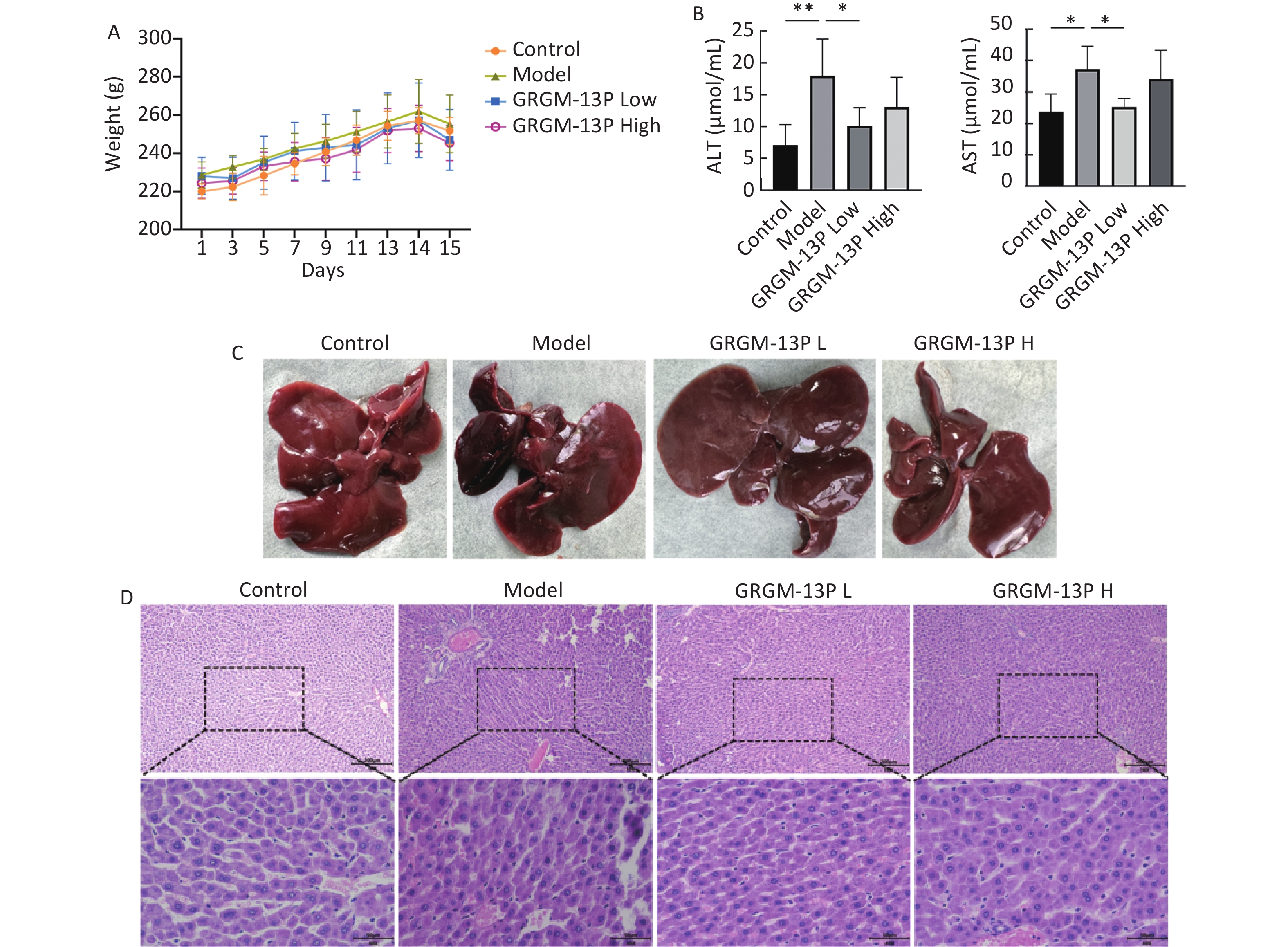
Fig.1 Pharmacodynamic study of GRGM-13P in DILI rats A: curve of rat body weight changes ($\bar x $±s, n=6); B: effect of GRGM-13P on ALT and AST in DILI rats ($\bar x $±s, n=6); C: representative images of liver morphology observation; D: representative images of liver HE staining. *P<0.05,**P<0.01.
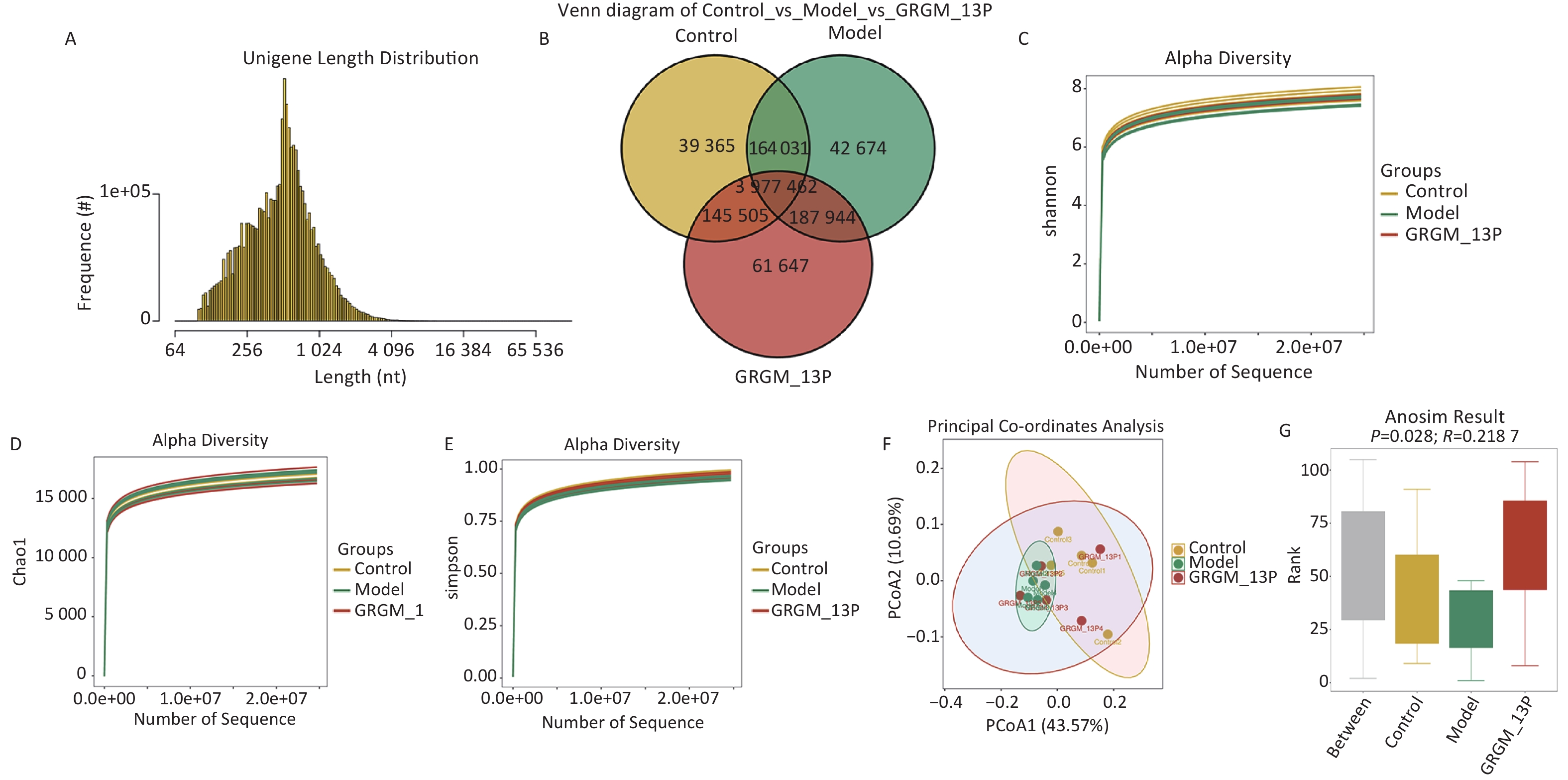
Fig.2 Analysis of the number and diversity of genes in the intestinal microbiota A: histogram of gene length distribution; B: venn diagram analysis of gene numbers; C: Shannon index; D: Chao1 index; E: Simpson index; F: PCoA analysis of the control, model and GRGM-13P groups; G: anosim analysis.
| Df | Sum of squares | R2 | F | Pr(>F) | |
| Group | 2 | 0.08 | 0.25 | 2.00 | 0.04 |
| Residual | 12 | 0.24 | 0.75 | ||
| Total | 14 | 0.32 | 1 |
Table 1 Anosim analysis of the control, model, and GRGM-13P groups
| Df | Sum of squares | R2 | F | Pr(>F) | |
| Group | 2 | 0.08 | 0.25 | 2.00 | 0.04 |
| Residual | 12 | 0.24 | 0.75 | ||
| Total | 14 | 0.32 | 1 |
Fig.3 Analysis of the structure and function of the intestinal microbiota A-B: horizontal species abundance statistical analysis bar charts and Circos diagrams. C-D: vertical species abundance statistical analysis bar charts and Circos diagrams. E-J: heatmaps and network diagrams of microbiome correlations for the control, model, and GRGM-13P groups. K: bubble chart for GO abundance composition analysis. L: bar chart for KEGG pathway classification. M: classification statistical graph of eggNOG.
Fig.4 Difference analysis A: evolutionary branch diagram of LEfSe difference analysis. B: abundance bar chart of LEfSe difference analysis. C-D: Manhattan plots of MetagenomeSeq difference analysis between model vs. control group and GRGM-13P vs. model group. E-F: pathway bar charts of ReporterScore difference analysis between control group vs. model. G-H: ReporterScore difference analysis between GRGM-13P vs. model group.
Fig.5 Metabolomics analysis A-B: positive ion mode PLS-DA and permutation test plots. C-D: negative ion mode PLS-DA and permutation test plots. E-F: heatmaps of potential biomarker expressions for the control group vs. model and GRGM-13P vs. model groups. G: KEGG metabolic pathway enrichment bubble plot.
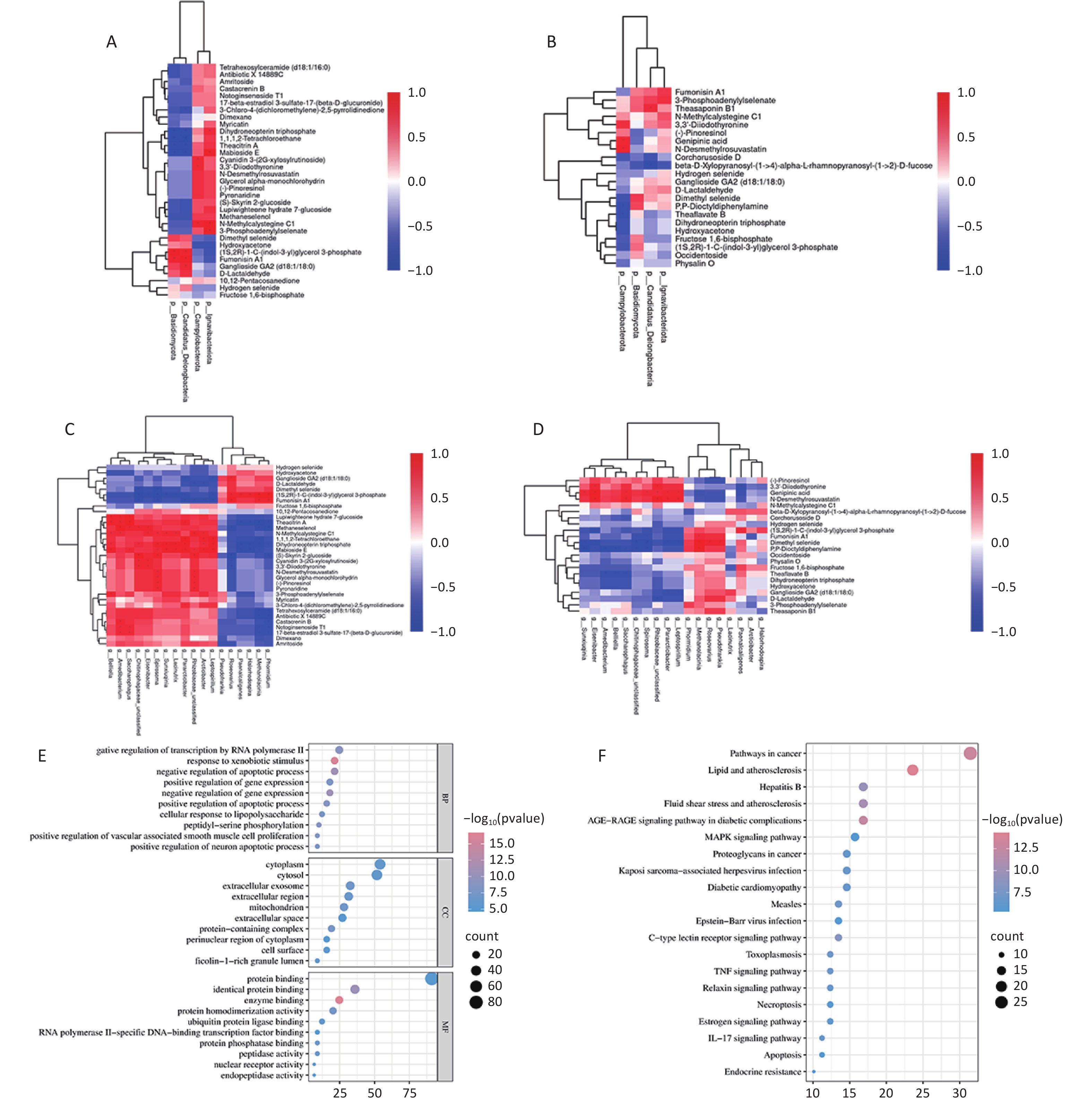
Fig.6 Association analysis between gut microbiota and metabolomics A-B: heatmap showing the correlations of the differential metabolites at the pathway level between the control group and model group, and between GRGM-13P and model group. C-D: heatmap showing the correlations of the differential metabolites at the family level between the control group and model group, and between GRGM-13P and model group. E: bubble plot for GO enrichment analysis. F: bubble plot for KEGG enrichment analysis.
| NO | Ret. Time | Measured m/z | Metabolite | Formula | Delta (ppm) |
| 1 | Cyanidin 3-(2G-xylosylrutinoside) | C32H39O19 | 3 | ||
| 2 | Ganglioside GA2 (d18:1/18:0) | C56H104N2O18 | 11 | ||
| 3 | Theaflavate B | C36H28O15 | 44 | ||
| 4 | Dihydroneopterin triphosphate | C9H16N5O13P3 | 32 | ||
| 5 | N-Methylcalystegine C1 | C8H15NO5 | 19 | ||
| 6 | Theacitrin A | C37H28O18 | 22 | ||
| 7 | Genipinic acid | C11H14O6 | 25 | ||
| 8 | 12.183 | (1S,2R)-1-C-(indol-3-yl)glycerol 3-phosphate | C11H14NO6P | 4 | |
| 9 | Goyaglycoside c | C38H62O9 | 21 | ||
| 10 | Goyaglycoside c | C38H62O9 | 28 | ||
| 11 | 3-Phosphoadenylylselenate | C10H15N5O13P2Se | 36 | ||
| 12 | 14.431 | 3,3'-Diiodothyronine | C15H13I2NO4 | 184 | |
| 13 | 786.41 | Fumonisin A1 | C36H61NO16 | 28 | |
| 14 | beta-D-Xylopyranosyl-(1->4)-alpha- L-rhamnopyranosyl-(1->2)-D-fucose | C17H30O13 | 13 | ||
| 15 | Mabioside E | C48H78O22S | 49 | ||
| 16 | Theasaponin B1 | C65H94O27 | 69 | ||
| 17 | N-Desmethylrosuvastatin | C21H26FN3O6S | 58 | ||
| 18 | P,P-Dioctyldiphenylamine | C28H43N | 219 | ||
| 19 | 3-Chloro-4-(dichloromethylene)-2,5-pyrrolidinedione | C5H2Cl3NO2 | 229 |
Table 2 Potential biomarkers related to the hepatoprotective effect of GRGM-13 after joint analysis
| NO | Ret. Time | Measured m/z | Metabolite | Formula | Delta (ppm) |
| 1 | Cyanidin 3-(2G-xylosylrutinoside) | C32H39O19 | 3 | ||
| 2 | Ganglioside GA2 (d18:1/18:0) | C56H104N2O18 | 11 | ||
| 3 | Theaflavate B | C36H28O15 | 44 | ||
| 4 | Dihydroneopterin triphosphate | C9H16N5O13P3 | 32 | ||
| 5 | N-Methylcalystegine C1 | C8H15NO5 | 19 | ||
| 6 | Theacitrin A | C37H28O18 | 22 | ||
| 7 | Genipinic acid | C11H14O6 | 25 | ||
| 8 | 12.183 | (1S,2R)-1-C-(indol-3-yl)glycerol 3-phosphate | C11H14NO6P | 4 | |
| 9 | Goyaglycoside c | C38H62O9 | 21 | ||
| 10 | Goyaglycoside c | C38H62O9 | 28 | ||
| 11 | 3-Phosphoadenylylselenate | C10H15N5O13P2Se | 36 | ||
| 12 | 14.431 | 3,3'-Diiodothyronine | C15H13I2NO4 | 184 | |
| 13 | 786.41 | Fumonisin A1 | C36H61NO16 | 28 | |
| 14 | beta-D-Xylopyranosyl-(1->4)-alpha- L-rhamnopyranosyl-(1->2)-D-fucose | C17H30O13 | 13 | ||
| 15 | Mabioside E | C48H78O22S | 49 | ||
| 16 | Theasaponin B1 | C65H94O27 | 69 | ||
| 17 | N-Desmethylrosuvastatin | C21H26FN3O6S | 58 | ||
| 18 | P,P-Dioctyldiphenylamine | C28H43N | 219 | ||
| 19 | 3-Chloro-4-(dichloromethylene)-2,5-pyrrolidinedione | C5H2Cl3NO2 | 229 |
| 1 |
Allison R, Guraka A, Shawa IT, et al. Drug induced liver injury – a 2023 update[J]. J Toxicol Environ Health B, 2023, 26 (8): 442- 467.
doi: 10.1080/10937404.2023.2261848 |
| 2 |
Andrade RJ, Chalasani N, Bjornsson ES, et al. Drug-induced liver injury[J]. Nat Rev Dis Primers, 2019, 5 (1): 58- 69.
doi: 10.1038/s41572-019-0105-0 |
| 3 | Hionides-Gutierrez A, Goikoetxea-Usandizaga N, Sanz-Garcia C, et al. Novel emerging mechanisms in acetaminophen-induced hepatotoxicity[J]. Liver Int, 2024, 44 (3): 567- 581. |
| 4 |
Chowdhury A, Nabila J, Adelusi TI, et al. Current etiological comprehension and therapeutic targets of acetaminophen-induced hepatotoxicity[J]. Pharmacol Res, 2020, 161, 105102.
doi: 10.1016/j.phrs.2020.105102 |
| 5 |
Jaeschke H, Ramachandran A. Acetaminophen hepatotoxicity: paradigm for understanding mechanisms of drug-induced liver injury[J]. Annu Rev Pathol, 2024, 19, 453- 478.
doi: 10.1146/annurev-pathmechdis-051122-094016 |
| 6 | Zhu R, Gao Y, Dong J, et al. Changes of gut microbiota and metabolites in different drug-induced liver injuries[J]. J Med Microbiol, 2023, 72 (11): 001705. |
| 7 |
Tao W, Fan Q, Wei J. Gut–liver axis as a therapeutic target for drug-induced liver injury[J]. Curr Issues Mol Biol, 2024, 46 (2): 1219- 1236.
doi: 10.3390/cimb46020078 |
| 8 |
赵艳霞. 蒙药古日古木-13丸概述[J]. 中国民族医药杂志, 2021, 27 (8): 68- 70.
doi: 10.3969/j.issn.1006-6810.2021.08.031 |
| 9 |
美丽. 蒙药古日古木-13的药理作用及临床应用研究进展[J]. 中国民族医药杂志, 2025, 31 (2): 68- 70.
doi: 10.3969/j.issn.1006-6810.2025.02.024 |
| 10 |
李思潼, 彭雅宁, 刘晨旭, 等. 解毒护肝通络方对药物性肝损伤小鼠的保护作用及其对肠道菌群和肠黏膜屏障的影响[J]. 世界科学技术-中医药现代化, 2024, 26 (2): 351- 359.
doi: 10.11842/wst.20230131008 |
| 11 |
Kang S, Bo Y, Yang D, et al. Tandem mass tag-based proteomics analysis reveals the effects of Guri Gumu-13 pill on drug-induced liver injury[J]. J Chromatogr B, 2022, 1206, 123353.
doi: 10.1016/j.jchromb.2022.123353 |
| 12 |
Singh D, Khan MA, Siddique HR, et al. Unveiling the therapeutic promise of natural products in alleviating drug-induced liver injury: present advancements and future prospects[J]. Phytother Res, 2024, 38 (1): 22- 41.
doi: 10.1002/ptr.8022 |
| 13 |
Li G, Hou Y, Zhang C, et al. Interplay between drug-induced liver injury and gut microbiota: a comprehensive overview[J]. Cell Mol Gastroenterol Hepatol, 2024, 18 (3): 101355.
doi: 10.1016/j.jcmgh.2024.05.003 |
| 14 |
Beger RD, Bhattacharyya S, Yang X, et al. Translational biomarkers of acetaminophen-induced acute liver injury[J]. Arch Toxicol, 2015, 89 (9): 1497- 1522.
doi: 10.1007/s00204-015-1519-4 |
| 15 |
Jourova L, Vavreckova M, Zemanova N, et al. Gut microbiome alters the activity of liver cytochromes P450 in mice with sex-dependent differences[J]. Front Pharmacol, 2020, 11, 1303.
doi: 10.3389/fphar.2020.01303 |
| 16 |
Lu J, Gong Y, Gao Y, et al. Wolfberry, yam and chrysanthemum polysaccharides increased intestinal Akkermansia muciniphila abundance and hepatic YAP1 expression to alleviate DILI[J]. FASEB J, 2023, 37 (12): e23286.
doi: 10.1096/fj.202301388R |
| 17 | Chen H, Li W, Zhang Q, et al. Microbiota-gut-liver axis: a new target for drug-induced liver injury[J]. Acta Pharmacol Sin, 2024, 45 (5): 889- 901. |
| 18 | Yang F, Wu X, Liu C, et al. Selenium-containing compounds as hepatoprotective agents: mechanisms and therapeutic potential[J]. Free Radic Biol Med, 2024, 215, 123- 135. |
| 19 |
Xu B, Hao K, Chen X, et al. Broussonetia papyrifera polysaccharide alleviated acetaminophen-induced liver injury by regulating the intestinal flora[J]. Nutrients, 2022, 14 (13): 2636.
doi: 10.3390/nu14132636 |
| 20 |
文一如, 杨金拉姆, 美嘎, 等. 巨噬细胞极化与肠道菌群及其代谢产物在器官损伤中相关研究进展[J]. 中国临床药理学与治疗学, 2025, 30 (1): 1- 9.
doi: 10.12092/j.issn.1009-2501.2026.01.014 |
| 21 |
An JK, Chung AS, Churchill DG. Nontoxic levels of Se-containing compounds increase survival by blocking oxidative and inflammatory stresses via signal pathways, whereas high levels of Se induce apoptosis[J]. Molecules, 2023, 28 (13): 5234.
doi: 10.3390/molecules28135234 |
| 22 |
Jiang Y, He X, Simonaro CM, et al. Acid ceramidase protects against hepatic ischemia/reperfusion injury by modulating sphingolipid metabolism and reducing inflammation and oxidative stress[J]. Front Cell Dev Biol, 2021, 9, 633657.
doi: 10.3389/fcell.2021.633657 |
| 23 |
Liu YJ, Li H, Tian Y, et al. PCTR1 ameliorates lipopolysaccharide-induced acute inflammation and multiple organ damage via regulation of linoleic acid metabolism by promoting FADS1/FADS2/ELOVL2 expression and reducing PLA2 expression[J]. Lab Invest, 2020, 100 (7): 904- 915.
doi: 10.1038/s41374-020-0412-9 |
| 24 |
Zhou J, Feng Y, Zhou W, et al. Ultrasound-assisted metabolite detection in different extraction processes of Bletilla striata and bitter metabolite detection[J]. Ultrason Sonochem, 2025, 114, 107266.
doi: 10.1016/j.ultsonch.2025.107266 |
| 25 |
Swallah MS, Fan H, Wang S, et al. Prebiotic impacts of soybean residue (okara) on eubiosis/dysbiosis condition of the gut and the possible effects on liver and kidney functions[J]. Molecules, 2021, 26 (2): 326.
doi: 10.3390/molecules26020326 |

| [1] | ZENG Xiangchang1, 2, 3, 4, 5, 7, RAO Tai1, 3, 4, 5, CHEN Lulu2, LI Chaopeng2, ZENG Guirong6, CHEN Jun7, OUYANG Dongsheng1, 2, 3, 4, 5. Advances in immunogenetic mechanisms of drug-induced liver injury [J]. Chinese Journal of Clinical Pharmacology and Therapeutics, 2025, 30(8): 1133-1146. |
| [2] | SU Qihui, WANG Jing, LUO Rongrong, HUANG Yurong, LI Xin, WANG Yingli, JIA Ying. Study on the mechanism of action of Siheifang on zebrafish melanin based on metabolomics and network pharmacology [J]. Chinese Journal of Clinical Pharmacology and Therapeutics, 2024, 29(9): 988-1001. |
| [3] | XU Lan, HAI Yang, REN Ke, ZHANG Yarong, CAO Haoshi, LIU Dongling. Study on the mechanism of astragalus glycyrrhiza decoction regulating SIRT1/FOXO1 pathway to prevent QT interval prolongation induced by arsenic trioxide based on metabolomics [J]. Chinese Journal of Clinical Pharmacology and Therapeutics, 2024, 29(2): 130-138. |
| [4] | YOU Rongli, HUANG Yurong, MAORui, HAI Lina, WANG Yingli, WANG Yan. Mechanism of compound kushen injection in the treatment of lung cancer based on serum metabolomics and network pharmacology [J]. Chinese Journal of Clinical Pharmacology and Therapeutics, 2023, 28(9): 988-999. |
| [5] | SHI Dandan, SUN Yiyao, CHEN Xiaoqi, YANG Fangming, ZHANG Chuanlei, WANG Xinting, YUAN Changwei, CHEN Xinju. Curative effect of fuzheng xiaoliu granules in the treatment of primary liver cancer and analysis of serum metabolomics [J]. Chinese Journal of Clinical Pharmacology and Therapeutics, 2023, 28(11): 1247-1262. |
| [6] | HE Huan, XUE Zhenyu, MAO Haoli, ZHANG Lei. Effects of prolonged sevoflurane exposure on metabolomics of prefrontal cortex in aged mice [J]. Chinese Journal of Clinical Pharmacology and Therapeutics, 2022, 27(12): 1375-1380. |
| [7] | LIU Wenjing, WU Zhitao, PAN Guoyu. Early dectection and prediction hepatotoxic risk in vitro [J]. Chinese Journal of Clinical Pharmacology and Therapeutics, 2021, 26(8): 923-930. |
| [8] | SONG Ruzheng, PENG Ying, WANG Guangji, SUN Jianguo. Commonly used quantitative proteomics research techniques and their application in the study of pathogenesis of liver-derived diseases [J]. Chinese Journal of Clinical Pharmacology and Therapeutics, 2021, 26(5): 570-578. |
| [9] | YANG Qian, YU Yunli, ZHANG Quanying. Metabolomics-based analysis of serum BAs in healthy Chinese adults taking acetaminophen [J]. Chinese Journal of Clinical Pharmacology and Therapeutics, 2021, 26(3): 292-298. |
| [10] | XU Lina, LI Yue, PENG Jinyong. microRNA and drug-induced liver injury [J]. Chinese Journal of Clinical Pharmacology and Therapeutics, 2020, 25(7): 803-809. |
| [11] | LIU Yan1,2, LIU Dan1,3, ZHU Cui-ming1,HUANG Ze-zhi2, ZHU Jin2, MENG Song-nian2, LI Ping3. Clinical observation of the formation of fatty liver after anti-tuberculosis treatment [J]. Chinese Journal of Clinical Pharmacology and Therapeutics, 2013, 18(11): 1280-1283. |
| [12] | Jiye Aa. Analysis of metabolomic data: principal component analysis [J]. Chinese Journal of Clinical Pharmacology and Therapeutics, 2010, 15(5): 481-489. |
| [13] | LU Yi-hong, HAO Hai-ping, WANG Guang-ji, CHEN Hu-xiao,ZHU Xuan-xuan, XIANG Bing-ren, HUANG Qing, A Ji-Y. Metabolomics approach to the biochemical differentiation of Traditional Chinese Medicine syndrome types of hypertension [J]. Chinese Journal of Clinical Pharmacology and Therapeutics, 2007, 12(10): 1144-1150. |
| Viewed | ||||||
|
Full text |
|
|||||
|
Abstract |
|
|||||