Chinese Journal of Clinical Pharmacology and Therapeutics ›› 2026, Vol. 31 ›› Issue (6): 722-728.doi: 10.12092/j.issn.1009-2501.2026.06.001
Received:2025-05-15
Online:2026-06-26
Published:2026-07-06
Contact:
Zhongqun WANG
E-mail:cling9110@163.com;wangtsmc@126.com
CLC Number:
Ling CHEN, Zhongqun WANG. SGLT2 inhibitor from a clinical research perspective: boundary-breaking pioneer in the treatment of diabetic heart failure[J]. Chinese Journal of Clinical Pharmacology and Therapeutics, 2026, 31(6): 722-728.
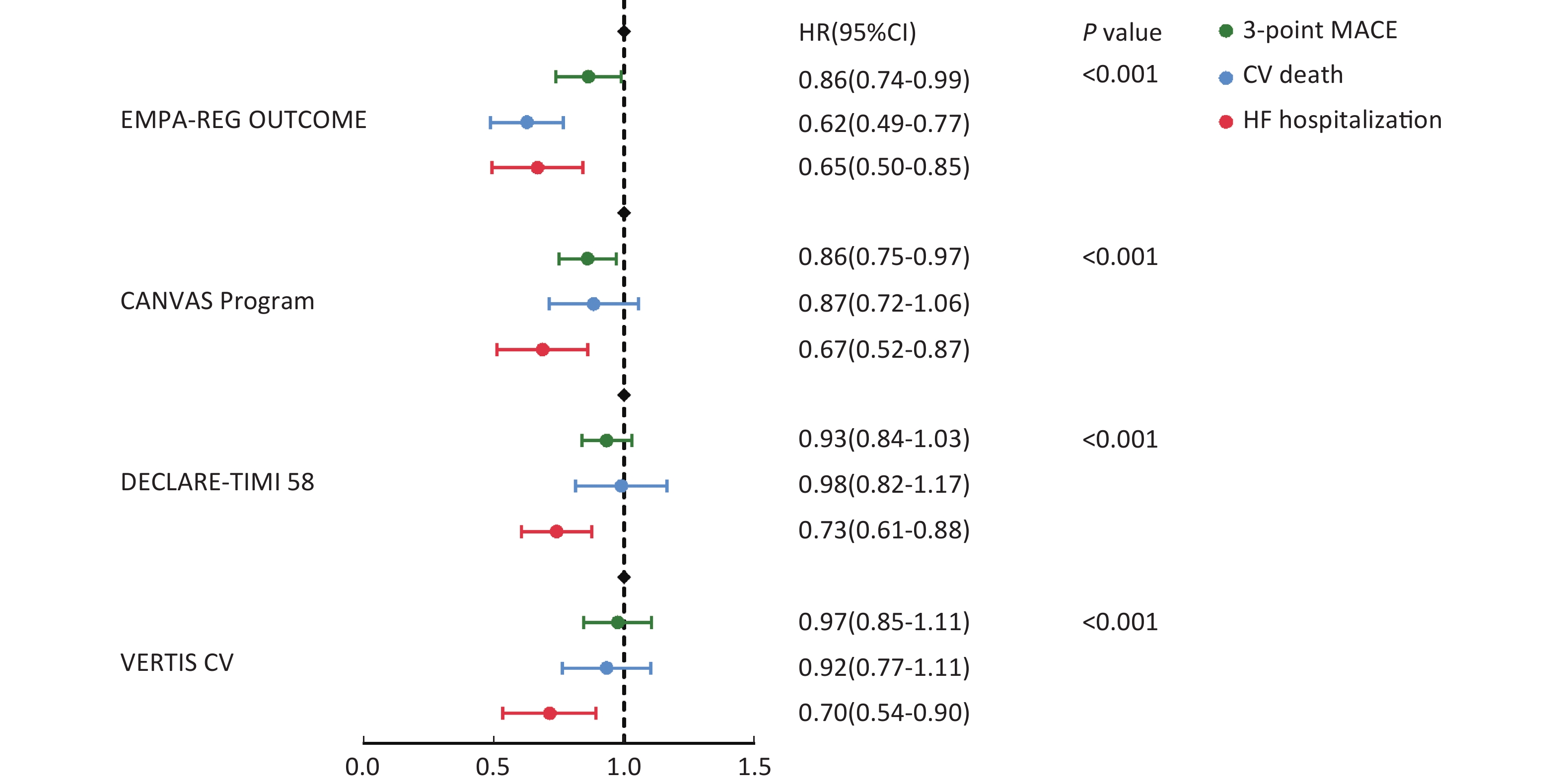
Fig.1 Comparison of hazard ratios (HR) for key events across four cardiovascular outcomes trials of SGLT2 inhibitors The forest plot displays hazard ratios (HR) with 95% confidence intervals for 3-point MACE (cardiovascular death, non-fatal myocardial infarction, or stroke), cardiovascular death (CV death), and heart failure hospitalization (HF hospitalization) in the EMPA-REG OUTCOME, CANVAS Program, DECLARE-TIMI 58, and VERTIS CV trials. The vertical dashed line at HR=1.0 represents the null effect, with HR values to the left (<1.0) indicating statistically significant risk reduction. The x-axis scale (0.0-1.0) demonstrates the magnitude of cardiovascular risk reduction observed across trials. Data were extracted from references [8-11].
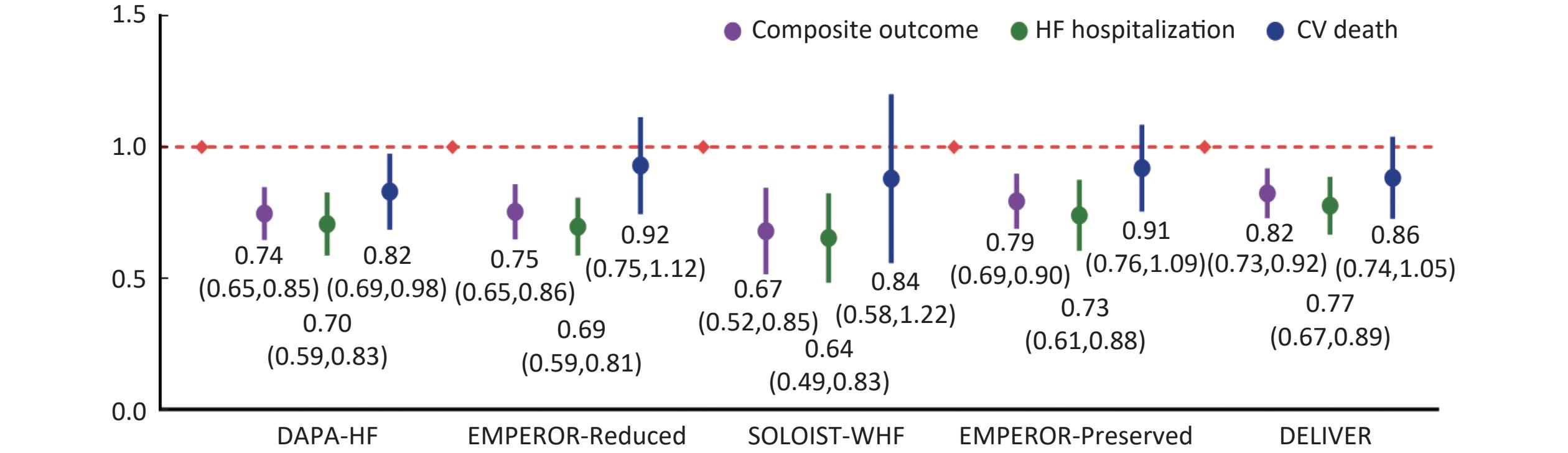
Fig.2 Comparison of hazard ratios (HR) for primary outcomes across five dedicated heart failure trials of SGLT2 inhibitors The forest plot presents hazard ratios (HR) with 95% confidence intervals for heart failure hospitalization (HF hospitalization), cardiovascular death (CV death), and the primary composite outcome in the DAPA-HF, EMPEROR-Reduced, SOLOIST-WHF, EMPEROR-Preserved, and DELIVER trials. The horizontal reference line at HR=1.0 indicates null effect, with values below this line (HR<1.0) demonstrating statistically significant risk reduction. The y-axis scale (0.0-1.0) quantifies the degree of risk reduction across trials. Data were extracted from references [15-19].
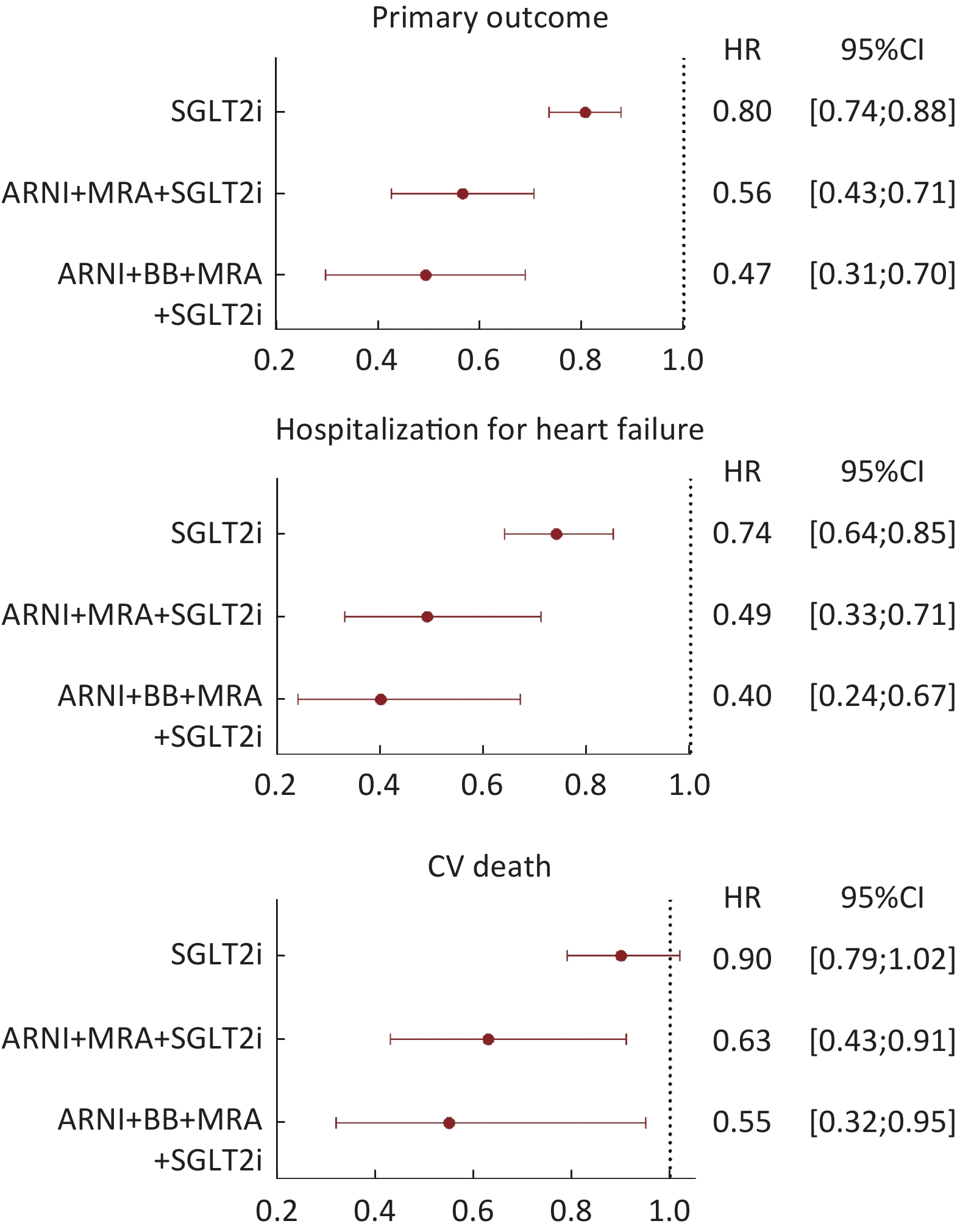
Fig.3 Comparison of cardiovascular outcomes between SGLT2 inhibitor monotherapy and combination regimens The forest plot displays hazard ratios (HR) with 95% confidence intervals for primary outcome, hospitalization for heart failure, and cardiovascular mortality across three treatment regimens: SGLT2 inhibitor monotherapy, ARNI+MRA+SGLT2i combination, and ARNI+BB+MRA+SGLT2i intensive combination. The vertical reference line at HR=1.0 indicates null effect, with values to the left (<1.0) demonstrating statistically significant risk reduction. The x-axis scale reveals a consistent gradient of incremental benefit from monotherapy to combination regimens across all clinical endpoints.Data were extracted from reference [26].
| 1 |
Pandey A, Khan MS, Patel KV, et al. Predicting and preventing heart failure in type 2 diabetes[J]. Lancet Diab Endocrinol, 2023, 11 (8): 607- 624.
doi: 10.1016/S2213-8587(23)00128-6 |
| 2 |
Pop-Busui R, Januzzi JL, Bruemmer D, et al. Heart failure: an underappreciated complication of diabetes. A consensus report of the American diabetes association[J]. Diabetes Care, 2022, 45 (7): 1670- 1690.
doi: 10.2337/dci22-0014 |
| 3 | Khan MS, Shahid I, Bennis A, et al. Global epidemiology of heart failure[J]. Nat Rev Cardiol, 2024, 21 (10): 717- 734. |
| 4 | Davies MJ, Aroda VR, Collins BS, et al. Management of hyperglycemia in type 2 diabetes, 2022. A consensus report by the American Diabetes Association (ADA) and the european association for the study of diabetes (EASD)[J]. Diabetes Care, 2022, 45 (11): 2753- 2786. |
| 5 | Dunlay SM, Givertz MM, Aguilar D, et al. Type 2 diabetes mellitus and heart failure: ascientific statement from the American heart association and the heart failure society of america: this statement does not represent an update of the 2017 ACC/AHA/HFSA heart failure guideline update[J]. Circulation, 2019, 140 (7): 311- 318. |
| 6 | Preda A, Montecucco F, Carbone F, et al. SGLT2 inhibitors: from glucose-lowering to cardiovascular benefits[J]. Cardiovas Res, 2024, 120 (5): 443- 460. |
| 7 | Bonaventura A, Carbone S, Dixon DL, et al. Pharmacologic strategies to reduce cardiovascular disease in type 2 diabetes mellitus: focus on SGLT‐2 inhibitors and GLP ‐1 receptor agonists[J]. J Intern Med, 2019, 286 (1): 16- 31. |
| 8 | Zinman B, Wanner C, Lachin JM, et al. Empagliflozin, cardiovascular outcomes, and mortality in type 2 diabetes[J]. N Engl J Med, 2015, 373 (22): 2117- 2128. |
| 9 | Neal B, Perkovic V, Mahaffey KW, et al. Canagliflozin and cardiovascular and renal events in type 2 diabetes[J]. N Engl J Med, 2017, 377 (7): 644- 657. |
| 10 | Wiviott SD, Raz I, Bonaca MP, et al. Dapagliflozin and cardiovascular outcomes in type 2 diabetes[J]. N Engl J Med, 2019, 380 (4): 347- 357. |
| 11 | Cannon CP, Pratley R, Dagogo-Jack S, et al. Cardiovascular outcomes with ertugliflozin in type 2 diabetes[J]. N Engl J Med, 2020, 383 (15): 1425- 1435. |
| 12 | Rao S. Use of sodium-glucose cotransporter-2 inhibitors in clinical practice for heart failure prevention and treatment: Beyond type 2 diabetes. A narrative review[J]. Adv Ther, 2022, 39 (2): 845- 861. |
| 13 | Greene SJ, Butler J, Kosiborod MN. Chapter 3: clinical trials of sodium-glucose co-transporter-2 inhibitors for treatment of heart failure[J]. Am J Med, 2024, 137 (2): S25- S34. |
| 14 | Khunti K, Kosiborod M, Kim DJ, et al. Cardiovascular outcomes with sodium–glucose cotransporter-2 inhibitors vs other glucose-lowering drugs in 13 countries across three continents: Analysis of CVD-REAL data[J]. Cardiovasc Diabetol, 2021, 20 (1): 159. |
| 15 | McMurray JJV, Solomon SD, Inzucchi SE, et al. Dapagliflozin in patients with heart failure and reduced ejection fraction[J]. N Engl J Med, 2019, 381 (21): 1995- 2008. |
| 16 | Packer M, Anker SD, Butler J, et al. Cardiovascular and renal outcomes with empagliflozin in heart failure[J]. N Engl J Med, 2020, 383 (15): 1413- 1424. |
| 17 | Szarek M, Bhatt DL, Steg PhG, et al. Effect of sotagliflozin on total hospitalizations in patients with type 2 diabetes and worsening heart failure: a randomized trial[J]. Ann Intern Med, 2021, 174 (8): 1065- 1072. |
| 18 | Anker SD, Butler J, Filippatos G, et al. Empagliflozin in heart failure with a preserved ejection fraction[J]. N Engl J Med, 2021, 385 (16): 1451- 1461. |
| 19 | Solomon SD, McMurray JJV, Claggett B, et al. Dapagliflozin in heart failure with mildly reduced or preserved ejection fraction[J]. N Engl J Med, 2022, 387 (12): 1089- 1098. |
| 20 | Bhatt AS, Kosiborod MN, Vaduganathan M, et al. Effect of dapagliflozin on health status and quality of life across the spectrum of ejection fraction: participant‐level pooled analysis from the DAPA‐HF and DELIVER trials[J]. Eur J Heart Fail, 2023, 25 (7): 981- 988. |
| 21 | Beghini A, Sammartino AM, Papp Z, et al. 2024 update in heart failure[J]. ESC Heart Failure, 2025, 12 (1): 8- 42. |
| 22 | Heidenreich PA, Bozkurt B, Aguilar D, et al. 2022 AHA/ACC/HFSA guideline for the management of heart failure: a report of the American college of cardiology/american heart association joint committee on clinical practice guidelines[J]. Circulation, 2022, 145 (18): e895- e1032. |
| 23 | McDonagh TA, Metra M, Adamo M, et al. 2023 focused update of the 2021 ESC guidelines for the diagnosis and treatment of acute and chronic heart failure[J]. Eur Heart J, 2023, 44 (37): 3627- 3639. |
| 24 | Schupp T, Bertsch T, Reinhardt M, et al. Effect of heart failure pharmacotherapies in patients with heart failure with mildly reduced ejection fraction[J]. Eur J Prev Cardiol, 2024, 31 (11): 1347- 1360. |
| 25 | Vaduganathan M, Claggett BL, Inciardi RM, et al. Estimating the benefits of combination medical therapy in heart failure with mildly reduced and preserved ejection fraction[J]. Circulation, 2022, 145 (23): 1741- 1743. |
| 26 | Zafeiropoulos S, Farmakis IT, Milioglou I, et al. Pharmacological treatments in heart failure with mildly reduced and preserved ejection fraction[J]. JACC: Heart Failure, 2024, 12 (4): 616- 627. |
| 27 | 中国医师协会心血管内科医师分会, 中国心衰中心联盟, 《慢性心力衰竭"新四联"药物治疗临床决策路径专家共识》工作组. 慢性心力衰竭"新四联"药物治疗临床决策路径专家共识[J]. 中国循环杂志, 2022, 37 (8): 769- 781. |

| [1] | Mei CHENG, Zhaohui FANG, Jindong ZHAO, Fengxia SHENG, Mengnan MA. Liraglutide combined with metformin on glycolipid metabolism level and intima-media thickness in overweight/obese patients with type 2 diabetes mellitus [J]. Chinese Journal of Clinical Pharmacology and Therapeutics, 2026, 31(5): 623-630. |
| [2] | Ying ZHOU, Juntong LIU, Qingfeng WANG, Yufeng YANG, Yan SHI. Research progress on pharmacological mechanism of traditional Chinese medicine targeting type 2 diabetes related pathways [J]. Chinese Journal of Clinical Pharmacology and Therapeutics, 2026, 31(4): 500-508. |
| [3] | Qianyuan SHI, Kai HUANG, Yi ZHANG, Jiahao DUAN, Chun YANG, Ling YANG. Role of endogenous hallucinogens in heart failure comorbid with depression [J]. Chinese Journal of Clinical Pharmacology and Therapeutics, 2026, 31(2): 272-280. |
| [4] | Ziyu WU, Ting YU, Mouwei ZHENG, Tailin GUO. Metformin inhibits diabetes induced ferroptosis in renal proximal tubular epithelial cells by up-regulating Nrf2 expression [J]. Chinese Journal of Clinical Pharmacology and Therapeutics, 2026, 31(1): 40-47. |
| [5] | LIU Xing, CHEN Ying. Drug therapy and new technology progress of type 2 diabetes mellitus [J]. Chinese Journal of Clinical Pharmacology and Therapeutics, 2025, 30(9): 1215-1223. |
| [6] | XING Ying, ZHENG Rongjiong, JIANG Chunhui, Mayila·kahaer, Muhuyati·wulasihan. Changes of intestinal flora in patients with type 2 diabetes mellitus complicated with coronary heart disease after liraglutide treatment and its correlation with glucose and lipid metabolism indexes [J]. Chinese Journal of Clinical Pharmacology and Therapeutics, 2025, 30(8): 1084-1091. |
| [7] | LIU Wanyu, SUN Tongwen, MAO Zhengrong. Application of inhaled levosimendan in pulmonary hypertension complicated with right heart failure [J]. Chinese Journal of Clinical Pharmacology and Therapeutics, 2025, 30(8): 1147-1152. |
| [8] |
LI Qian, WANG Zhenxiang, LIANG Yanting, MA Weiwei, ZHANG Zhen, WANG Xia, AN Qiong.
Effect and mechanism of Tamarix chinensis Lour. on streptozotocin-induced diabetic rats based on network pharmacology, molecular docking and experimental validation
[J]. Chinese Journal of Clinical Pharmacology and Therapeutics, 2025, 30(7): 907-920.
|
| [9] | DING Ding, WU Shengnan, WANG Ancai, WANG Deguo. Research progress on the inhibition of cardiac remodeling by vericiguat [J]. Chinese Journal of Clinical Pharmacology and Therapeutics, 2025, 30(6): 858-863. |
| [10] | LI Dilu, PEI Yuanyuan, WANG Wuchao, CAO Lingjie, YANG Fengtao, SHI Shuangkui, ZHOU Guyue, YANG Kunyu, ZHU Jihong. The NO-sGC-cGMP pathway and heart failure [J]. Chinese Journal of Clinical Pharmacology and Therapeutics, 2025, 30(5): 702-708. |
| [11] | ZHANG Mengli, WU Fangfang, TAN Zhien, OU Min, LIU Lingjie, LU Na, QIAO Liya, YANG Xiaonan. Effects of branched-chain and aromatic amino acids on type 2 diabetes mellitus and the progress [J]. Chinese Journal of Clinical Pharmacology and Therapeutics, 2025, 30(4): 526-532. |
| [12] | DENG Yanru, CAO Gexi, LI Ying, LI Yajing, DONG Zhanjun. Research progress on pharmacokinetic interactions of sodium-glucose co-transporter 2 inhibitors [J]. Chinese Journal of Clinical Pharmacology and Therapeutics, 2025, 30(4): 570-576. |
| [13] | ZHANG Yibing, HUANG Yuhan, YU Yanan, ZHOU Tingting, WU Yixi, WANG Xiaotong, WANG Tao. Association between TCF7L2 rs290487 gene polymorphism and the hypoglycaemic efficacy of exenatide [J]. Chinese Journal of Clinical Pharmacology and Therapeutics, 2025, 30(3): 374-384. |
| [14] | LIU Zihan, DU Wenyu, GUO Caihui, WANG Zhi, LI Ying, DONG Zhanjun. Research progress of empagliflozin in the treatment of type 2 diabetes mellitus and cardiovascular and renal benefits [J]. Chinese Journal of Clinical Pharmacology and Therapeutics, 2025, 30(3): 412-418. |
| [15] | LYU Shichao, WANG Yunjiao, ZUO Yiming, SHANG Hongcai. Evidence map on the treatment of heart failure with Yiqifumai injection [J]. Chinese Journal of Clinical Pharmacology and Therapeutics, 2025, 30(2): 222-231. |
| Viewed | ||||||
|
Full text |
|
|||||
|
Abstract |
|
|||||