Loading...
Welcome to Chinese Journal of Clinical Pharmacology and Therapeutics,Today is Chinese

Table of Content

    Volume 30 Issue 10
    26 October 2025
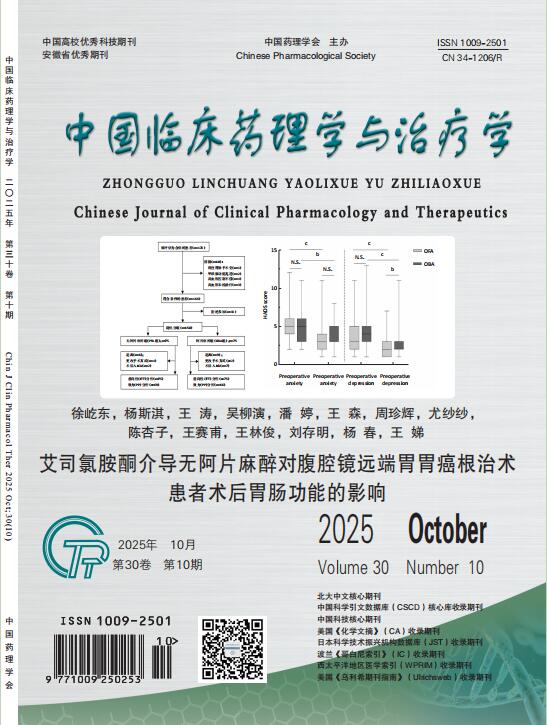
    Effects of esketamine-mediated opioid-free anesthesia on postoperative gastrointestinal function in patients undergoing laparoscopic radical resection of distal gastric cancer
    XU Yidong, YANG Siqi, WANG Tao, WU Liuyan, PAN Ting, WANG Sen, ZHOU Zhenhui, YOU Shasha, CHEN Xingzi, WANG Saifu, WANG Linjun, LIU Cunming, YANG Chun, WANG Di
    2025, 30(10):  1297-1304.  doi:10.12092/j.issn.1009-2501.2025.10.001
    Asbtract ( 125 )   PDF (923KB) ( 195 )  
    Related Articles | Metrics
    AIM: To investigate the impact of esketamine-mediated opioid-free anesthesia (OFA) on postoperative gastrointestinal function in patients undergoing laparoscopic distal gastrectomy for gastric cancer. METHODS: A total of 150 patients, scheduled for elective laparoscopic distal gastrectomy for gastric cancer and meeting the inclusion and exclusion criteria, were randomly assigned to either the OFA group or the opioid-based anesthesia (OBA) group using a random number table,?with 75 patients in each group. The OFA group was administered an anesthesia regimen primarily consisting of esketamine, while the OBA group received conventional opioid anesthesia, primarily consisting of sufentanil and remifentanil. The primary outcome measure was postoperative flatus time, defined as the interval from the end of surgery to the first passage of gas. RESULTS: The OFA group exhibited a shorter postoperative flatus time compared to the OBA group (P<0.01). Intraoperative blood loss and norepinephrine consumption were significantly less in the OFA group compared to the OBA group (P<0.05); the postoperative HADS-D score was better in the OFA group than in the OBA group, and both the OFA and OBA groups showed significantly lower postoperative HADS-A and HADS-D scores compared to their preoperative levels (P<0.05); the incidence rate of abdominal distension was significantly lower in the OFA group compared to the OBA group (P<0.05). CONCLUSION: The use of esketamine-mediated opioid-free anesthesia can expedite gastrointestinal function recovery, reduce hospital stay duration, and decrease postoperative adverse reactions in patients undergoing laparoscopic distal gastrectomy for gastric cancer. 
    Research progress of hydromorphone in postoperative analgesia for obstetrics and gynecology
    JIN Xuedong, CAO Xin, GUO Tang, CHEN Dikun, WANG Yan
    2025, 30(10):  1305-1311.  doi:10.12092/j.issn.1009-2501.2025.10.002
    Asbtract ( 127 )   PDF (636KB) ( 82 )  
    Related Articles | Metrics
    Hydromorphone, a semi-synthetic morphine derivative, offers strong analgesia with fewer side effects than traditional opioids. It has been widely used in multimodal analgesia protocols in obstetrics and gynecology. This paper reviews the current applications and research progress of hydromorphone in postoperative pain management for gynecological patients, assessing its efficacy and safety to provide evidence for clinical practice.
    A clinical study on the preventive and therapeutic effects of oxycodone administered at different timings on rebound pain following the wearing off of intercostal nerve block in thoracic surgery
    JIANG Luxiang, ZHANG Jianyou, ZHANG Zhuan, GUO Miao, TANG Suhong
    2025, 30(10):  1312-1318.  doi:10.12092/j.issn.1009-2501.2025.10.003
    Asbtract ( 106 )   PDF (732KB) ( 76 )  
    Related Articles | Metrics
    AIM: To evaluate the effect of intravenous oxycodone administration at different timing on rebound pain following the resolution of intercostal nerve blockade after thoracoscopic surgery. METHODS: A total of 114 patients undergoing elective thoracoscopic surgery under general anesthesia between January and July 2024 were selected. The patients were aged 18 to 64 years, regardless of gender, with a BMI of 18 to 30 kg/m2, and classified as ASA I-II. The patients were randomly divided into three groups using a random number table: control group (Group C), oxycodone administration at the end of surgery group (Group Q1), and oxycodone administration 6 hours postoperatively group (Group Q2), with 38 patients in each group. Group C received a normal saline injection at the end of surgery, Group Q1 received an intravenous injection of oxycodone 0.04 mg/kg at the end of surgery, and Group Q2 received an intravenous injection of oxycodone 0.04 mg/kg at 6 hours postoperatively. Patients in the three groups were treated with a postoperative intravenous self-control analgesic pump (PCIA). The occurrence of rebound pain was recorded, the time of the first analgesic pump press, the number of presses, the dosage of sufentanil, and the need for rescue analgesia were also recorded. Numerical Rating Scale (NRS) scores at rest and during movement were recorded at 6, 8, 12, 24, 48 and 72 hours postoperatively. The Pittsburgh Sleep Quality Index (PSQI) was used to assess the sleep quality of patients the night before surgery and for two nights postoperatively. Adverse reactions such as respiratory depression, postoperative nausea and vomiting (PONV), and pruritus were recorded. RESULTS: Compared with group C and Q1, the incidence of rebound pain, postoperative sufentanil consumption, effective compression frequency of PCIA from 0-24 hours after surgery, and the rate of rescue analgesia were lower in Groups Q2 (P<0.05); Compared to Group C, the NRS scores at rest and during movement at 8, 12, and 24 hours postoperatively were significantly lower in Groups Q1 and Q2 (P<0.05). However, compared to Group Q1, Group Q2 exhibited lower NRS scores at rest and during movement at 8, 12, and 24 hours postoperatively (P<0.05). On the first postoperative night, the PSQI scores of patients in Group Q2 were significantly better than those in Groups C and Q1 (P<0.05). There was no statistically significant difference in the incidence of PONV among the three groups (P>0.05). No respiratory depression, drowsiness, or pruritus were observed postoperatively in any of the groups. CONCLUSION: Intravenous injection of 0.04 mg/kg oxycodone 6 hours after surgery can reduce the occurrence of rebound pain after intercostal nerve block resolution in thoracoscopic surgery and improves patients' sleep quality.
    Suzetrigine: A novel non-opioid analgesic for the treatment of moderate-to-severe acute pain in adults
    TIAN Jie, JIANG Sheng, CHANG Huili
    2025, 30(10):  1319-1325.  doi:10.12092/j.issn.1009-2501.2025.10.004
    Asbtract ( 115 )   PDF (778KB) ( 86 )  
    Related Articles | Metrics
    Suzetrigine is the first approved selective NaV1.8 channel inhibitor. On January 30, 2025, the U.S. FDA approved Suzetrigine for the oral treatment of moderate to severe acute pain. In two phase III clinical trials (NAVIGATE-1 and NAVIGATE-2), Suzetrigine demonstrated statistically significant improvements in the primary efficacy endpoint, time-weighted sum of pain intensity differences over 48 hours (SPID48), compared with placebo. The least squares mean differences were 29.3 (95% CI: 14.0-44.6; P=0.000 2) and 48.4 (95% CI: 33.6-63.1; P<0.000 1), respectively, confirming its robust analgesic efficacy. Furthermore, owing to its high selectivity for NaV1.8, Suzetrigine exhibited favorable safety and tolerability profiles, with notably lower incidences of nausea, vomiting, and drug dependence compared to conventional opioid analgesics, underscoring its substantial clinical value.
    Exploring the mechanism of Licorice in the treatment of liver injury induced by Semen Strychni based on network pharmacology, molecular docking and animal experiments
    FU Xiaoyan, GONG Zihan, GAO Guangmiao, YANG Biqian, DENG Yi, WANG Liping, YANG Xiujuan, YANG Zhijun
    2025, 30(10):  1326-1341.  doi:10.12092/j.issn.1009-2501.2025.10.005
    Asbtract ( 110 )   PDF (3750KB) ( 92 )  
    Related Articles | Metrics
    AIM:  To investigate the potential mechanism of licorice on liver injury induced by Semen Strychni based on network pharmacology, molecular docking combined with animal experiments, providing an effective strategy for prevention and treatment of liver injury induced by Semen Strychni. METHODS: Firstly, the active ingredients of Semen Strychni and licorice were obtained through the ETCM, TCMSP database and analysis platform, CTD database and literature supplementation. Then, the potential toxic ingredients of Semen Strychni were further screened based on the SwissADME platform, and the targets corresponding to the active ingredients were predicted through the SwissTargetPrediction platform. By using the GeneCards and OMIM databases to collect DILI-related targets, the potential targets for licorice to alleviate liver injury caused by Semen Strychni were obtained. By constructing the active ingredient-target network, the core ingredients of licorice in alleviating liver injury caused by Semen Strychni were screened. The key targets obtained were used to construct and analyze the protein-protein interaction networks (PPI) through the STRING database and Cytoscape 3.9.0 software. The potential targets were subjected to GO and KEGG pathway enrichment analysis with the aid of the DAVID database, and constructed a network of active ingredient-target-pathway. Molecular docking study was approved for the core targets and the active ingredients by using Schrodinger 2023-1 software, and the visualization operation was conducted through Pymol. Finally, the regulatory effect of licorice on the key pathway of liver injury caused by Semen Strychni was validated by establishing a rat model of liver injury induced by Semen Strychni. RESULTS: After screening, 6 potential toxic components of Semen Strychni and 104 corresponding targets, 89 active components of licorice and 347 corresponding targets, and 3 200 DILI targets were obtained. A total of 23 intersection targets were obtained through Venn analysis. By constructing the active ingredient-target network, it was found that the main core ingredients were 7-methoxy-2-methyl isoflavone, medicarpin, shinpterocarpin, quercetin, formononetin and isoliquiritigenin. The PPI network indicated that the core targets were protein kinase B1 (AKT1), epidermal growth factor receptor (EGFR), human epidermal growth factor receptor 2 (ERBB2), glycogen synthase kinase 3 beta (GSK3B), kinase insert domain receptor (KDR) and Janus kinase 2 (JAK2). A total of 39 relevant pathways were enriched in KEGG (P<0.01), among which the phosphatidylinositol 3-kinase (PI3K)-protein kinase B (AKT) (PI3K-AKT) signaling pathway, which has been confirmed and ranks first in enrichment, and was closely related to liver injury. Molecular docking results showed that the core components have good binding ability with the core targets. In vivo animal experiments demonstrated that, compared to the model group, licorice significantly reduced the liver index (P<0.01), serum levels of alkaline phosphatase (ALP), alanine aminotransferase (ALT), aspartate aminotransferase (AST), indirect bilirubin (IBIL), and total bilirubin (TBIL) in rats with liver injury, while increasing total protein (TP) levels (P<0.05 or P<0.01). Additionally, licorice alleviated congestion in the central veins and hepatic sinusoids, improved the alignment of hepatocytes, and reduced inflammatory cell infiltration. Furthermore, licorice significantly decreased the levels of malondialdehyde (MDA), tumor necrosis factor-α (TNF-α), interleukin-1β (IL-1β), and interleukin-6 (IL-6) in the liver tissue of injured rats, while elevating the levels of superoxide dismutase (SOD) and glutathione peroxidase (GSH-Px) (P<0.01). It also markedly downregulated the phosphorylation levels of PI3K and AKT (P<0.01). CONCLUSION: Licorice has multi-component and multi-target properties in the treatment of liver injury induced by Semen Strychni, which may play a hepatoprotective role by inhibiting the activation of PI3K-AKT signaling pathway.
    Study on the protective mechanism of midazolam on cardiac function and angiogenesis in myocardial infarction rats by regulating the JNK/STAT3 pathway
    LI Aifang, LIANG Dong, DAI Yuanhui, CHEN Siyu
    2025, 30(10):  1342-1350.  doi:10.12092/j.issn.1009-2501.2025.10.006
    Asbtract ( 99 )   PDF (1828KB) ( 85 )  
    Related Articles | Metrics
    AIM: To investigate the protective effect of midazolam (MID) on cardiac function and angiogenesis in myocardial infarction (MI) rats and its effect on c-Jun N-terminal kinase-signal transducer and activator of transcription 3 (JNK/STAT3) pathway. METHODS: MI rat model was established by left anterior descending coronary artery ligation method. A total of 68 rats were modeled. After excluding the rats that died (n=3, mortality rate≈4.4%) or failed modeling (n=5), the 60 MI rats included in this experiment were randomly divided into the model group (Model group), MID low, medium and high dose group (1 mg/kg MID-L group, 3 mg/kg MID-M group, 6 mg/kg MID-H group), MID high dose+JNK activator Anisomycin group (6 mg/kg MID-H+Anisomycin group), 12 rats in each group. Another 12 rats undergoing sham surgery were selected as the control group. All rats were echocardiographic and evaluated for cardiac function. The myocardial tissue pathological morphology and the myocardial fibrosis degree were observed by hematoxylin-eosin (HE) staining and Masson staining. The serum myocardial injury markers [creatine kinase isoenzyme (CK-MB) and brain natriuretic peptide (BNP)] and inflammatory factors [tumor necrosis factor-α (TNF-α), interleukin-1β (IL-1β) and C-reactive protein (CRP)], myocardial tissue oxidative stress indicators [malondialdehyde (MDA), superoxide dismutase (SOD) and reduced glutathione (GSH)] levels were detected by enzyme-linked immunosorbent assay (ELISA). The vascular endothelial growth factor (VEGF), vascular endothelial growth factor receptor 2 (VEGFR2), p-JNK, JNK, p-STAT3 and STAT3 proteins expression levels were detected by Protein blot method (Western blot). RESULTS: Compared with Control group, the myocardial tissue damage degree in Model group was more severe, the myocardial interstitial fibrosis degree was greatly deepened, the collagen volume fraction was significantly increased, the left ventricular end-systolic diameter (LVESD), left ventricular end-diastolic diameter (LVEDD), CK-MB, BNP, CRP, TNF-α, IL-1β and MDA levels were significantly increased, the left ventricular ejection fraction (LVEF), left ventricular short axis shortening rate (LVFS), GSH and SOD levels were significantly decreased, and the VEGF, VEGFR2 proteins expression levels were significantly decreased, the p-JNK/JNK and p-STAT3/STAT3 were significantly increased (P<0.05). Compared with Model group, with the MID dose increase, the myocardial tissue damage degree in MID-L, MID-M and MID-H groups was significantly reduced, the myocardial interstitial fibrosis degree was reduced, the collagen volume fraction was decreased, the LVESD, LVEDD, CK-MB, BNP, CRP, TNF-α, IL-1β and MDA levels were significantly decreased, the LVEF, LVFS, GSH and SOD levels were significantly increased, and the VEGF, VEGF2R protein expression levels were significantly increased, p-JNK/JNK and p-STAT3/STAT3 were significantly decreased (P<0.05). Compared with MID-H group, the myocardial tissue damage degree in MID-H+Anisomycin group was more severe, the myocardial interstitial fibrosis degree was greatly deepened, the collagen volume fraction was significantly increased, the cardiac function was weakened, the oxidative stress and inflammation were aggravated, LVESD, LVEDD, CK-MB, BNP, CRP, TNF-α, IL-1β and MDA levels were increased, the LVEF, LVFS, GSH, SOD, VEGF and VEGFR2 proteins expression levels were significantly decreased, p-JNK/JNK and p-STAT3/STAT3 were significantly increased (P<0.05). CONCLUSION: MID may improve myocardial tissue damage in MI rats by regulating JNK/STAT3 pathway, reduce oxidative stress and inflammatory response, promote angiogenesis, so as to play a role in cardiac protection.

    Mechanism study on the improvement of lung injury in mice with influenza A virus pneumonia by Shufeng Jiedu capsules based on regulating intestinal microflora
    WU Yikun, GUO Hongmin, LI Yan, MU Weige, HUANG Shuyun, ZHU Jiuling, YANG Zhu, ZHONG Shuzhi
    2025, 30(10):  1351-1360.  doi:10.12092/j.issn.1009-2501.2025.10.007
    Asbtract ( 84 )   PDF (1724KB) ( 61 )  
    Related Articles | Metrics
    AIM: To study the improvement effect and possible mechanism of Shufeng Jiedu capsules(SFJDC) on viral pneumonia. METHODS: Forty-eight BALB/c mice were used to establish a viral pneumonia model by intranasal administration of influenza A virus H1N1. They were randomly divided into 4 groups, with twelve mice in each group. Except for the Model group, the treatment group was given oseltamivir (OSTW) , low and high dose groups of Shufeng Jiedu capsules (SFJDC-L,SFJD-H) by gavage,take another 12 mice as the normal group, continuously administered for 7 days. The physical signs of each group of mice were observed during the administration process, and the daily body weight change rate and disease activity index was calculated; After administration, lung, intestinal tissue, and intestinal contents were taken, and the pathological changes in mouse lung tissue were detected using hematoxylin eosin (HE) staining method, Alisin blue staining was used to detect goblet cells in the intestinal wall; RT-qPCR method for detecting viral load influenza (infA) and the expression of tumor necrosis factor-a (TNF-α) and interleukin-6 (IL-6) mRNA in mouse lung tissue; Detection of mouse gut microbiota using 16S rRNA high-throughput sequencing; ELISA method for detecting lipopolysaccharide (LPS) , TNF-α and IL-6 level in mouse serum; The expression of cyclic GMP AMP synthase (cGAS), interferon gene stimulating protein (STING), phospho-STING (p-STING), nuclear factor-κB (NF-κB) phospho-nuclear factor-κB (p-NF-κB) in lung tissue and ZO-1,Occludin in small small intestine was detected by Western Blotting. RESULTS: Compared with the model group, the lung index and viral load of mice in the Shufeng Jiedu capsules group were significantly reduced (P<0.01); significant reduction in lung tissue inflammation accompanied by TNF-α; The expression level of IL-6 mRNA decreased (P<0.01); The abundance of Firmicutes and Lachnospiraceae in the intestine significantly increased (P<0.01), while the abundance of Bacteroidetes and Bacteroidaceae communities significantly decreased (P<0.05 or 0.01); The number of goblet cells in the small intestine epithelium significantly increased (P<0.01); the levels of serum LPS and TNF-α,IL-6 were significantly reduced (P<0.01); The protein expression level of cGAS, p-STING, p-NF-κB significantly decreased in lung tissue (P<0.05 or 0.01), ZO-1, Occludin significantly decreased in small intestine (P<0.05). CONCLUSION: Shufeng Jiedu capsules reduces the inflammatory response of mice lung tissue, and its mechanism may be related to its regulation of intestinal flora, protection of intestinal mucosal barrier, and reduction the activation of cGAS/STING/NF-κB signaling pathway actived by LPS leakaging from the intestine.
    Effect and mechanism of extracts from oxytropis falcata on improving oxidative damage of podocytes induced by high glucose via regulating PI3K/AKT/Nrf2 pathway
    REN Menghan, YAO Jianli, YANG Lixia, SHU Chang
    2025, 30(10):  1361-1373.  doi:10.12092/j.issn.1009-2501.2025.10.008
    Asbtract ( 106 )   PDF (4491KB) ( 83 )  
    Related Articles | Metrics
    AIM: To investigate the effect of drug-containing serum of oxytropis falcata extract on oxidative stress injury of podocyte induced by high glucose through PI3K/AKT/Nrf2 pathway. METHODS:The rat renal podocyte was cultured in vitro, and the concentration and time of D-glucose modelling and the optimal concentration and time of administration in the drug-containing serum of oxytropis falcata extract were screened. The cells were divided into normal group, high glucose group, high glucose+blank serum group, oxytropis falcata group, inhibitor group, oxytropis falcata+inhibitor group. Rhodamine staining and electron microscopy were used to observe the morphological and pathological changes of podocyte, flow cytometry was used to detect apoptosis rate, and cell migration ability was detected by scratch test. Immunofluorescence and fluorescence probe were used to detect the fluorescence expression of p-AKT and ROS level of cells, ELISA was used to detect the content of MDA, NO, SOD and T-AOC in the supernatant of cells, and Western Blot was used to detect the protein expression of p-PI3K/PI3K, p-AKT/AKT and Nrf2 in cells.The mRNA expressions of Nrf2, HO-1, GCLM and SOD were detected by RT-qPCR. RESULTS: It was selected that 45 mmol/LD-glucose induction for 48 hours was the best modeling condition, and the 1-fold dilution of the medicated serum of oxytropis falcata extract for 48 hours was the best concentration and intervention time. Compared with the normal group, the foot processes of the high glucose group were widely fused and adhered to each other, the apoptosis rate, migration ability and intracellular ROS level were significantly increased (P<0.01), the fluorescence expression of p-AKT was markedly decreased (P<0.01), the contents of MDA and NO were dramatically enhanced, and the contents of SOD and T-AOC were significantly downregulated (P<0.01). The protein expression of p-PI3K/PI3K, p-AKT/AKT, Nrf2 and the mRNA expression of Nrf2, HO-1, GCLM and SOD markedly declined (P<0.01). Compared with high glucose group, foot process fusion and adhesion of podocytes in oxytropis falcata group and oxytropis falcata + inhibitor group were improved in varying degrees, apoptosis rate, migration ability and intracellular ROS level significantly declined (P<0.05, P<0.01), p-AKT fluorescence expression increased (P<0.01), NO content decreased, T-AOC level elevated (P<0.01); the content of MDA decreased and the activity of SOD notably rose (P<0.01), the protein expression of p-PI3K/PI3K, p-AKT/AKT, Nrf2 and the mRNA expression of Nrf2, HO-1, GCLM and SOD markedly increased in oxytropis falcata group (P<0.05, P<0.01); the level of ROS in podocytes improved (P<0.01), the fluorescence expression of p-AKT decreased (P<0.05), the content of NO upregulated, the content of T-AOC downregulated, and the expression of p-PI3K/PI3K, p-AKT/AKT, Nrf2 protein and HO-1, GCLM, SOD mRNA decreased in inhibitor group (P<0.05, P<0.01). Compared with oxytropis falcata group, the apoptosis rate, migration ability and intracellular ROS level of podocytes in oxytropis falcata + inhibitor group markedly increased (P<0.05, P<0.01), p-AKT fluorescence expression declined (P<0.01), MDA and NO content increased, SOD and T-AOC content decreased (P<0.05, P<0.01), p-PI3K/PI3K, p-AKT/AKT, Nrf2 protein and Nrf2, HO-1, GCLM, SOD mRNA expression all dramatically downregulated (P<0.05, P<0.01). CONCLUSION: Oxytropis falcata extract may protect podocytes by activating the PI3K/AKT/Nrf2 signaling pathway, thereby improving the morphological, structural and functional changes of podocytes induced by high glucose and inhibiting oxidative stress response.
    The mechanism of polygonatum polysaccharide inducing the differentiation of tendon stem cells into chondrocytes through TGF-β3/Smad2 signaling pathway
    CHEN Junjie, YANG Dujiang, HE Jiayang, YUAN Xintong, LIU Yingqi, YANG Jiexiang, WANG Guoyou, PENG Teng, SHEN Huarui
    2025, 30(10):  1374-1382.  doi:10.12092/j.issn.1009-2501.2025.10.009
    Asbtract ( 103 )   PDF (2362KB) ( 57 )  
    Related Articles | Metrics
    AIM: To verify the effect of polygonatum polysaccharide (PSP) combined with TGF-β3 in inducing the differentiation of rat tendon-derived stem cells (TDSCs) into chondrocytes by activating the TGF-β3/Smad2 pathway. METHODS: TDSCs were extracted from rat tail tendons using enzyme digestion, purified, passaged, and identified via flow cytometry. TDSCs were treated with different concentrations of PSP, and the optimal growth concentration was determined using the CCK-8 assay. TDSCs were divided into four groups: PSP, TGF-β3, PSP+TGF-β3, and Control for differentiation induction. Chondrogenic differentiation was evaluated using morphological observations, toluidine blue staining, immunofluorescence staining, and Western blot analysis to detect COLⅡ, SOX9, and AGG. Western blot was also used to measure the expression levels of Smad2 and p-Smad2 to evaluate the activation of the TGF-β3/Smad2 pathway after chondrogenic induction. RESULTS: Flow cytometry analysis showed that TDSCs highly expressed CD90 and CD29, while CD11b and CD45 expression was low. The CCK-8 assay indicated that 5 μmol/L PSP was the optimal intervention dose. Toluidine blue staining revealed that the blue staining area in the PSP, PSP+TGF-β3, and TGF-β3 groups was larger compared to the Control group. Immunofluorescence analysis demonstrated that COLⅡ expression was significantly increased in the PSP, TGF-β3, and PSP+TGF-β3 groups, with the highest expression in the PSP+TGF-β3 group (P<0.05). Western blot analysis showed that the levels of p-Smad2/Smad2, COLⅡ, SOX9, and AGG were elevated in the PSP, TGF-β3, and PSP+TGF-β3 groups, with the highest expression in the PSP+TGF-β3 group (P<0.05). Compared to the Control group, the TGF-β3 and PSP groups also showed significantly increased expression (P<0.05). CONCLUSION: PSP promotes the proliferation and chondrogenic differentiation of TDSCs, possibly by activating the TGF-β3/Smad2 pathway.
    Correlation between GST gene polymorphism and concentration of azathioprine active metabolite 6-TGN in patients with inflammatory bowel disease
    DONG Jiashan, CHEN Jiarui, ZENG Dayong, LIU Yiwei, XU Jianwen, LIN Rongfang
    2025, 30(10):  1383-1390.  doi:10.12092/j.issn.1009-2501.2025.10.010
    Asbtract ( 81 )   PDF (662KB) ( 79 )  
    Related Articles | Metrics
    AIM: To investigate the effects of glutathione-S-transferase (GST) gene polymorphism on the concentration of 6-thioguanine nucleotides (6-TGN), an active metabolite of azathioprine (AZA), in patients with inflammatory bowel disease (IBD), in order to provide reference for the optimization of AZA treatment in patients. METHODS: The clinical data of patients with IBD treated by AZA were collected prospectively, the genotypes of GST-A1, GST-M1, GST-P1 and GST-T1 were detected by targeted sequencing of multiplex PCR combined with high-throughput sequencing technology before administration, and the steady-state trough concentrations of 6-TGN in patients' red blood cells were determined by HPLC. Statistical analysis was carried out by SPSS 26.0 software. RESULTS: A total of 90 patients were included in this study. The alleles frequencies of GST-A1, GST-M1, GST-P1 and GST-T1 were consistent with Hardy-Weinberg equilibrium law. Logistic regression analysis showed that carrying GST-A1 mutant gene was an independent risk factor for the increase of trough concentration of 6-TGN (low concentration OR=17.50, P=0.030; high concentration OR=3.60, P=0.033), while the gene polymorphism of GST-M1, GST-P1, GST-T1 had no significant correlation with the concentration of 6-TGN (P>0.05). CONCLUSION: The gene polymorphism of GST-A1 may affect the concentration of 6-TGN, an active metabolite of AZA, and detection of GST-A1 genotype before AZA treatment will contribute to clinical individualized medication.
    Effect of Angong Niuhuang pill combined with conventional treatment on neurological function recovery in patients with phlegm-heat internal closed cerebral hemorrhage: A randomized controlled trial based on the AMPK-PGC1α-NRF2 pathway
    WU Yuxing, Li Yi, YUE Xiaoqing, ZHANG Chenlu, ZHANG Yanping
    2025, 30(10):  1391-1399.  doi:10.12092/j.issn.1009-2501.2025.10.011
    Asbtract ( 148 )   PDF (2324KB) ( 60 )  
    Related Articles | Metrics
    AIM: To examine the impact of Angong Niuhuang pill in conjunction with conventional therapy on the recovery of neurological function in patients with cerebral hemorrhage (ICH) characterized by phlegm-heat internal obstruction, and to evaluate its efficacy in enhancing neurological function, promoting brain tissue repair, and mitigating oxidative stress. Additionally, this study aims to elucidate the potential mechanisms underlying these effects through the AMPK-PGC1α-Nrf2 pathway. METHODS: A total of 130 patients with ICH characterized by phlegm-heat internal closure were recruited and randomly allocated into a control group (receiving conventional treatment) and a study group (receiving Angong Niuhuang pill in combination with conventional treatment) using the random number table method, with 65 cases in each group. Post-treatment assessments included the National Institutes of Health Stroke Scale (NIHSS) score, Glasgow Coma Scale (GCS) score, modified Rankin scale (mRS) score, as well as tissue levels of AMP-activated protein kinase (AMPK), peroxisome proliferator-activated receptor gamma coactivator-1α (PGC1α), and nuclear factor erythroid 2-related factor 2 (NRF2). Additionally, serum levels of superoxide dismutase (SOD), malondialdehyde (MDA), reactive oxygen species (ROS), interleukin-10 (IL-10), tumor necrosis factor-α (TNF-α), interleukin-6 (IL-6), glutathione peroxidase 4 (GPX4), acyl-coenzyme A synthetase long-chain family member 4 (ACSL4), iron ions, tumor volume, brain edema volume, and the incidence of adverse reactions were evaluated. RESULTS: Each group comprised 65 cases. Post-treatment, the NIHSS score (9.97±1.22) and mRS score (2.29±0.33) in the Research Group were significantly lower than those in the Control Group (11.17±1.52 and 2.64±0.45, respectively), with p-values less than 0.05. Additionally, the GCS score for the Research Group (14.57±1.19) was notably higher compared to the control group (13.18±1.05) (P<0.05). After treatment, the expressions of AMPK [(3.34±0.81) ng/mL], PGC1α [(2.30±0.67) ng/mL] and NRF2 [(3.72±0.85) ng/mL] in the tissues of the group were higher than those of the control group [(2.63±0.65) ng/mL, (1.83±0.70) ng/mL, (2.91±0.96) ng/mL] (P<0.05). After treatment, the levels of serum SOD [(98.76±6.67) U/mL] and IL-10 [(40.37±5.61) pg/mL] in the research group were higher than those in the Control group group [(89.65±6.89) U/mL, (35.69±4.65) pg/mL] (P<0.05); the serum levels of MDA [(3.36±0.62) nmol/mL], ROS [(126.35±23.74) U/mL], TNF-α [(17.22±2.07) pg/mL] and IL-6 [(33.37±3.76) pg/mL] in the group were lower than those in the control group group [(3.76±0.83) nmol/mL, (159.85±26.67) nmol/mL, (19.15±2.34) nmol/mL, (41.26±4.91) nmol/mL] (P<0.05). After treatment, the serum GPX4 level in the Research Group [(9.87±1.25) ng/mL] was higher than that in the control group [(8.16±1.12) ng/mL] (P<0.05). The serum levels of ACSL4 [(8.74±1.45) ng/mL] and iron ion [(27.44±3.35) μmol/L] in the study group were lower than those in the control group (10.12±2.11) ng/mL, (30.46±3.17) μmol/L] (P<0.05). After treatment, the hematoma volume [(6.46±1.13) mL] and brain edema volume [(11.47±1.76) mL] in the research group were better than those in the Control group [(8.71±1.02) mL, (3.41±2.04) mL] (P<0.05). CONCLUSION: The combination of Angong Niuhuang pill with conventional treatment demonstrates significant efficacy in improving neurological function, promoting brain tissue repair, and alleviating oxidative stress, thereby exhibiting high application value in clinical practice.
    PCSK9 through non-lipid pathways in the pathogenesis of atherosclerosis: a review of progress in research
    LI Dongze, ZHAO Jiyi
    2025, 30(10):  1400-1407.  doi:10.12092/j.issn.1009-2501.2025.10.012
    Asbtract ( 101 )   PDF (978KB) ( 68 )  
    Related Articles | Metrics
    Proprotein convertase subtilisin/KEXIN type 9 (PCSK9) is the ninth member of the proprotein convertase family and released into the bloodstream. It reduces the availability of low-density lipoprotein receptors and leads to the accumulation of low-density lipoprotein cholesterol in plasma, thereby promoting the development of atherosclerotic plaques and thrombotic events. In addition to its classical pathway, recent studies have demonstrated multiple non-classical pathways by which PCSK9 influences the development of atherosclerosis-related diseases, including participation in inflammatory responses, regulation of autophagy and cell apoptosis, promotion of platelet activation and thrombus formation, etc. This article provides an overview of the latest progress in the molecular mechanism by which PCSK9 affects atherosclerotic diseases through non-lipid-dependent pathways.
    Research progress on the effect and mechanism of natural products of traditional Chinese medicine in preventing vascular restenosis
    LUO Jiawei, CHEN Tianwang, WANG Xinyu, LIU Juan, HUANG Bo, LI Lisheng, XU Shangfu
    2025, 30(10):  1408-1416.  doi:10.12092/j.issn.1009-2501.2025.10.013
    Asbtract ( 88 )   PDF (651KB) ( 57 )  
    Related Articles | Metrics
    Percutaneous coronary intervention (PCI) has been widely applied in the clinical treatment of coronary atherosclerotic heart disease and achieved good therapeutic effects. However, vascular restenosis caused by postoperative vascular remodeling still needs attention, which seriously affects the long-term efficacy of PCI. The prevention of vascular restenosis is of great significance for cardiovascular diseases. Traditional Chinese medicine natural products, with their characteristics of multiple targets, low toxicity and high safety, have attracted increasing attention in recent years. More and more studies have found that traditional Chinese medicine natural products have the effect of preventing and treating vascular restenosis and can effectively control its occurrence and development. This article reviews the effects and mechanisms of flavonoids, alkaloids, terpenoids and glycosides, polysaccharides and polyphenols and other traditional Chinese medicine natural products in preventing vascular restenosis, and analyzes and summarizes the differences in the effects and mechanisms of various natural products, providing new ideas for the development of safe and effective drugs to prevent vascular restenosis.
    Advances in the pharmacological mechanisms of monomers from Chinese medicine that target pathways involved in Alzheimer's disease
    CHANG Chengtian, LIU Zhihua, CHENG Shuaifang, WANG Xueke, ZHAO Qianqian, GAO Liting
    2025, 30(10):  1417-1428.  doi:10.12092/j.issn.1009-2501.2025.10.014
    Asbtract ( 104 )   PDF (801KB) ( 94 )  
    Related Articles | Metrics
    Alzheimer's disease (AD) is a prevalent neurodegenerative disorder, characterized by the accumulation of beta-amyloid plaques, the phosphorylation of Tau proteins, and neuronal loss. As the global population ages, the incidence of AD is rising, and there is currently no effective cure.Herbal monomers have garnered interest due to their multifaceted pharmacological effects and low toxicity. This paper aims to provide a comprehensive overview of the mechanisms of Nrf2, NF-κB, PI3K/Akt, MAPK and other signalling pathways in the pathogenesis of AD. It also explores the modulation of these pathways by various TCM monomers, such as leptomeningine and tanshinone IIA, and details the research progress to date. For instance, Leptosine has been shown to activate Nrf2, thereby reducing oxidative stress, while Tanshinone IIA has been observed to inhibit the NF-κB pathway, leading to a reduction in inflammation. Notwithstanding the encouraging indications for the treatment of AD with TCM monomers, there are several challenges that must be addressed. Firstly, the precise mechanism of action remains to be fully elucidated. Secondly, there are significant challenges related to pharmacokinetics and bioavailability. Thirdly, the sample size of clinical studies is limited and of variable quality. Fourthly, the quality control process is complex. Finally, interactions with other drugs must be taken into account.
    Research progress of lemborexant in the treatment of insomnia disorder
    GUO Lijia, DONG Zixuan, WU Huizhen
    2025, 30(10):  1429-1435.  doi:10.12092/j.issn.1009-2501.2025.10.015
    Asbtract ( 132 )   PDF (685KB) ( 866 )  
    Related Articles | Metrics
    Lemborexant is a new drug for the treatment of insomnia. It is a dual orexin receptor antagonist that competitively binds to two orexin receptors, OX1R and OX2R, inhibits orexin neurotransmission, and regulates the sleep-wake rhythm. This article comprehensively reviews the discovery of the drug target, basic information, clinical studies, safety assessment, and limitation analysis of lemborexant, aiming to provide a comprehensive understanding of the current research status and achievements of this drug in clinical practice.
    Tyrosine phosphatase Shp2 and acute lung injury
    JI Haoyu, QIN Lilong, ZHA Lei, WANG Hanli, CHENG Yusheng
    2025, 30(10):  1436-1440.  doi:10.12092/j.issn.1009-2501.2025.10.016
    Asbtract ( 76 )   PDF (542KB) ( 150 )  
    Related Articles | Metrics
    Acute lung injury (ALI) is a common critical illness caused by intrapulmonary or extrapulmonary factors, which is accompanied by extremely high morbidity and mortality. Its pathogenesis is extremely complex and difficult to treat. Src homology 2 domain-containing protein tyrosine phosphatase (Shp2), a key cellular signal transduction molecule, plays a pivotal role in the pathophysiological processes of diverse diseases. Notably, in the context of pathogen infection, Shp2 regulates the functionality of cellular immunity, lung epithelial cells, and vascular endothelial cells. This review article highlights the significant role of Shp2 in the onset and progression of ALI, emphasizing its regulation of inflammatory response, apoptosis, and oxidative stress. Shp2 could emerge as a novel therapeutic target for ALI, offering valuable insights for the development of innovative drug candidates to treat this debilitating condition.