中国临床药理学与治疗学 ›› 2026, Vol. 31 ›› Issue (8): 1112-1126.doi: 10.12092/j.issn.1009-2501.2026.08.012
• 综述与讲座 • 上一篇
姚景曦( ), 魏钰舒, 袁文君, 魏星, 孙可馨, 尚菁, 史正刚()
收稿日期:2025-10-13
修回日期:2025-12-03
出版日期:2026-08-26
发布日期:2026-09-09
通讯作者:
史正刚
E-mail:yaojx2pdcm@126.com;shizhenggang007@163.com
作者简介:姚景曦,男,博士研究生,研究方向:中医药防治小儿心肝系统疾病研究。E-mail:基金资助:
Jingxi YAO(), Yushu WEI, Wenjun YUAN, Xing WEI, Kexin SUN, Jing SHANG, Zhenggang SHI()
Received:2025-10-13
Revised:2025-12-03
Online:2026-08-26
Published:2026-09-09
Contact:
Zhenggang SHI
E-mail:yaojx2pdcm@126.com;shizhenggang007@163.com
摘要:
中枢神经系统(central nervous system,CNS)疾病是全球热点关注疾病类型,已严重影响全球健康并造成巨大经济负担。中医药治疗CNS疾病具有理论及临床双重优势。钩藤作为应用千年的平肝息风药,能够通过多途径、多靶点在CNS疾病的治疗中发挥重要作用。研究表明,钩藤吲哚类生物碱是其主要活性成分,钩藤碱、异钩藤碱等是钩藤治疗CNS疾病的主要物质基础。其活性成分能够通过抗炎、抗氧化、抑制细胞凋亡、促进自噬、抑制β淀粉样蛋白沉积及Tau蛋白异常磷酸化等途径发挥作用。本文通过系统性总结钩藤及其单体干预阿尔茨海默病、帕金森病、癫痫及抑郁症等常见CNS疾病的作用机制,以期为钩藤在CNS疾病中的进一步研究及临床应用提供参考,为研究者了解钩藤治疗CNS疾病的研究进展及不足提供一定帮助。
中图分类号:
姚景曦, 魏钰舒, 袁文君, 魏星, 孙可馨, 尚菁, 史正刚. 钩藤及其单体干预中枢神经系统疾病的作用机制研究进展[J]. 中国临床药理学与治疗学, 2026, 31(8): 1112-1126.
Jingxi YAO, Yushu WEI, Wenjun YUAN, Xing WEI, Kexin SUN, Jing SHANG, Zhenggang SHI. Advances in the mechanisms of Uncaria rhynchophylla and its monomeric compounds against central nervous system diseases[J]. Chinese Journal of Clinical Pharmacology and Therapeutics, 2026, 31(8): 1112-1126.
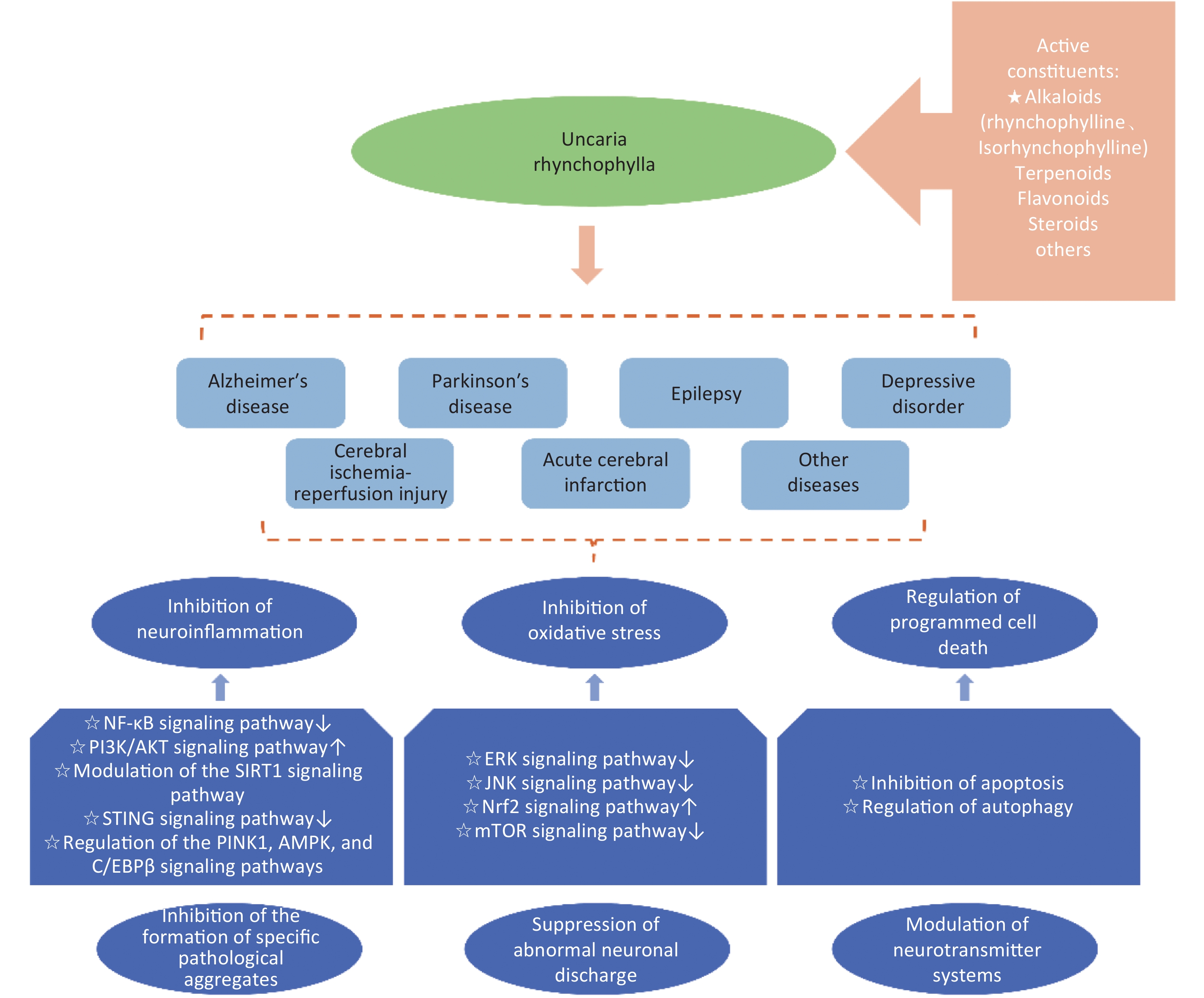
图 1
Fig.1 Mechanisms of Uncaria rhynchophylla and its monomers in intervening CNS diseases
| Disease | Intervention | Model | Mechanism | References |
| AD | Extract of Uncaria rhynchophylla | 5XFAD mice (transgenic model) | Iba-1↓ | [ |
| AD | Uncaria rhynchophylla alkaloid extract | APP/PS1 (transgenic model) mice; splenic lymphocytes (ConA) | Aβ, p-tau, IFN-γ, IL-17, CD4? effector T cells, HK2, GLUT1, p-PI3K, p-Akt, p-mTOR↓; IL-10, TGF-β, Treg↑ | [ |
| AD | RN,IRN | N9 microglial cells (LPS) | TNF-α, IL-1β, NO, iNOS, ERK, MAPKs, IκBα↓ | [ |
| AD | RN | Primary microglia (LPS) | NO, PEG2, MCP-1, TNF-α, IL-1β, iNOS, COX2, p-IκBα, p-MAPKs↓ | [ |
| AD | Extract of Uncaria rhynchophylla | SD rats (STZ) | p-tau, IL-6, IL-1β, TNF-α↓; p-Akt, p-GSK-3β↑ | [ |
| AD | RN | TgCRND8 mice,5×FAD mice, 3×Tg-AD mice (transgenic models); BV-2 cells (Aβ42) | p-tau, p-APP, BACE1, APH1, FL-APP, IL-6, IL-1β, TNF-α, Galectin-3, C/EBPβ, AEP, HDAC2, AMPKα1↓; IDE, PINK1↑ | [ |
| PD | Hirsutine | SD rats (6-OHDA) | p-IκBα, NF-κB p65, IL-6, IL-1β, TNF-α↓; DA, TH↑ | [ |
| PD | Uncaria rhynchophylla alkaloid extract | C57BL/6J mice (MPTP); BV-2 cells, SH-SY5Y cells (LPS) | IL-1β, TNF-α, IL-6, TLR4, NLRP3, COX2↓; TH, IL-10↑ | [ |
| EP | Extract of Uncaria rhynchophylla,RN | SD rats (kainic acid) | Superoxide anion, NF-κB, AP-1, p-JNK↓ | [ |
| EP | Extract of Uncaria rhynchophylla | SD rats (kainic acid) | ED1, nNOS, iNOS↓ | [ |
| EP | Extract of Uncaria rhynchophylla,RN | SD rats (kainic acid) | MIF, CypA↑ | [ |
| EP | Extract of Uncaria rhynchophylla,RN | SD rats (kainic acid) | MAPK, p-JNK↓ | [ |
| EP | Extract of Uncaria rhynchophylla,RN | SD rats (kainic acid) | IL-1β, BDNF↓ | [ |
| EP | IRN | SD rats (Lithium-pilocarpine) | IL-6, IL-1β, TNF-α, Acetyl-p53/p53, cleaved caspase-3/caspase-3↓; SIRT1↑ | [ |
| DD | IRN | ICR mice (CUMS) | TNF-α, IL-6, NF-kB p-65↓; NGF, BDNF, p-GSK-3β, p-Akt↑ | [ |
| Cerebral Ischemia/ Reperfusion Injury | IRN | SD rats (MCAO) | GFAP, IBA-1, TNFα, IL-1β, CX3CR1, p-NF-κB p65↓; YM-1/2, IκB-α↑ | [ |
| ACI | IRN | SD rats (MCAO) | IL-6, TNF-α, STING, p-TBK1, p-IRF3↓; ZO-1, occludin↑ | [ |
表 1
Table 1 Mechanisms of Uncaria rhynchophylla and its monomers in inhibiting neuroinflammation
| Disease | Intervention | Model | Mechanism | References |
| AD | Extract of Uncaria rhynchophylla | 5XFAD mice (transgenic model) | Iba-1↓ | [ |
| AD | Uncaria rhynchophylla alkaloid extract | APP/PS1 (transgenic model) mice; splenic lymphocytes (ConA) | Aβ, p-tau, IFN-γ, IL-17, CD4? effector T cells, HK2, GLUT1, p-PI3K, p-Akt, p-mTOR↓; IL-10, TGF-β, Treg↑ | [ |
| AD | RN,IRN | N9 microglial cells (LPS) | TNF-α, IL-1β, NO, iNOS, ERK, MAPKs, IκBα↓ | [ |
| AD | RN | Primary microglia (LPS) | NO, PEG2, MCP-1, TNF-α, IL-1β, iNOS, COX2, p-IκBα, p-MAPKs↓ | [ |
| AD | Extract of Uncaria rhynchophylla | SD rats (STZ) | p-tau, IL-6, IL-1β, TNF-α↓; p-Akt, p-GSK-3β↑ | [ |
| AD | RN | TgCRND8 mice,5×FAD mice, 3×Tg-AD mice (transgenic models); BV-2 cells (Aβ42) | p-tau, p-APP, BACE1, APH1, FL-APP, IL-6, IL-1β, TNF-α, Galectin-3, C/EBPβ, AEP, HDAC2, AMPKα1↓; IDE, PINK1↑ | [ |
| PD | Hirsutine | SD rats (6-OHDA) | p-IκBα, NF-κB p65, IL-6, IL-1β, TNF-α↓; DA, TH↑ | [ |
| PD | Uncaria rhynchophylla alkaloid extract | C57BL/6J mice (MPTP); BV-2 cells, SH-SY5Y cells (LPS) | IL-1β, TNF-α, IL-6, TLR4, NLRP3, COX2↓; TH, IL-10↑ | [ |
| EP | Extract of Uncaria rhynchophylla,RN | SD rats (kainic acid) | Superoxide anion, NF-κB, AP-1, p-JNK↓ | [ |
| EP | Extract of Uncaria rhynchophylla | SD rats (kainic acid) | ED1, nNOS, iNOS↓ | [ |
| EP | Extract of Uncaria rhynchophylla,RN | SD rats (kainic acid) | MIF, CypA↑ | [ |
| EP | Extract of Uncaria rhynchophylla,RN | SD rats (kainic acid) | MAPK, p-JNK↓ | [ |
| EP | Extract of Uncaria rhynchophylla,RN | SD rats (kainic acid) | IL-1β, BDNF↓ | [ |
| EP | IRN | SD rats (Lithium-pilocarpine) | IL-6, IL-1β, TNF-α, Acetyl-p53/p53, cleaved caspase-3/caspase-3↓; SIRT1↑ | [ |
| DD | IRN | ICR mice (CUMS) | TNF-α, IL-6, NF-kB p-65↓; NGF, BDNF, p-GSK-3β, p-Akt↑ | [ |
| Cerebral Ischemia/ Reperfusion Injury | IRN | SD rats (MCAO) | GFAP, IBA-1, TNFα, IL-1β, CX3CR1, p-NF-κB p65↓; YM-1/2, IκB-α↑ | [ |
| ACI | IRN | SD rats (MCAO) | IL-6, TNF-α, STING, p-TBK1, p-IRF3↓; ZO-1, occludin↑ | [ |
| Disease | Intervention | Model | Mechanism | References |
| AD | Extract of Uncaria rhynchophylla | ICR mice(D-galactose) | ACh, GSH↑; AChE, MDA↓ | [ |
| AD | IRN | PC12 cells (Aβ25-35) | ROS, MDA↓; GSH↑ | [ |
| AD | Geissoschizine methyl ether | HT22 (H2O2) | ROS, p-ERK↓ | [ |
| AD | Extract of Uncaria rhynchophylla | SD rats (STZ) | Keap1↓; SOD, CAT, GPx, HO-1, Nrf2↑ | [ |
| AD | RN | Astrocytes (TNF-α) | IL-23, IL-6, MDA, p-mTOR, p-STAT3↓; NOS, NO, SOD↑ | [ |
| PD | Uncaria rhynchophylla alkaloid extract | C57BL/6J mice (MPTP); BV-2 cells, SH-SY5Ycells (LPS) | IL-1β, TNF-α, IL-6, LDH, MDA, TLR4, NLRP3, COX2↓; TH, IL-10, SOD, GSH, Nrf2, HO-1↑ | [ |
| DD | IRN | SD rats (CUMS) | MDA, p-JNK↓; SOD, GSH-Px↑ | [ |
表 2
Table 2 Mechanisms of Uncaria rhynchophylla and its monomers in inhibiting oxidative stress
| Disease | Intervention | Model | Mechanism | References |
| AD | Extract of Uncaria rhynchophylla | ICR mice(D-galactose) | ACh, GSH↑; AChE, MDA↓ | [ |
| AD | IRN | PC12 cells (Aβ25-35) | ROS, MDA↓; GSH↑ | [ |
| AD | Geissoschizine methyl ether | HT22 (H2O2) | ROS, p-ERK↓ | [ |
| AD | Extract of Uncaria rhynchophylla | SD rats (STZ) | Keap1↓; SOD, CAT, GPx, HO-1, Nrf2↑ | [ |
| AD | RN | Astrocytes (TNF-α) | IL-23, IL-6, MDA, p-mTOR, p-STAT3↓; NOS, NO, SOD↑ | [ |
| PD | Uncaria rhynchophylla alkaloid extract | C57BL/6J mice (MPTP); BV-2 cells, SH-SY5Ycells (LPS) | IL-1β, TNF-α, IL-6, LDH, MDA, TLR4, NLRP3, COX2↓; TH, IL-10, SOD, GSH, Nrf2, HO-1↑ | [ |
| DD | IRN | SD rats (CUMS) | MDA, p-JNK↓; SOD, GSH-Px↑ | [ |
| Disease | Intervention | Model | Mechanism | References |
| AD | IRN | SD rats (Aβ25-35) | caspase-3, caspase-9, GSK-3β↓; Bcl-2/Bax, Akt↑ | [ |
| AD | IRN | PC12 cells (Aβ25-35) | caspase-3↓; Bcl-2/Bax↑ | [ |
| AD | Extract of Uncaria rhynchophylla | SD rats (NMDA) | c-jun, p53, bax↓ | [ |
| PD | RN | Primary cerebellar granule neurons (MPP?) | Bax/Bcl-2↓; MEF2, MEF2D, p-GSK3β, p-Ser473-Akt↑ | [ |
| PD | RN | PC12 cells (MPP?) | LDH, Ca2+, ROS, caspase-3↓; Bcl-2/Bax, p-Akt↑ | [ |
| PD | Extract of Uncaria rhynchophylla | C57BL/6 mice (MPTP) | caspase-3↓; DA, HVA, DAT, TH, p-mTOR, p-Akt, Bcl-2/BAD↑ | [ |
| PD | Gastrodin, IRN | PC12 cells (MPP+) | caspase-3, LPO, ERK1/2, PI3K, GSK-3β↓; HO-1, NQO-1↑ | [ |
| DD | IRN | SD rats (CUMS) | level of apoptosis, Bax, Cleaved Caspase-3, p-JNK↓; Bcl-2↑ | [ |
表 3
Table 3 Mechanisms of Uncaria rhynchophylla and its monomers in inhibiting apoptosis
| Disease | Intervention | Model | Mechanism | References |
| AD | IRN | SD rats (Aβ25-35) | caspase-3, caspase-9, GSK-3β↓; Bcl-2/Bax, Akt↑ | [ |
| AD | IRN | PC12 cells (Aβ25-35) | caspase-3↓; Bcl-2/Bax↑ | [ |
| AD | Extract of Uncaria rhynchophylla | SD rats (NMDA) | c-jun, p53, bax↓ | [ |
| PD | RN | Primary cerebellar granule neurons (MPP?) | Bax/Bcl-2↓; MEF2, MEF2D, p-GSK3β, p-Ser473-Akt↑ | [ |
| PD | RN | PC12 cells (MPP?) | LDH, Ca2+, ROS, caspase-3↓; Bcl-2/Bax, p-Akt↑ | [ |
| PD | Extract of Uncaria rhynchophylla | C57BL/6 mice (MPTP) | caspase-3↓; DA, HVA, DAT, TH, p-mTOR, p-Akt, Bcl-2/BAD↑ | [ |
| PD | Gastrodin, IRN | PC12 cells (MPP+) | caspase-3, LPO, ERK1/2, PI3K, GSK-3β↓; HO-1, NQO-1↑ | [ |
| DD | IRN | SD rats (CUMS) | level of apoptosis, Bax, Cleaved Caspase-3, p-JNK↓; Bcl-2↑ | [ |
| Disease | Intervention | Model | Mechanism | References |
| PD | Corynoxine | C57BL/6J mice (Rotenone) | p-mTOR, p-p70↓; LC3 Ⅱ↑ | [ |
| PD | IRN | Primary mouse cortical neurons (WT), Neuroblastoma cell line (A53T, A30P) | α-Syn, α-syn oligomers, α-Syn/synphilin-1 aggregates↓; LC3-II, GFP↑ | [ |
| PD | Corynoxine | N2a, SH-SY5Y cells (ATG5 knockdown, 3-MA, chloroquine) | p-Akt, p-mTOR, p-p70 S6↓; CTS D↑ | [ |
| PD | Corynoxine B | N2a cells (overexpression of EGFP-2xFYVE and RFP-LC3); Prp-α-syn mice (transgenic model) | EGFP-2xFYVE, HMGB1, HMGB2, Beclin 1, PI3KC3↑ | [ |
| PD | Uncaria rhynchophyllaalkaloid extract | C57BL/6J mice, SD rats (MPTP); PC12 cells (6-OHDA) | ROS↓; UCHL1, ATP↑ | [ |
表 4
Table 4 Mechanisms of Uncaria rhynchophylla and its monomers in regulating autophagy
| Disease | Intervention | Model | Mechanism | References |
| PD | Corynoxine | C57BL/6J mice (Rotenone) | p-mTOR, p-p70↓; LC3 Ⅱ↑ | [ |
| PD | IRN | Primary mouse cortical neurons (WT), Neuroblastoma cell line (A53T, A30P) | α-Syn, α-syn oligomers, α-Syn/synphilin-1 aggregates↓; LC3-II, GFP↑ | [ |
| PD | Corynoxine | N2a, SH-SY5Y cells (ATG5 knockdown, 3-MA, chloroquine) | p-Akt, p-mTOR, p-p70 S6↓; CTS D↑ | [ |
| PD | Corynoxine B | N2a cells (overexpression of EGFP-2xFYVE and RFP-LC3); Prp-α-syn mice (transgenic model) | EGFP-2xFYVE, HMGB1, HMGB2, Beclin 1, PI3KC3↑ | [ |
| PD | Uncaria rhynchophyllaalkaloid extract | C57BL/6J mice, SD rats (MPTP); PC12 cells (6-OHDA) | ROS↓; UCHL1, ATP↑ | [ |
| Disease | Intervention | Model | Mechanism | References |
| DD | IRN | BALB/c mice (/) | MAO-A↓, NE, 5-HT↑ | [ |
| DD | Extract of Uncaria rhynchophylla | C57BL/6 mice (CUMS) | 5-HT, 5-HIAA, DA, DOPAC, HVA, BDNF, the number of BrdU?/NeuN? double-positive cells, 5-HT1A, CREB, BDNF, PKA↑ | [ |
| DD | IRN | C57BL/6J mice (CUMS) | CORT, Glu, GluN2A、GluN2B↓; D-Ser, SRR↑ | [ |
| DD | Catechin | HEK293 cells (/) | MT1, MT2↑ | [ |
表 5
Table 5 Mechanisms of Uncaria rhynchophylla and its monomers in modulating neurotransmitters
| Disease | Intervention | Model | Mechanism | References |
| DD | IRN | BALB/c mice (/) | MAO-A↓, NE, 5-HT↑ | [ |
| DD | Extract of Uncaria rhynchophylla | C57BL/6 mice (CUMS) | 5-HT, 5-HIAA, DA, DOPAC, HVA, BDNF, the number of BrdU?/NeuN? double-positive cells, 5-HT1A, CREB, BDNF, PKA↑ | [ |
| DD | IRN | C57BL/6J mice (CUMS) | CORT, Glu, GluN2A、GluN2B↓; D-Ser, SRR↑ | [ |
| DD | Catechin | HEK293 cells (/) | MT1, MT2↑ | [ |
| 1 | 唐德才, 吴庆光. 中药学 [M]. 北京: 人民卫生出版社, 2024: 291-292. |
| 2 |
Jin M, Wang C, Xu Y, et al. Pharmacological effects of salidroside on central nervous system diseases[J]. Biomed Pharmacother, 2022, 156, 113746.
doi: 10.1016/j.biopha.2022.113746 |
| 3 | 张雯昕, 张春霞, 韩凌飞, 等. 钩藤网络药理学多靶点效应价值研究进展[J]. 中国药科大学学报, 2025, 56 (3): 376- 381. |
| 4 |
余俊, 黄宗雯. 钩藤属化学成分研究进展[J]. 中药材, 2021, 44 (1): 233- 239.
doi: 10.3969/j.issn.1008-021X.2022.22.031 |
| 5 |
Cao R, Wang Y, Zhou Y, et al. Advanced researches of traditional uses, phytochemistry, pharmacology, and toxicology of medical uncariae ramulus cum uncis[J]. J Ethnopharmacol, 2024, 325, 117848.
doi: 10.1016/j.jep.2024.117848 |
| 6 |
周泽琴, 刘方敏, 蔡延渠. 《中国药典》2020年版一部方剂中含“后下”中药的水提取工艺问题分析[J]. 广东药科大学学报, 2025, 41 (1): 136- 141.
doi: 10.16809/j.cnki.2096-3653.2024101002 |
| 7 |
Khan AU, Nazir S, El-Keblawy A, et al. Uncaria rhynchophylla mediated Ag/NiO nanocomposites: a new insight for the evaluation of cytotoxicity, antibacterial and photocatalytic applications[J]. Photodiagnosis Photodyn Ther, 2022, 37, 102681.
doi: 10.1016/j.pdpdt.2021.102681 |
| 8 |
Li H, Wei W, Li Z, et al. An enhanced strategy integrating offline two-dimensional separation with data independent acquisition mode and deconvolution: characterization of metabolites of uncaria rhynchophylla in rat plasma as a case[J]. J Chromatogr B Analyt Technol Biomed Life Sci, 2021, 1181, 122917.
doi: 10.1016/j.jchromb.2021.122917 |
| 9 |
Zhang X, Wang S, Shu L, et al. Rapid screening of hepatotoxic components in uncariae ramulus cum uncis based on “component-target-pathway” network[J]. J Pharm Biomed Anal, 2022, 219, 114968.
doi: 10.1016/j.jpba.2022.114968 |
| 10 | Wang M, Li H, Zhao Y, et al. Rhynchophylline attenuates allergic bronchial asthma by inhibiting transforming growth factor-β1-mediated smad and mitogen-activated protein kinase signaling transductions in vivo and in vitro[J]. Exp Ther Med, 2019, 17 (1): 251- 259. |
| 11 |
Lv C, Li H, Cui H, et al. Solid lipid nanoparticle delivery of rhynchophylline enhanced the efficiency of allergic asthma treatment via the upregulation of suppressor of cytokine signaling 1 by repressing the p38 signaling pathway[J]. Bioengineered, 2021, 12 (1): 8635- 8649.
doi: 10.1080/21655979.2021.1988364 |
| 12 |
王瑞欣, 刘莉, 邹国良, 等. 基于国家专利中药复方治疗高血压病的用药规律研究[J]. 现代中药研究与实践, 2024, 38 (1): 78- 82.
doi: 10.13728/j.1673-6427.2024.01.014 |
| 13 |
Shi FD, Yong VW. Neuroinflammation across neurological diseases[J]. Science, 2025, 388 (6753): eadx0043.
doi: 10.1126/science.adx0043 |
| 14 |
Ravizza T, Scheper M, Di Sapia R, et al. mTOR and neuroinflammation in epilepsy: implications for disease progression and treatment[J]. Nat Rev Neurosci, 2024, 25 (5): 334- 350.
doi: 10.1038/s41583-024-00805-1 |
| 15 |
Zhang W, Xiao D, Mao Q, et al. Role of neuroinflammation in neurodegeneration development[J]. Signal Transduct Target Ther, 2023, 8, 267.
doi: 10.1038/s41392-023-01486-5 |
| 16 |
常承天, 刘志华, 程率芳, 等. 中药单体靶向阿尔茨海默病相关通路的药理机制研究进展[J]. 中国临床药理学与治疗学, 2025, 30 (10): 1417- 1428.
doi: 10.12092/j.issn.1009-2501.2025.10.014 |
| 17 |
Heneka MT, Van Der Flier WM, Jessen F, et al. Neuroinflammation in alzheimer disease[J]. Nat Rev Immunol, 2025, 25 (5): 321- 352.
doi: 10.1038/s41577-024-01104-7 |
| 18 |
Shin SJ, Jeong Y, Jeon SG, et al. Uncaria rhynchophylla ameliorates amyloid beta deposition and amyloid beta-mediated pathology in 5XFAD mice[J]. Neurochem Int, 2018, 121, 114- 124.
doi: 10.1016/j.neuint.2018.10.003 |
| 19 |
Xian Y, Ip S, Li H, et al. Isorhynchophylline exerts antidepressant‐like effects in mice via modulating neuroinflammation and neurotrophins: involvement of the PI3K/akt/GSK‐3β signaling pathway[J]. FASEB J, 2019, 33 (9): 10393- 10408.
doi: 10.1096/fj.201802743RR |
| 20 |
Chen L, Huang Y, Yu X, et al. Corynoxine protects dopaminergic neurons through inducing autophagy and diminishing neuroinflammation in rotenone-induced animal models of parkinson’s disease[J]. Front Pharmacol, 2021, 12, 642900.
doi: 10.3389/fphar.2021.642900 |
| 21 |
雷琦, 朱婷鸽, 何进伟, 等. 异钩藤碱对癫痫大鼠SIRT1/p53/caspase-3通路及海马神经元凋亡的影响[J]. 中国免疫学杂志, 2022, 38 (18): 2205- 2208.
doi: 10.3969/j.issn.1000-484X.2022.18.006 |
| 22 |
徐利, 李莹莹, 张锦军, 等. 毛钩藤碱对6-羟基多巴胺诱导的帕金森病模型大鼠神经保护作用及机制研究[J]. 沈阳药科大学学报, 2023, 40 (5): 613- 619.
doi: 10.14066/j.cnki.cn21-1349/r.2021.0836 |
| 23 |
Kuang Y, Zhu M, Gu H, et al. Alkaloids in uncaria rhynchophylla improves AD pathology by restraining CD4+ T cell-mediated neuroinflammation via inhibition of glycolysis in APP/PS1 mice[J]. J Ethnopharmacol, 2024, 331, 118273.
doi: 10.1016/j.jep.2024.118273 |
| 24 |
Guo Q, Jin Y, Chen X, et al. NF-κB in biology and targeted therapy: New insights and translational implications[J]. Signal Transduct Target Ther, 2024, 9, 53.
doi: 10.1038/s41392-024-01757-9 |
| 25 |
Mao H, Zhao X, Sun SC. NF-κB in inflammation and cancer[J]. Cell Mol Immunol, 2025, 22 (8): 811- 839.
doi: 10.1038/s41423-025-01310-w |
| 26 |
Yuan D, Ma B, Yang JY, et al. Anti-inflammatory effects of rhynchophylline and isorhynchophylline in mouse N9 microglial cells and the molecular mechanism[J]. Int Immunopharmacol, 2009, 9 (13/14): 1549- 1554.
doi: 10.1016/j.intimp.2009.09.010 |
| 27 |
Song Y, Qu R, Zhu S, et al. Rhynchophylline attenuates LPS‐induced pro‐inflammatory responses through down‐regulation of MAPK/NF‐κB signaling pathways in primary microglia[J]. Phytother Res, 2012, 26 (10): 1528- 1533.
doi: 10.1002/ptr.4614 |
| 28 |
Deng Y, Tan R, Li F, et al. Isorhynchophylline ameliorates cerebral ischemia/reperfusion injury by inhibiting CX3CR1-mediated microglial activation and neuroinflammation[J]. Front Pharmacol, 2021, 12, 574793.
doi: 10.3389/fphar.2021.574793 |
| 29 |
Hsieh CL, Ho TY, Su SY, et al. Uncaria rhynchophylla and rhynchophylline inhibit c-jun N-terminal kinase phosphorylation and nuclear factor-κκB activity in kainic acid-treated rats[J]. Am J Chin Med, 2009, 37 (2): 351- 360.
doi: 10.1142/S0192415X09006898 |
| 30 |
Tang NY, Liu CH, Su SY, et al. Uncaria rhynchophylla (miq) jack plays a role in neuronal protection in kainic acid-treated rats[J]. Am J Chin Med, 2010, 38 (2): 251- 263.
doi: 10.1142/S0192415X10007828 |
| 31 |
Lo WY, Tsai FJ, Liu CH, et al. Uncaria rhynchophylla upregulates the expression of MIF and cyclophilin a in kainic acid-induced epilepsy rats: a proteomic analysis[J]. Am J Chin Med, 2010, 38 (4): 745- 759.
doi: 10.1142/S0192415X10008214 |
| 32 | Hsu HC, Tang NY, Liu CH, et al. Antiepileptic effect of uncaria rhynchophylla and rhynchophylline involved in the initiation of c-jun N-terminal kinase phosphorylation of MAPK signal pathways in acute seizures of kainic acid-treated rats[J]. Evid Based Complement Alternat Med, 2013, 2013, 961289. |
| 33 |
Jadhav VS, Khatri DK. Understanding the influence of TLR-mediated immune system on necroptosis-induced neurodegeneration in parkinson’s disease[J]. Ageing Res Rev, 2025, 112, 102872.
doi: 10.1016/j.arr.2025.102872 |
| 34 |
林艺燕, 吴月莹, 严锐, 等. 槲皮素防治急性肺损伤作用机制的研究进展[J]. 中国临床药理学与治疗学, 2025, 30 (9): 1272- 1280.
doi: 10.12092/j.issn.1009-2501.2025.09.014 |
| 35 |
Ho TY, Tang NY, Hsiang CY, et al. Uncaria rhynchophylla and rhynchophylline improved kainic acid-induced epileptic seizures via IL-1β and brain-derived neurotrophic factor[J]. Phytomedicine, 2014, 21 (6): 893- 900.
doi: 10.1016/j.phymed.2014.01.011 |
| 36 |
Zhang C, Zhou J, Zhuo L, et al. The TLR4/NF-κB/NLRP3 and Nrf2/HO-1 pathways mediate the neuroprotective effects of alkaloids extracted from uncaria rhynchophylla in parkinson’s disease[J]. J Ethnopharmacol, 2024, 333, 118391.
doi: 10.1016/j.jep.2024.118391 |
| 37 |
Hassan D, Menges CW, Testa JR, et al. AKT kinases as therapeutic targets[J]. J Exp Clin Cancer Res, 2024, 43 (1): 313.
doi: 10.1186/s13046-024-03207-4 |
| 38 |
Xu QQ, Shaw PC, Hu Z, et al. Comparison of the chemical constituents and anti-alzheimer’s disease effects of uncaria rhynchophylla and uncaria tomentosa[J]. Chin Med, 2021, 16, 110.
doi: 10.1186/s13020-021-00514-2 |
| 39 |
Li HR, Liu Q, Zhu CL, et al. β-nicotinamide mononucleotide activates NAD+/SIRT1 pathway and attenuates inflammatory and oxidative responses in the hippocampus regions of septic mice[J]. Redox Biol, 2023, 63, 102745.
doi: 10.1016/j.redox.2023.102745 |
| 40 |
Zhang Z, Zhang C. Regulation of cGAS–STING signalling and its diversity of cellular outcomes[J]. Nat Rev Immunol, 2025, 25 (6): 425- 444.
doi: 10.1038/s41577-024-01112-7 |
| 41 |
那丽莎, 陈毅超, 张凯, 等. 异钩藤碱对急性脑梗死大鼠认知障碍的影响及机制研究[J]. 中国脑血管病杂志, 2024, 21 (7): 444- 454.
doi: 10.3969/j.issn.1672-5921.2024.07.002 |
| 42 |
Wang X, Xue Y, Yao Y, et al. PINK1 regulates mitochondrial fission/fusion and neuroinflammation in β-amyloid-induced alzheimer’s disease models[J]. Neurochem Int, 2022, 154, 105298.
doi: 10.1016/j.neuint.2022.105298 |
| 43 |
Qi Y, Zhu H, Chen Y, et al. 4-hydroxydictyolactone alleviates cerebral ischemia injury by regulating neuroinflammation and autophagy via AMPK signaling pathway[J]. Phytomedicine, 2024, 135, 156157.
doi: 10.1016/j.phymed.2024.156157 |
| 44 |
Zhong M, Xu QQ, Huang MQ, et al. Rhynchophylline alleviates cognitive deficits in multiple transgenic mouse models of alzheimer’s disease via modulating neuropathology and gut microbiota[J]. Acta Pharmacol Sin, 2025, 46 (7): 1813- 1833.
doi: 10.1038/s41401-025-01475-0 |
| 45 |
Wen P, Sun Z, Gou F, et al. Oxidative stress and mitochondrial impairment: key drivers in neurodegenerative disorders[J]. Ageing Res Rev, 2025, 104, 102667.
doi: 10.1016/j.arr.2025.102667 |
| 46 |
He Z, Li X, Wang Z, et al. Protective effects of luteolin against amyloid beta-induced oxidative stress and mitochondrial impairments through peroxisome proliferator-activated receptor γ-dependent mechanism in alzheimer’s disease[J]. Redox Biol, 2023, 66, 102848.
doi: 10.1016/j.redox.2023.102848 |
| 47 |
Kalyanaraman B, Cheng G, Hardy M. Gut microbiome, short-chain fatty acids, alpha-synuclein, neuroinflammation, and ROS/RNS: relevance to parkinson’s disease and therapeutic implications[J]. Redox Biol, 2024, 71, 103092.
doi: 10.1016/j.redox.2024.103092 |
| 48 | Xian YF, Lin ZX, Zhao M, et al. Uncaria rhynchophylla ameliorates cognitive deficits induced by D-galactose in mice[J]. Planta Med, 2011, 77 (18): 1977- 1983. |
| 49 |
Xian YF, Lin ZX, Mao QQ, et al. Protective effect of isorhynchophylline against β-amyloid-induced neurotoxicity in PC12 cells[J]. Cell Mol Neurobiol, 2012, 32 (3): 353- 360.
doi: 10.1007/s10571-011-9763-5 |
| 50 |
Chen H, Dong M, He H, et al. Ginsenoside re prevents depression-like behaviors via inhibition of inflammation, oxidative stress, and activating BDNF/TrkB/ERK/CREB signaling: an in vivo and in vitro study[J]. J Agric Food Chem, 2024, 72 (36): 19838- 19851.
doi: 10.1021/acs.jafc.4c04394 |
| 51 |
Yang YC, Chien Y, Yarmishyn AA, et al. Inhibition of oxidative stress-induced epithelial-mesenchymal transition in retinal pigment epithelial cells of age-related macular degeneration model by suppressing ERK activation[J]. J Adv Res, 2024, 60, 141- 157.
doi: 10.1016/j.jare.2023.06.004 |
| 52 |
Hu S, Yang L, Ma Y, et al. Protection against H2O2-evoked toxicity in HT22 hippocampal neuronal cells by geissoschizine methyl ether via inhibiting ERK pathway[J]. Transl Neurosci, 2022, 13 (1): 369- 378.
doi: 10.1515/tnsci-2022-0243 |
| 53 |
Liu H, Zhou Y, Wang Z, et al. Heat shock protein family a member 1A attenuates apoptosis and oxidative stress via ERK/JNK pathway in hyperplastic prostate[J]. Med Comm, 2025, 6 (3): e70129.
doi: 10.1002/mco2.70129 |
| 54 |
张学, 黄红英, 赵顺程, 等. 异钩藤碱对抑郁小鼠海马神经细胞凋亡和氧化应激的影响及其作用机制[J]. 中西医结合心脑血管病杂志, 2023, 21 (1): 69- 73.
doi: 10.12102/j.issn.1672-1349.2023.01.011 |
| 55 |
Shen B, Wang Y, Cheng J, et al. Pterostilbene alleviated NAFLD via AMPK/mTOR signaling pathways and autophagy by promoting Nrf2[J]. Phytomedicine, 2023, 109, 154561.
doi: 10.1016/j.phymed.2022.154561 |
| 56 |
Li C, Cai Y, Chen Y, et al. ABCG2 shields against epilepsy, relieves oxidative stress and apoptosis via inhibiting the ISGylation of STAT1 and mTOR[J]. Redox Biol, 2024, 75, 103262.
doi: 10.1016/j.redox.2024.103262 |
| 57 |
安畅, 张颖, 马阮昕, 等. 钩藤中钩藤碱对肿瘤坏死因子-α诱导人星型胶质细胞炎症模型作用机制研究[J]. 河南师范大学学报(自然科学版), 2019, 47 (2): 98- 104.
doi: 10.16366/j.cnki.1000-2367.2019.02.015 |
| 58 |
Newton K, Strasser A, Kayagaki N, et al. Cell death[J]. Cell, 2024, 187 (2): 235- 256.
doi: 10.1016/j.cell.2023.11.044 |
| 59 |
Yuan J, Ofengeim D. A guide to cell death pathways[J]. Nat Rev Mol Cell Biol, 2024, 25 (5): 379- 395.
doi: 10.1038/s41580-023-00689-6 |
| 60 |
Kumari S, Dhapola R, Reddy DH. Apoptosis in alzheimer’s disease: insight into the signaling pathways and therapeutic avenues[J]. Apoptosis, 2023, 28 (7/8): 943- 957.
doi: 10.1007/s10495-023-01848-y |
| 61 |
Saadh MJ, Faisal A, Adil M, et al. Parkinson’s disease and microRNAs: a duel between inhibition and stimulation of apoptosis in neuronal cells[J]. Mol Neurobiol, 2024, 61 (11): 8552- 8574.
doi: 10.1007/s12035-024-04111-w |
| 62 |
Shen S, Liang L, Shi T, et al. Microglia‐derived interleukin‐6 triggers astrocyte apoptosis in the hippocampus and mediates depression‐like behavior[J]. Adv Sci, 2025, 12 (11): 2412556.
doi: 10.1002/advs.202412556 |
| 63 |
Lee YG, Yang N, Chun I, et al. Apoptosis: a janus bifrons in T-cell immunotherapy[J]. J Immunother Cancer, 2023, 11 (4): e005967.
doi: 10.1136/jitc-2022-005967 |
| 64 |
Lee J, Son D, Lee P, et al. Alkaloid fraction of uncaria rhynchophylla protects against N-methyl-d-aspartate-induced apoptosis in rat hippocampal slices[J]. Neurosci Lett, 2003, 348 (1): 51- 55.
doi: 10.1016/S0304-3940(03)00613-X |
| 65 |
Wang W, Liu M, Fu X, et al. Hydroxysafflor yellow a ameliorates alcohol-induced liver injury through PI3K/AKT and STAT3/NF-κB signaling pathways[J]. Phytomedicine, 2024, 132, 155814.
doi: 10.1016/j.phymed.2024.155814 |
| 66 |
Hu S, Mak S, Zuo X, et al. Neuroprotection against MPP+-induced cytotoxicity through the activation of PI3-K/akt/GSK3β/MEF2D signaling pathway by rhynchophylline, the major tetracyclic oxindole alkaloid isolated from uncaria rhynchophylla[J]. Front Pharmacol, 2018, 9, 768.
doi: 10.3389/fphar.2018.00768 |
| 67 |
Zheng M, Chen M, Wang W, et al. Protection by rhynchophylline against MPTP/MPP+-induced neurotoxicity via regulating PI3K/AKT pathway[J]. J Ethnopharmacol, 2021, 268, 113568.
doi: 10.1016/j.jep.2020.113568 |
| 68 |
Zheng M, Chen M, Liu C, et al. Alkaloids extracted from uncaria rhynchophylla demonstrate neuroprotective effects in MPTP-induced experimental parkinsonism by regulating the PI3K/akt/mTOR signaling pathway[J]. J Ethnopharmacol, 2021, 266, 113451.
doi: 10.1016/j.jep.2020.113451 |
| 69 | 李旭, 徐天娇, 刘立琨, 等. 天麻素联合异钩藤碱抑制MPP+诱导的PC12细胞凋亡的抗氧化机制[J]. 中国中药杂志, 2021, 46 (2): 420- 425. |
| 70 |
Xian YF, Mao QQ, Wu JC, et al. Isorhynchophylline treatment improves the amyloid-β-induced cognitive impairment in rats via inhibition of neuronal apoptosis and tau protein hyperphosphorylation[J]. J Alzheimers Dis, 2014, 39 (2): 331- 346.
doi: 10.3233/jad-131457 |
| 71 |
Nechushtai L, Frenkel D, Pinkas-Kramarski R. Autophagy in parkinson’s disease[J]. Biomolecules, 2023, 13 (10): 1435.
doi: 10.3390/biom13101435 |
| 72 |
Lu JH, Tan JQ, Durairajan SSK, et al. Isorhynchophylline, a natural alkaloid, promotes the degradation of alpha-synuclein in neuronal cells via inducing autophagy[J]. Autophagy, 2012, 8 (1): 98- 108.
doi: 10.4161/auto.8.1.18313 |
| 73 |
Chen LL, Song JX, Lu JH, et al. Corynoxine, a natural autophagy enhancer, promotes the clearance of alpha-synuclein via AKT/mTOR pathway[J]. J Neuroimmune Pharmacol, 2014, 9 (3): 380- 387.
doi: 10.1007/s11481-014-9528-2 |
| 74 |
Zhu Q, Song J, Chen JY, et al. Corynoxine B targets at HMGB1/2 to enhance autophagy for α-synuclein clearance in fly and rodent models of parkinson’s disease[J]. Acta Pharm Sin B, 2023, 13 (6): 2701- 2714.
doi: 10.1016/j.apsb.2023.03.011 |
| 75 |
Hou X, Liang X, Zhao X, et al. Uncaria rhynchophylla alkaloid extract exerts neuroprotective activity against parkinson’s disease via activating mitophagy with the involvement of UCHL1[J]. J Ethnopharmacol, 2025, 338, 119009.
doi: 10.1016/j.jep.2024.119009 |
| 76 |
Yang Y, Ji WG, Zhu ZR, et al. Rhynchophylline suppresses soluble Aβ1-42-induced impairment of spatial cognition function via inhibiting excessive activation of extrasynaptic NR2B-containing NMDA receptors[J]. Neuropharmacology, 2018, 135, 100- 112.
doi: 10.1016/j.neuropharm.2018.03.007 |
| 77 |
Jiang S, Borjigin G, Sun J, et al. Identification of uncaria rhynchophylla in the potential treatment of alzheimer’s disease by integrating virtual screening and in vitro validation[J]. Int J Mol Sci, 2023, 24 (20): 15457.
doi: 10.3390/ijms242015457 |
| 78 |
Bod R, Tóth K, Essam N, et al. Synaptic alterations and neuronal firing in human epileptic neocortical excitatory networks[J]. Front Synaptic Neurosci, 2023, 15, 1233569.
doi: 10.3389/fnsyn.2023.1233569 |
| 79 |
Zhong J, Zhang M, Huang S, et al. Traditional Chinese medicine treatment for epilepsy: focusing on voltage-gated ion channels[J]. J Ethnopharmacol, 2025, 351, 120129.
doi: 10.1016/j.jep.2025.120129 |
| 80 |
Lin YW, Hsieh CL. Oral uncaria rhynchophylla (UR) reduces kainic acid-induced epileptic seizures and neuronal death accompanied by attenuating glial cell proliferation and S100B proteins in rats[J]. J Ethnopharmacol, 2011, 135 (2): 313- 320.
doi: 10.1016/j.jep.2011.03.018 |
| 81 |
Shao H, Yang Y, Mi Z, et al. Anticonvulsant effect of rhynchophylline involved in the inhibition of persistent sodium current and NMDA receptor current in the pilocarpine rat model of temporal lobe epilepsy[J]. Neuroscience, 2016, 337, 355- 369.
doi: 10.1016/j.neuroscience.2016.09.029 |
| 82 |
Duman RS, Sanacora G, Krystal JH. Altered connectivity in depression: GABA and glutamate neurotransmitter deficits and reversal by novel treatments[J]. Neuron, 2019, 102 (1): 75- 90.
doi: 10.1016/j.neuron.2019.03.013 |
| 83 |
Xian YF, Fan D, Ip SP, et al. Antidepressant-like effect of isorhynchophylline in mice[J]. Neurochem Res, 2017, 42 (2): 678- 685.
doi: 10.1007/s11064-016-2124-5 |
| 84 |
Qiao YL, Zhou JJ, Liang JH, et al. Uncaria rhynchophylla ameliorates unpredictable chronic mild stress-induced depression in mice via activating 5-HT1A receptor: insights from transcriptomics[J]. Phytomedicine, 2021, 81, 153436.
doi: 10.1016/j.phymed.2020.153436 |
| 85 |
Wang C, Zhu MH, Sun N, et al. Isorhynchophylline ameliorates stress-induced emotional disorder and cognitive impairment with modulation of NMDA receptors[J]. Front Neurosci, 2022, 16, 1071068.
doi: 10.3389/fnins.2022.1071068 |
| 86 |
Geng CA, Yang TH, Huang XY, et al. Antidepressant potential of uncaria rhynchophylla and its active flavanol, catechin, targeting melatonin receptors[J]. J Ethnopharmacol, 2019, 232, 39- 46.
doi: 10.1016/j.jep.2018.12.013 |
| [1] | 王晓丽, 邵静, 张薇, 田萍, 张雪侠, 刘长河, 李开言, 杨丹, 郭晓燕. 基于自噬流及CXCL12/CXCR4轴研究天麻钩藤饮对肝阳上亢证脑缺血再灌注大鼠模型的神经保护作用及机制[J]. 中国临床药理学与治疗学, 2025, 30(8): 1037-1048. |
| [2] | 李亚东, 于清崧, 何超, 王静. 超越睡眠觉醒调控:食欲素调控认知与情绪功能研究进展[J]. 中国临床药理学与治疗学, 2025, 30(11): 1453-1466. |
| [3] | 常承天, 刘志华, 程率芳, 王雪可, 赵倩倩, 郜利婷. 中药单体靶向阿尔茨海默病相关通路的药理机制研究进展[J]. 中国临床药理学与治疗学, 2025, 30(10): 1417-1428. |
| [4] | 王准, 孙谕莹, 黄汉昌. 以哺乳动物雷帕霉素靶蛋白为靶点治疗阿尔茨海默病的研究进展[J]. 中国临床药理学与治疗学, 2023, 28(12): 1378-1390. |
| [5] | 谭峰浪, 任宏丽, 王宏飞. 黄柏提取物对Aβ1-42诱导的海马神经细胞的影响[J]. 中国临床药理学与治疗学, 2022, 27(11): 1213-1220. |
| [6] | 郭宇婷, 李珊珊, 李庆林. 天麻钩藤饮抑制铁死亡-脂质代谢保护鱼藤酮诱导的PC12细胞损伤[J]. 中国临床药理学与治疗学, 2022, 27(1): 8-14. |
| [7] | 樊文香, 张锦璐, 徐驰. α7烟碱型乙酰胆碱受体在中枢神经系统性疾病中作用的研究进展[J]. 中国临床药理学与治疗学, 2021, 26(9): 1065-1072. |
| [8] | 盛泳佳, 李文燕, 祝迪薇, 王瑾, 顾艳玲. 米诺环素抑制炎症小体介导的细胞焦亡改善阿尔茨海默病小鼠的认知能力研究[J]. 中国临床药理学与治疗学, 2020, 25(6): 625-632. |
| [9] | 原 丽,韩玲娜,常永丽,张翠英. 肠促胰岛素类似物拮抗APP/PS1转基因鼠认知功能损伤的研究[J]. 中国临床药理学与治疗学, 2019, 24(7): 721-729. |
| [10] | 杨芳骅,南 克,项芳芳,刘绪华,韩 园,曹 红,李 军. 信号蛋白HMGB1和RAGE在Aβ 25-35损伤神经元中的表达变化[J]. 中国临床药理学与治疗学, 2017, 22(8): 841-845. |
| [11] | 周水妹,瞿 伟,姚建标,徐 露. 原花青素对AD大鼠学习记忆及CREB蛋白表达的影响[J]. 中国临床药理学与治疗学, 2017, 22(6): 650-653. |
| [12] | 王 欢,杨解人,张俊秀,姚 海,马同军. 芝麻素对阿尔茨海默病大鼠学习记忆及海马谷氨酸表达的影响[J]. 中国临床药理学与治疗学, 2017, 22(5): 507-511. |
| [13] | 施 晴,薛锦慧,刘彦君,李 娟. 基于AChE双位点抑制的新型多靶向配基抗阿尔茨海默病研究进展[J]. 中国临床药理学与治疗学, 2016, 21(8): 943-949. |
| [14] | 汪婷婷,蔡 标,王 艳,吴 倩,蔡润泽,刘长安. 染料木素对阿尔茨海默病模型大鼠氧化应激和Bcl-2的影响[J]. 中国临床药理学与治疗学, 2016, 21(12): 1335-1340. |
| [15] | 李刚, 况超, 孟赞, 周良, 马晶, 罗艳敏, 李曌, 刘品月, 何洁, 唐勇, 刘永刚. 氟西汀对阿尔茨海默病模型小鼠的神经元保护作用[J]. 中国临床药理学与治疗学, 2015, 20(5): 514-519. |
| 阅读次数 | ||||||
|
全文 |
|
|||||
|
摘要 |
|
|||||